A family home requires a different HVAC approach than an apartment. It has more rooms, a larger area, often several floors, different room orientations, and greater seasonal changes in energy use. That is why HVAC in a home is not only about choosing equipment for heating and cooling, but about long-term planning of comfort and costs.
In a house, mistakes in selection are felt more strongly. If the system is not properly sized, one floor may be too warm while another remains cold. If there is no good control, rooms that are not being used may still be heated or cooled. If ventilation is not addressed, better insulation can lead to humidity and stuffiness.
A house needs to be viewed by zones
The biggest difference between an apartment and a house is zoning. The living area, bedrooms, bathrooms, attic, garage, and utility spaces do not have the same usage pattern. The daytime area is active during the day, bedrooms at night, while some rooms are used only occasionally.
That is why zoning is one of the most important elements of a good HVAC solution for a house. It allows energy not to be used equally in all parts of the building. In practice, this means better comfort and lower bills, especially in larger homes.
In new houses, the advantage is that HVAC can be planned together with insulation, windows, solar systems, and installation layout. In existing houses, the first step is to analyze where the biggest losses occur, which rooms are problematic, and how much the existing system can be improved without complete redesign.
Heat pumps, underfloor heating, and ventilation
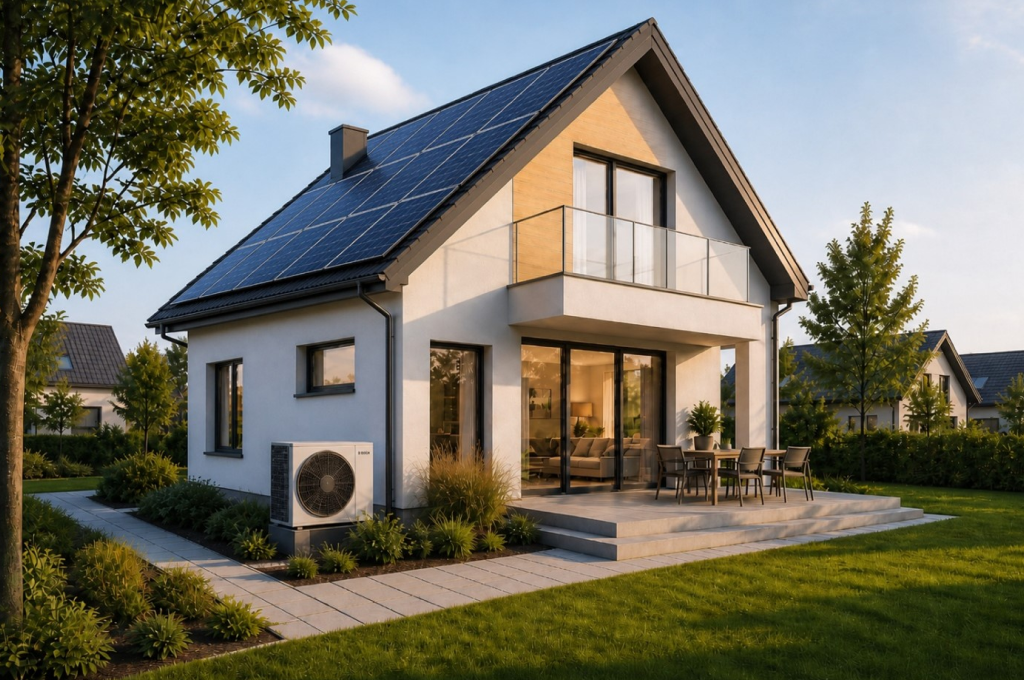
Heat pumps are increasingly considered for family homes, especially when the building has good insulation and a low-temperature heating system. Combined with underfloor heating, this kind of solution can provide even comfort and rational consumption.
Underfloor heating has an advantage in stability and comfort, but it gives the best results when properly designed. If installed later, floor height, existing installations, and real adaptation costs need to be considered.
Ventilation is especially important in newer and better-insulated houses. Lower energy losses are an advantage, but a more airtight building requires controlled fresh air supply. Heat recovery ventilation can be useful because it recovers part of the heat from exhaust air while improving indoor air quality.
Long-term cost depends on control
Efficient equipment is important, but it is not enough on its own. Consumption is affected by user habits, settings, servicing, insulation, and seasonal operating modes. Proper temperature settings can reduce heating and cooling costs by up to 10% per year, and in homes with several zones the effect can be even more visible.
Smart control has particular value in houses because it allows settings by room, time, and occupancy pattern. There is no need to maintain the same temperature throughout the whole house all day. When the system adapts to real daily life, consumption is lower and comfort is better.
Where mistakes most often happen
The most common mistake is choosing a heating or cooling source without analyzing the house as a whole. The second is excessive capacity, which may seem safer but can lead to inefficient operation and weaker control. The third is neglecting ventilation, especially after replacing windows and improving insulation.
In family homes, the solution should not be chosen only for current needs. A house is used for many years, and family needs change. Children grow up, rooms change purpose, the attic is adapted, a solar system is added, or an electric vehicle enters the household. HVAC should have enough flexibility to follow those changes.
A well-planned home HVAC solution connects heating, cooling, ventilation, and control into one functional whole. The best result is not only a lower bill, but a house where rooms are evenly comfortable, the air is better, and the system is reliable enough not to require constant attention from the user.