How a Battery Solves What the Grid Connection Can’t
Picture the ideal location for a fast charger, beside a motorway, at the entrance to a retail park, on a busy corridor. The traffic is there, the demand is there, and the only thing missing is enough grid capacity. A 150 or 300 kW DC charger needs a connection that often simply doesn’t exist at such sites, and upgrading it means a new transformer, new cabling, sometimes a new substation, along with permits and months, often years, of waiting.
The first instinct is to upgrade the connection. But that instinct frames the problem the wrong way.
The Problem Isn’t Quantity, It’s Timing
A fast charger doesn’t consume much energy overall, it consumes it in short, powerful bursts. A vehicle stays for twenty minutes or so, draws high power, and leaves; the site sits idle for most of the day. The connection, however, has to be sized for that peak burst, which occurs in a small fraction of the day. In other words, you pay for and wait on capacity that is only used occasionally.
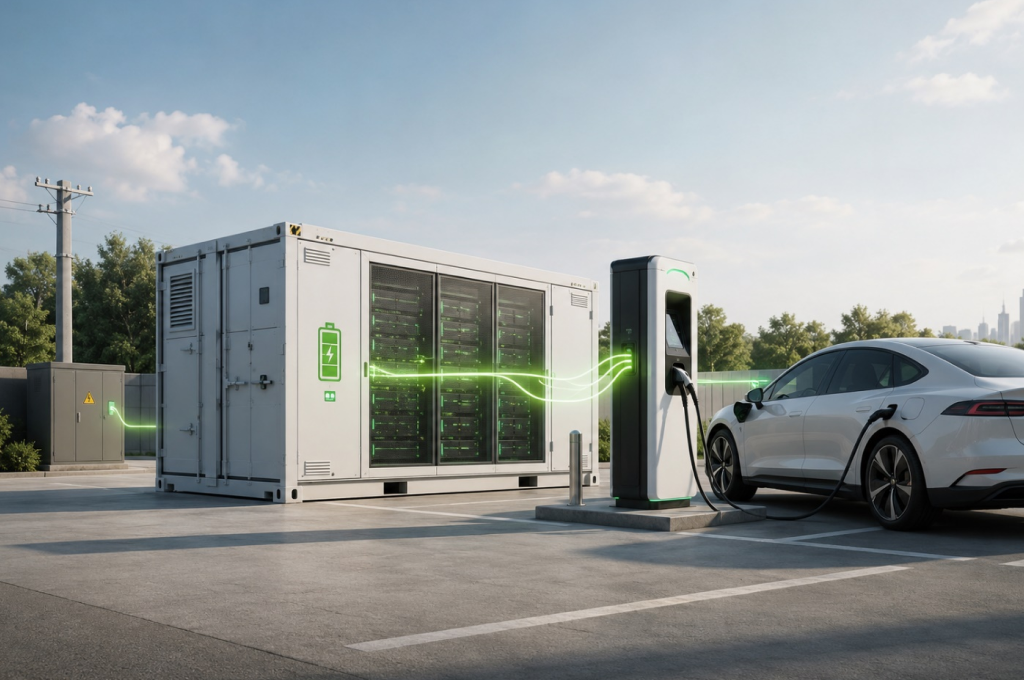
This is where the battery comes in. An energy storage system (BESS) is placed between the grid and the charger and works as a buffer: it charges continuously and modestly from the grid, at whatever power the connection allows, and delivers a short, powerful burst to the vehicle from its own capacity. A site with a 100 kW connection can supply a 300 kW charger, because the battery covers the difference during the session.
What This Changes in the Economics
The most obvious benefit is that the project becomes feasible at all and immediately, without waiting on a grid upgrade. Where reinforcing the connection costs as much as the charger itself, or where the utility simply has no spare capacity, the battery is often the only path to a working station.
The second benefit is permanent. In most commercial tariff models, part of the bill is tied to billing or peak demand. Because buffering means the grid never sees the charger’s full burst but a smoothed load, the peak stays low, and so does that part of the bill. The battery doesn’t just enable the station it lowers the cost of running it. On sites where peak demand is charged strictly, that difference can shift the entire payback period.
The third benefit is time to market. Upgrading the connection is a process that depends on the utility and its timelines; the battery is equipment that is delivered and commissioned on your schedule. For an operator who wants to secure a good location ahead of the competition, that difference in lead time is a commercial advantage, not a technical detail.
Sizing Is Not One-Size-Fits-All
Here it pays to be precise. A battery is sized by two quantities: the power it must deliver and the energy it holds. Power determines how strong a burst it can sustain; energy determines how long, and how many sessions, it can cover before it depletes. If vehicles arrive back to back, the battery drains faster than the grid refills it, so the site’s usage profile directly determines the size of the system. An oversized battery is wasted money; an undersized one leaves the charger without power at peak.
The Same Battery Does More Than This
Once it’s on site, a BESS rarely does just one thing. The same system can store energy from a solar installation and use it to charge vehicles, take on the role of backup power when the grid fails, or charge while energy is cheap and discharge when it’s expensive. With a DC-coupled architecture, where unnecessary conversions between the battery and the charger are avoided, the whole chain gains some efficiency as well.
The Battery Isn’t an Add-On to the Charger
The most useful shift is to stop seeing the battery as a cost bolted onto the charger. On a weak connection, it is what makes the charger possible at all and once the station is running, it keeps cutting the bill and unlocking functions the charger alone doesn’t have. The real question when planning a fast-charging site isn’t “how much does the battery cost,” but “what can this location actually do without it.”