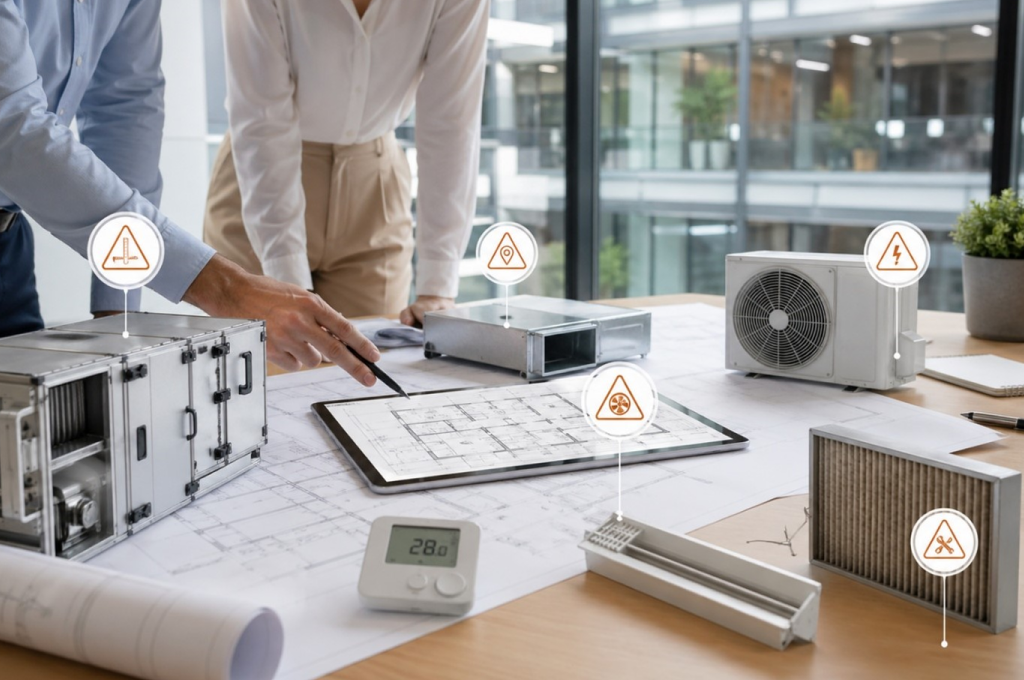
A poor HVAC choice is usually not visible immediately. At first, everything may seem functional: the equipment is installed, the space is heated or cooled, and basic conditions exist. Problems appear later, through high bills, uneven temperature, noise, poor air quality, frequent service interventions, and user dissatisfaction.
That is why it is important to avoid several typical HVAC mistakes. They appear in apartments, houses, offices, hotels, restaurants, and industrial buildings, although the consequences differ in severity.
1. Choosing only by initial price
The lowest price rarely gives the best result if energy consumption, servicing, equipment lifespan, and operating conditions are not considered. Cheaper equipment may later use more energy, operate more often under load, and require more maintenance.
In buildings used every day, the difference in consumption over several years can exceed the initial savings. HVAC should therefore be assessed through total cost of use, not only through purchase price.
2. Incorrect sizing
An oversized system is not an advantage, and an undersized system is not a saving. Oversized equipment can operate in short cycles, control humidity less effectively, and use more energy than necessary. Undersized equipment often runs continuously, reaches desired conditions more slowly, and wears out faster.
Sizing must include area, ceiling height, insulation, number of people, sun exposure, internal heat sources, and the way the building is used. Without this, it is easy to end up with a system that technically works, but does not deliver a good result.
3. Neglecting ventilation and air quality
Heating and cooling are not enough if the air is poor. People spend around 90% of their time indoors, while concentrations of some pollutants can be 2 to 5 times higher indoors than outdoors. That is why ventilation is not an add-on, but an important part of an HVAC solution.
In well-insulated buildings, this issue becomes even more important. Less natural air exchange means the space depends more on controlled ventilation. Without it, stuffiness, humidity, odors, and lower comfort can occur.
4. Using the same approach for different zones
A single building rarely has the same needs in all areas. An office, meeting room, kitchen, hotel room, corridor, warehouse, and production area do not require the same temperature, ventilation, or operating mode.
If all zones are managed with the same logic, the system often uses more energy while users experience weaker comfort. Zoning, proper air distribution, and separate control by functional area reduce this problem.
5. Planning maintenance only after a failure
HVAC should not be treated as equipment that is checked only when it stops working. Dirty filters, poor airflow, unbalanced systems, and small operating deviations can increase consumption and reduce comfort long before a serious failure occurs.
Regular maintenance extends equipment life and protects efficiency. In commercial and technical buildings, it is especially important because a failure does not only mean discomfort. It can also lead to work interruption, user dissatisfaction, or damage to goods and equipment.
A good HVAC solution starts with analyzing the building, not with choosing equipment from a catalog. When these mistakes are avoided, the system works more stably, consumes less energy, and retains its value for longer. The best result is achieved when price, comfort, indoor air quality, and maintenance are treated as one whole.