
When an energy investment starts in the wrong order, the consequences become visible very quickly — equipment is purchased before consumption analysis is completed, the project does not reflect real peak loads, and responsibility is fragmented across multiple contractors. That is why the question of what a turnkey solution includes is not a formality, but the foundation of a stable project, predictable costs, and reliable system performance.
In serious energy projects, “turnkey” means far more than simply delivering and installing equipment. It means that a single partner assumes technical, organizational, and execution responsibility for the entire project — from the initial analysis and engineering phase to procurement, commissioning, user training, and operational support. For industrial facilities, logistics centers, data centers, telecom infrastructure, and commercial buildings, this is the difference between a controlled investment and an expensive experiment.
What a Turnkey Solution Includes in Practice
Simply put, the turnkey model covers the complete project lifecycle. In the energy sector, this means that the investor does not separately coordinate designers, electrical contractors, equipment suppliers, and service providers. Instead, they receive one integrated solution with clearly defined scope, timelines, performance targets, and accountability.
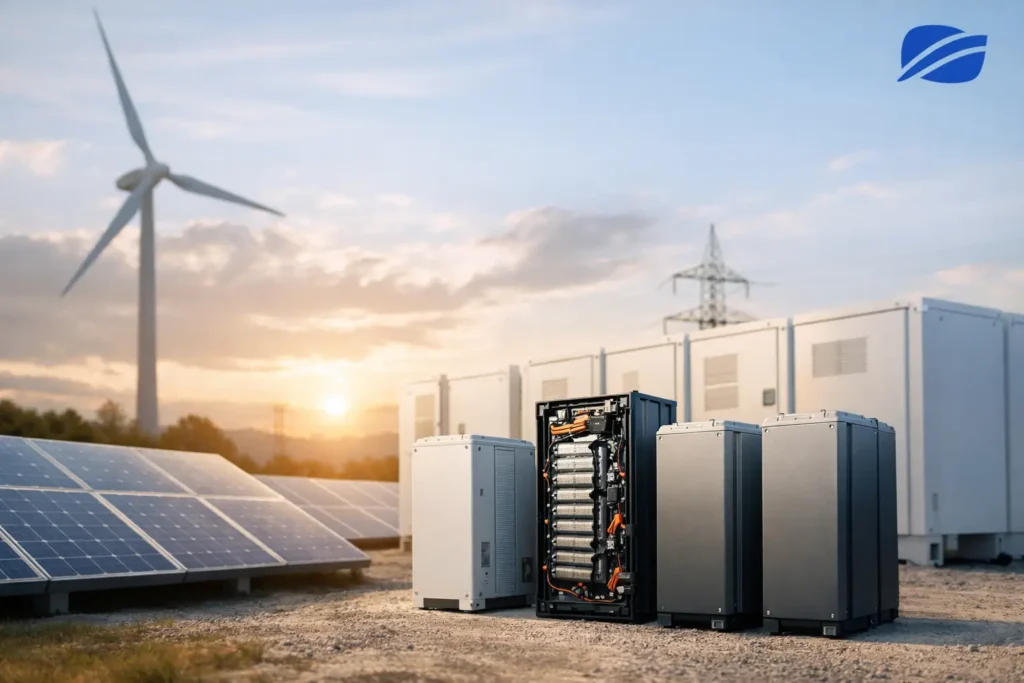
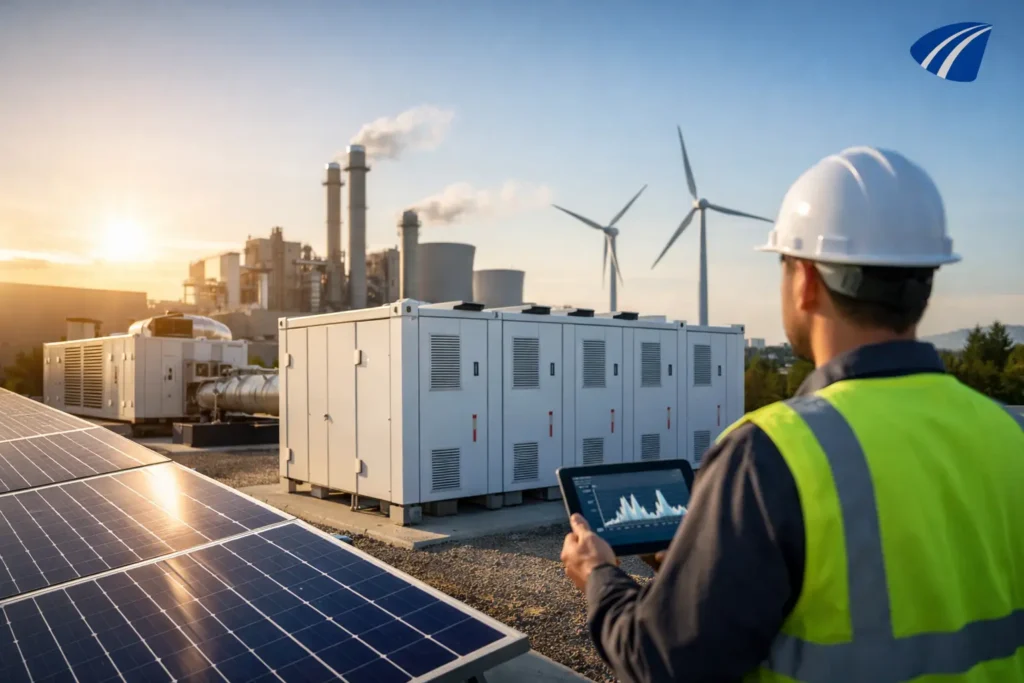
In practice, this usually includes feasibility studies, technical and financial modeling, conceptual and detailed engineering, equipment selection and assembly, installation, integration with existing infrastructure, testing, commissioning, and ongoing maintenance. In more complex systems — such as solar power plants combined with battery storage, UPS support, HVAC, and load management — this integration is precisely what makes the biggest difference.
The key value of this approach is not simply convenience for the investor. The real value lies in designing the system as a functional whole, rather than as a collection of individual components that may appear compatible on paper but create losses, limitations, and downtime under real operating conditions.
Phase One: Needs Assessment and Feasibility Study
Every quality project begins with data, not assumptions. That is why the first phase involves analyzing the existing situation — electricity consumption, load profiles, peak demand, power quality, available space, grid connection possibilities, and regulatory requirements.
For a manufacturing facility, for example, it is not enough to know only the monthly energy consumption. It is necessary to understand when peak loads occur, how critical operations are during grid outages, whether voltage fluctuations are present, how much energy solar generation can realistically cover, where energy storage makes sense, and what the actual payback period could be. Without this analysis, systems are easily misdimensioned.
A feasibility study is therefore not an administrative document, but a decision-making tool. It demonstrates technical feasibility, expected system production or availability, CAPEX and OPEX projections, risks, site limitations, and total cost of ownership forecasts. A serious partner does not sell maximum capacity — they provide the optimal solution.
Engineering Design: Where Investments Are Won or Lost
When discussing what a turnkey solution includes, engineering design is often underestimated, even though it determines most of the system’s future performance. A good design defines not only what equipment will be installed, but also how the system will operate under load, across seasonal conditions, and in relation to the facility’s existing infrastructure.
This includes electrical engineering, mechanical and civil aspects where necessary, system protection, cable routing, load calculations, equipment specifications, control logic, and integration planning with existing switchgear, generators, UPS systems, HVAC, or SCADA environments.
For solar power plants and BESS systems, engineering design must consider far more than roof or land area. Shading conditions, consumption profiles, grid limitations, battery charge and discharge strategies, fire protection requirements, and facility operating dynamics all play critical roles. This is where the difference becomes clear between a contractor that merely installs equipment and a partner that designs energy infrastructure.
Procurement and Equipment Selection: Not Every Component Is the Same
One of the most common causes of operational problems is focusing exclusively on the initial equipment price. In a turnkey model, procurement should never be separated from project requirements and targeted performance goals. Inverters, batteries, UPS systems, generators, rectifiers, and HVAC units must be selected as parts of a unified system, not as standalone products chosen only for having the lowest price.
This is where the total cost of ownership approach becomes essential. A cheaper component may have a shorter lifespan, lower efficiency, weaker warranty conditions, or higher maintenance costs. For industrial users, a single unplanned shutdown often costs more than the price difference between two classes of equipment.
That is why a serious turnkey solution includes technical selection, compatibility verification, robust warranties, spare parts planning, and clearly defined service support. In that case, the investor is not simply purchasing products, but long-term system reliability.
Installation and System Integration
The quality of all previous phases is ultimately proven on-site. Execution includes civil preparation where necessary, electrical installation works, assembly, equipment placement, connections, protection systems, labeling, testing, and compliance with project documentation and standards.
However, in energy systems, the most important word is integration. Solar generation without properly coordinated energy management may deliver significantly fewer benefits than expected. A battery storage system without optimized control logic can increase wear or fail to capture peak savings opportunities. UPS systems and generators without precise coordination may introduce additional risk instead of reliability.
That is why the turnkey model must also include functional integration of all subsystems. When one partner manages the complete project, there is far less room for situations where each supplier claims that “their part works correctly” while the system as a whole fails to deliver the expected result.
Commissioning, Testing, and Handover
Installation is not the end of the project. A project is only truly complete after testing, calibration, and commissioning under real operating conditions. This includes protection verification, measurements, load testing, communication checks between systems, safety mode validation, and documentation of all key parameters.
For systems designed to ensure business continuity — such as UPS systems, generators, and battery storage — this phase is particularly important. Investors must understand how the system reacts during grid failure, power restoration, peak loads, and transition modes. Only then does the project achieve operational value.
A proper handover includes technical documentation, certifications and reports, user training, defined operating procedures, and a clear maintenance plan. Without these elements, “turnkey” is reduced to installation rather than a completed solution.
Maintenance and Warranties Are Part of the Same Responsibility
Many investors incorrectly treat maintenance as a separate issue that comes later. In reality, maintenance must be integrated into the project from day one. When servicing methods, critical components, monitoring systems, and response times are already defined during the design phase, operational risk is significantly reduced.
That is why the answer to the question of what a turnkey solution includes must also include post-sales support. This means preventive and corrective maintenance, remote monitoring where applicable, warranty procedures, service availability, and recommendations for long-term optimization.
For large energy consumers, the true value of a partner is not measured only on the commissioning date, but by the ability to keep the system efficient, stable, and safe for years after implementation.
Where the Differences Between Providers Become Clear
On paper, many companies may claim to operate on a turnkey basis. In practice, the differences are significant. Some define turnkey as nothing more than delivery and installation. Others genuinely cover the complete engineering, execution, and service lifecycle.
The right questions are simple. Who performs the feasibility study and stands behind it? Who designs the system and assumes responsibility for performance? Who coordinates equipment, installation, commissioning, and maintenance? Who understands how solar, storage, UPS systems, generators, and HVAC operate as a unified energy architecture?
This is where the value of companies with a true system integrator model becomes evident. Energize, for example, develops solutions precisely on this principle — from analysis and engineering to implementation and maintenance, with a focus on total cost of ownership and long-term operational security.
Why Turnkey Does Not Mean the Same Thing for Every Project
Although this approach is the most rational solution for most investors, the scope can vary significantly. A household planning a small solar power plant requires a simpler process and clear support from assessment to grid connection. An industrial system with multiple power sources, battery storage, and backup systems requires much deeper analysis, stricter coordination, and a much higher level of documentation.
In other words, “turnkey” is not a universal label, but a framework that must be precisely defined through contracts, technical scope, and expected performance outcomes. The more complex the project, the more important it becomes to eliminate gray areas of responsibility.
If you are considering an investment in a solar power plant, energy storage, UPS protection, or complete energy infrastructure, the smartest question is not only how much the project costs. More importantly, ask who takes responsibility for ensuring that the system performs exactly as planned — both during normal operation and when conditions become demanding.