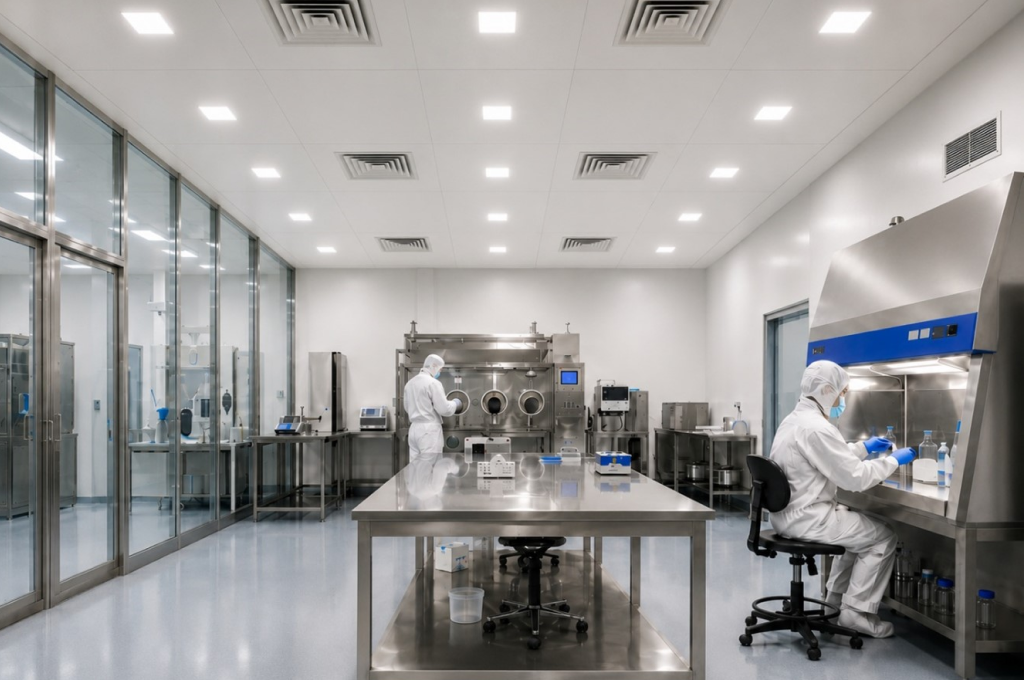
In pharmaceutical facilities and laboratories, HVAC is not only responsible for providing a comfortable temperature. Its main role is to control indoor conditions: temperature, humidity, ventilation, pressure, filtration, and air cleanliness. In these spaces, the quality of the HVAC solution can directly affect people’s safety, testing accuracy, process stability, and product quality.
Unlike an office, hotel, or retail space, deviations here are not only a comfort issue. Excess humidity, poor filtration, incorrect airflow direction, or unstable temperature can affect samples, materials, equipment, or the production process. That is why HVAC for pharmaceutical and laboratory environments requires more precise and stricter planning than most other building types.
Laboratories can use 5 to 10 times more energy than standard office spaces of the same size, while specialized laboratories and cleanroom areas can have even higher energy requirements. The reason is not only laboratory equipment, but the constant need for ventilation, filtration, humidity control, and stable indoor conditions.
A controlled space is not an ordinary room
The main difference between a standard room and a laboratory or pharmaceutical facility is the level of control. In an ordinary building, it is usually enough for the temperature to be comfortable and the air acceptable for occupancy. In a controlled environment, it is necessary to know how air moves, how often it changes, how it is filtered, and what pressure relationship exists between neighboring zones.
In pharmaceuticals, this is especially important in spaces where there is a risk of contamination of products, raw materials, or packaging. In laboratories, the focus is often on protecting people, samples, and equipment. In both cases, HVAC must support the process, not only user comfort.
That is why these spaces are planned by zones. A clean zone, preparation area, laboratory room, storage space, corridor, and administrative area cannot follow the same operating mode. If all rooms are managed with the same logic, the system will either use too much energy or fail to provide enough control where it matters most.
Temperature matters, but it is not enough
In pharmaceutical and laboratory environments, temperature is only one part of control. Relative humidity, filtration, pressure, airflow, and air-change rates are equally important. In certain clean spaces, classification is based on the number of airborne particles, which means HVAC must maintain cleanliness levels, not only thermal comfort.
In spaces with stricter requirements, HEPA filters, controlled airflow directions, and defined pressure relationships are often used. In some zones, the goal is for air to move from a cleaner area toward a less clean one. In other cases, the goal is to keep potentially risky air contained within a specific room. These relationships are essential for contamination control and safe operation.
In laboratories, ventilation has a special role. Chemicals, aerosols, vapors, and other contaminants must be safely removed from the space. Fume hoods, local exhaust, and general ventilation must work together. If ventilation is not properly balanced, employee protection may be reduced, contaminant spread may increase, or energy use may become unnecessarily high.
Precision must remain stable throughout the day
Controlled conditions have little value if they are maintained only occasionally. A pharmaceutical facility or laboratory must remain stable throughout its operating mode. This means HVAC needs to respond to changes in occupancy, equipment operation, door openings, process changes, and cleaning procedures.
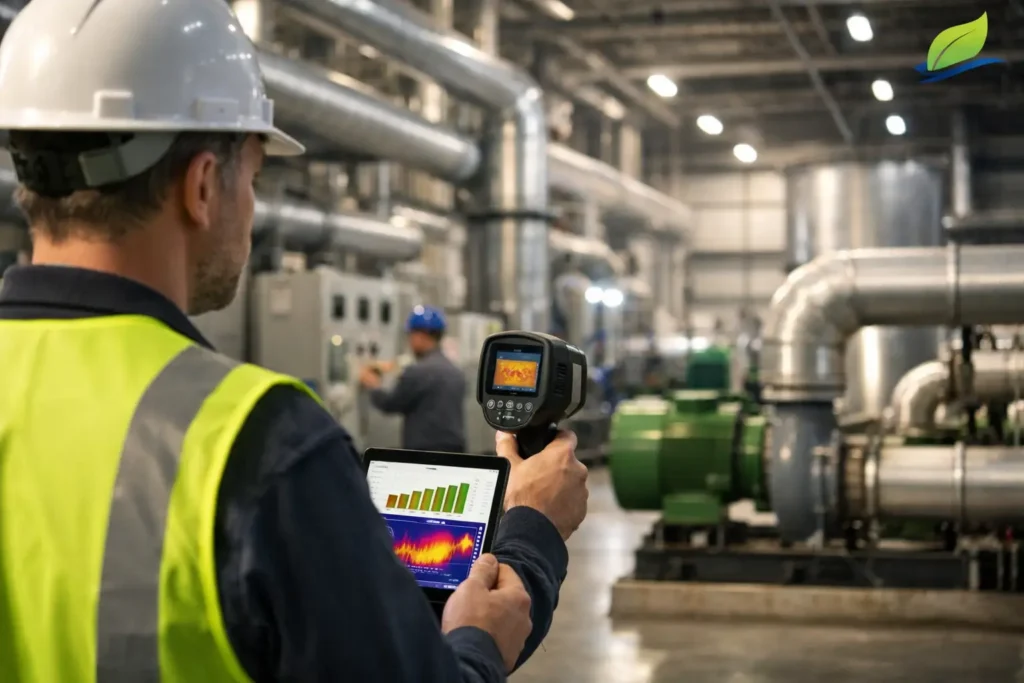
In practice, the biggest problems appear when the system is designed only for ideal conditions. When the space becomes occupied, equipment starts generating heat, doors open more often, or the operating mode changes, conditions can begin to drift. That is why monitoring, automation, and alarms are as important as the main equipment.
Good HVAC does not only maintain design values. It also allows the facility to monitor and prove that conditions are truly stable. In pharmaceuticals and laboratories, this is especially important because work quality often needs to be documented, verified, and repeated.
Energy efficiency without compromising control
Because laboratories and controlled environments use a lot of energy, optimization is highly important. However, savings cannot be achieved simply by reducing ventilation or filtration. If that compromises safety, cleanliness, or process stability, the savings are not acceptable.
Real optimization means the system operates according to the actual needs of the space. Zoning, variable airflow, smart controls, energy recovery where allowed, and regular system balancing can reduce consumption without compromising control.
In laboratories with changing operating patterns, systems that adjust ventilation according to occupancy, fume hood activity, or risk level can be especially useful. In pharmaceutical facilities, optimization must be carefully aligned with validation, standards, and quality procedures.
Maintenance is part of quality control
In these buildings, HVAC maintenance is not only technical service. It is part of quality control and safety. Dirty filters, faulty sensors, incorrect pressure settings, weak airflow, or unbalanced ventilation can compromise conditions before the problem becomes clearly visible.
That is why regular inspections, measurements, filter replacement, sensor calibration, and system documentation are especially important. In spaces with stricter requirements, it is necessary to periodically confirm that the system is still operating as designed.
If maintenance is delayed, the consequences can be greater than the failure itself. Condition deviations, quality problems, increased consumption, unplanned downtime, or additional corrective costs can appear.
HVAC for pharmaceutical facilities and laboratories should be viewed as part of the quality system, not as an ordinary building service. When temperature, humidity, filtration, pressure relationships, ventilation, and monitoring are properly aligned, the space becomes stable, safe, and reliable for work. In these facilities, precision is not an added value, but a basic requirement for protecting the process, people, and products.