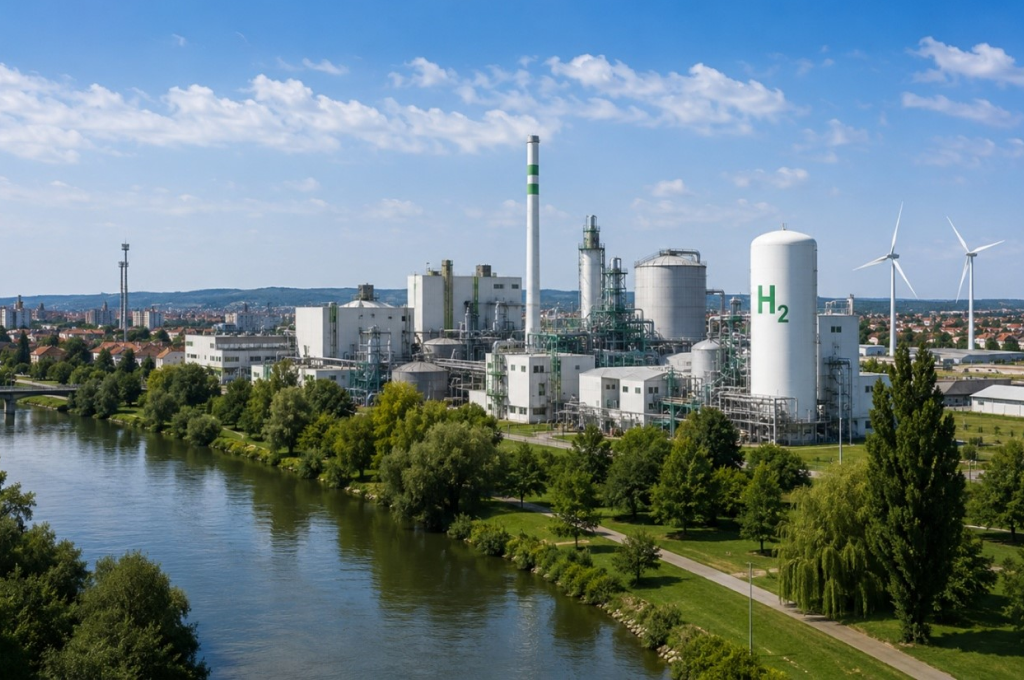
Imagine Smederevo without smoke above the steel plant. Without the grey and red clouds rolling over the river on certain days, without the distinctive smell travelers recognize kilometers before reaching the city, without rain that stains parked cars and without winter fog that refuses to lift even when the košava wind blows.
Imagine Pancevo without the sulfur smell entering apartments through open windows. Bor without dark clouds above the smelter. The surroundings of Kostolac without layers of ash settling on fields and rooftops.
This is not a clean-energy brochure fantasy or a poetic introduction. It is the mathematically and physically predictable outcome of one technological decision — the complete transition of heavy industry to green hydrogen. The consequences become measurable in the lungs of children in Pančevo, in orchard yields around Smederevo, in the water flowing through the Tamiš River and the Great Bačka Canal, and in the health of workers who have spent decades breathing air different from that of their neighbors.
What Exactly Disappears From Industrial Chimneys
The chemistry behind green hydrogen combustion is elegantly simple:
2H_2 + O_2 \rightarrow 2H_2O
Plus heat. That is all.
What leaves the factory chimney is water — in the form of steam. There is no CO₂ because hydrogen molecules contain no carbon. There is no SO₂ because there is no sulfur. There are no PM2.5 or PM10 particulate emissions because there are no solid impurities. NOx emissions are reduced to trace levels when combustion is properly controlled.
In practical terms, a fertilizer plant such as HIP Azotara, which today emits approximately 180,000 tons of CO₂ annually from hydrogen production, along with tens of tons of SO₂, hundreds of tons of NOx, and several tons of particulate matter, would, after transitioning to green hydrogen, emit virtually nothing across that entire spectrum. The reduction is not measured in percentages suitable for sustainability reports — it is measured in disappearance.
The Air Above the City
For years, Pančevo has ranked among the cities with the worst air quality in Europe. Studies by the Serbian Institute of Public Health have shown that particulate matter concentrations frequently exceed EU limit values by three to five times during winter months. Industrial sources — the NIS refinery, HIP-Petrohemija, and Azotara — contribute significantly to this burden, while the remainder comes from traffic, residential heating, and cross-border pollution transport.
Transitioning these facilities to green hydrogen as both an energy source and industrial feedstock would eliminate most emissions from large industrial point sources. The air above Pančevo in January would begin to resemble the same city’s air in May.
The difference in quality of life would be measured in fewer respiratory illnesses, fewer doctor visits, and fewer hospitalizations. These are concrete school days children spend in classrooms instead of at home in bed, concrete working days parents do not lose to sick leave, and concrete years added to retirement because people no longer leave the workforce early due to chronic respiratory conditions.
Soil, Water, and Forests
Acid rain is a direct consequence of SO₂ and NOx emissions in the atmosphere. The soils surrounding Smederevo, Bor, and Kostolac have shown elevated acidity levels for decades, directly affecting agricultural yields, forest coverage, and the condition of nearby water systems. Orchards located within five to fifteen kilometers of industrial emitters consistently produce lower yields than identical varieties planted twenty kilometers farther away. Farmers in these regions have treated this not as an exception, but as a fact of life for generations.
By eliminating industrial emissions, that acidification process stops intensifying. Over a period of ten to twenty years, natural buffering processes gradually restore the soil to a pH range where crops can grow without stress. Orchards that endured industrial impact for decades slowly return to yields that were once considered normal, rather than ambitious targets.
The rivers receiving wastewater from heavy industry evolve in parallel. Decarbonization rarely happens in isolation — it usually comes together with modernization of the entire process, which often includes improved water management, closed-loop cooling systems, and more advanced wastewater treatment technologies.
The Health of Industrial Workers
It is often forgotten that factories do not only pollute cities. They also pollute the people working inside them.
Workers in coke plants, foundries, and refineries spend years inhaling pollution levels that, outside the workplace, would trigger inspections and headlines. Transitioning to green hydrogen as an industrial energy source changes the microclimate inside the factory itself.
Employees are no longer exposed to coke dust, fuel vapors, and sulfur compounds at concentrations that until recently were considered a routine part of the workday. Data from Swedish and German steel plants that have entered the first phase of transition already show a significant decline in respiratory illnesses among workers within five years. This is reflected in lower health insurance costs, fewer lost working days, and ultimately in the number of employees who retire after decades of industrial work without chronic lung disease being treated as a “normal outcome of the profession.”
Why This Will Not Be a Matter of Goodwill Alone
The transition of heavy industry to green hydrogen is not driven by enthusiasm. The pressure comes from outside, and it can be measured in euros.
The EU Emissions Trading System (ETS) is already phasing out free allowances for sectors that were previously protected, while from 2026 onward, the full Carbon Border Adjustment Mechanism (CBAM) begins charging imports of steel, fertilizers, cement, and aluminum according to their carbon footprint.
In practice, a Serbian exporter selling steel to Germany or fertilizers to Italy will soon pay twice — once for the product itself, and once again for the emissions generated during production. Within that equation, the difference between grey and green technology stops being a question of corporate responsibility and becomes a question of competitiveness in key export markets.
Factories transitioning to green hydrogen are not choosing a morally superior version of the same profitability. They are choosing whether they will remain present on the European market after 2030 at all.
How Long the Transition Takes
A full transition of Serbian heavy industry to green hydrogen is not a single political mandate project. It is a ten-to-twenty-year transformation requiring substantial investment in every individual facility.
Every reactor, every furnace, every industrial process requires separate decisions, engineering, sizing, and in some cases, fundamental technological redesign.
Smederevo will not wake up in 2027 without smoke above the steel plant. But every production unit that is replaced brings measurable improvement for the people living nearby. If the transition begins seriously during this decade, children born today may reach adulthood in a completely different city from the one their parents grew up in. Not as a rhetorical statement, but as a consequence that can literally be marked on a calendar.
A Change Visible to the Naked Eye
Most environmental policies remain trapped on paper — numbers in reports rarely read outside professional circles. The transition of heavy industry to green hydrogen is different because its effects are not abstract.
They are visible from the highway, when the smoke that defined the entrance to an industrial city for decades simply disappears. They are visible in the sky above Pančevo in January. Visible in orchard yields around Smederevo. Visible in the number of children attending school in February instead of sitting in waiting rooms at health clinics.
For Pančevo, Smederevo, Bor, and Kostolac, this is not only industrial modernization. It is the return of air, water, and soil that had been borrowed for decades from people who had not yet even been born.
The change is not made for sustainability reports. It is made for the lives happening every day — both outside and inside those factory walls.