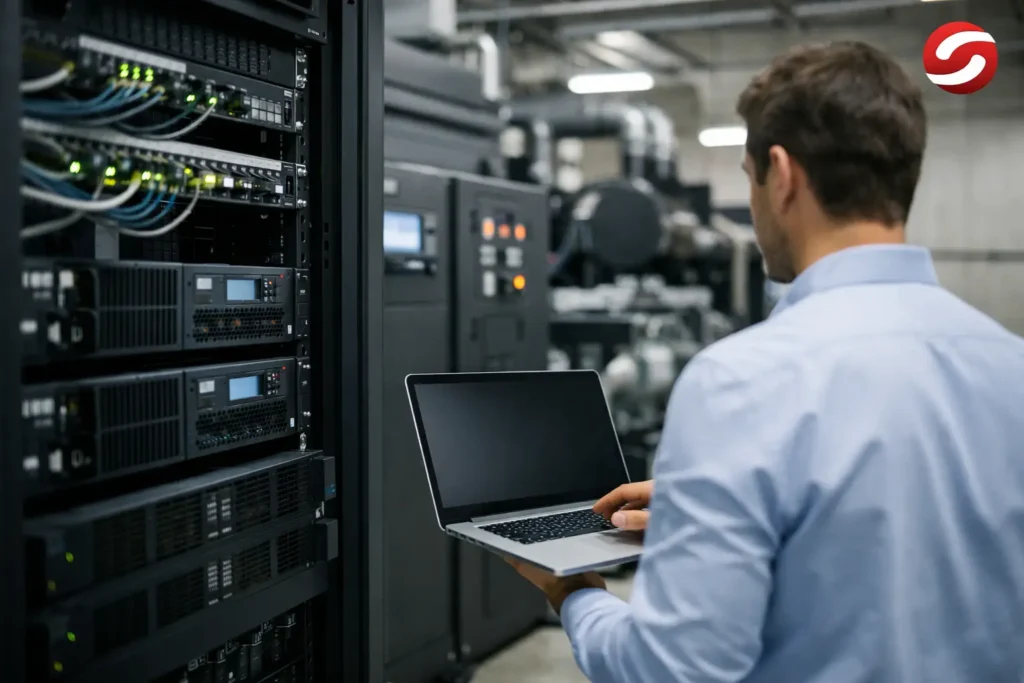
A brief voltage dip can stop a production line, bring down a server, reset a PLC, and cause damage that is measured in far more than minutes of downtime. When management asks how to prevent power outages, the real question is how to design a system that does not depend on a single point of failure.
For companies in manufacturing, logistics, telecommunications, the food industry, and data centers, a power outage is not a technical inconvenience but a business risk. The cost is not limited to lost energy—it includes production losses, damage to sensitive equipment, wasted raw materials, penalties for delays, and reputational damage. That is why power reliability is not solved with a single device, but through a combination of load analysis, backup power sources, and proper system integration.
How to Prevent Power Outages – From Causes to Solutions
The first step is not purchasing equipment but understanding the root causes. Not all outages are the same. Sometimes the problem is a complete grid failure, sometimes a short voltage dip, sometimes an overvoltage event, and sometimes poor power quality that gradually shortens equipment lifespan and causes random interruptions.
If a company experiences frequent micro-outages, a UPS is often essential. If outages last longer, a UPS alone is not enough and must work alongside a generator or a higher-capacity battery system. If the challenge is peak demand and an unstable grid, the solution may involve BESS, energy management, and local generation from a solar power plant. In other words, the answer depends on whether you are protecting seconds, hours, or the entire continuity of business operations.
Critical Weak Points That Often Go Unnoticed
In practice, problems rarely originate solely at the main incoming supply. Weak points are often found in distribution boards, undersized cables, poorly configured protection systems, insufficient breaker selectivity, or a lack of regular maintenance. Many companies invest in backup power sources while neglecting the distribution side of the system. As a result, they own the equipment but not the reliability.
Another common mistake is treating all loads equally. In a real-world system, this rarely makes sense. Server rooms, cooling systems, automation, fire protection systems, and specific production lines have different priorities. A well-designed project separates critical and non-critical loads because this directly affects both investment costs and overall system efficiency.
UPS Is Not a Luxury – It Is Basic Protection for Critical Loads
When discussing how to prevent power outages, UPS systems are usually the first line of defense. Their role is not only to provide energy when the grid fails but also to stabilize voltage and filter disturbances that could affect sensitive equipment.
For IT infrastructure, telecommunications, automation, and medical equipment, online UPS systems are the standard because they provide continuous, high-quality power without transfer time. For less demanding applications, other UPS technologies may sometimes be acceptable, but in critical processes, compromises often end up costing more than the savings achieved during procurement.
Correct sizing is essential. An undersized UPS operates under constant stress and reaches risk conditions more quickly, while an oversized system unnecessarily increases CAPEX and maintenance costs. For that reason, system design should be based on measurements, load profiles, power factor analysis, required autonomy, and anticipated growth in consumption—not assumptions.
Batteries Determine How Long Protection Actually Lasts
A UPS is only as reliable as its battery system. If batteries are not properly selected, climate-controlled, and maintained, the system may appear secure on paper but fail when it is needed most. There is no room for improvisation here.
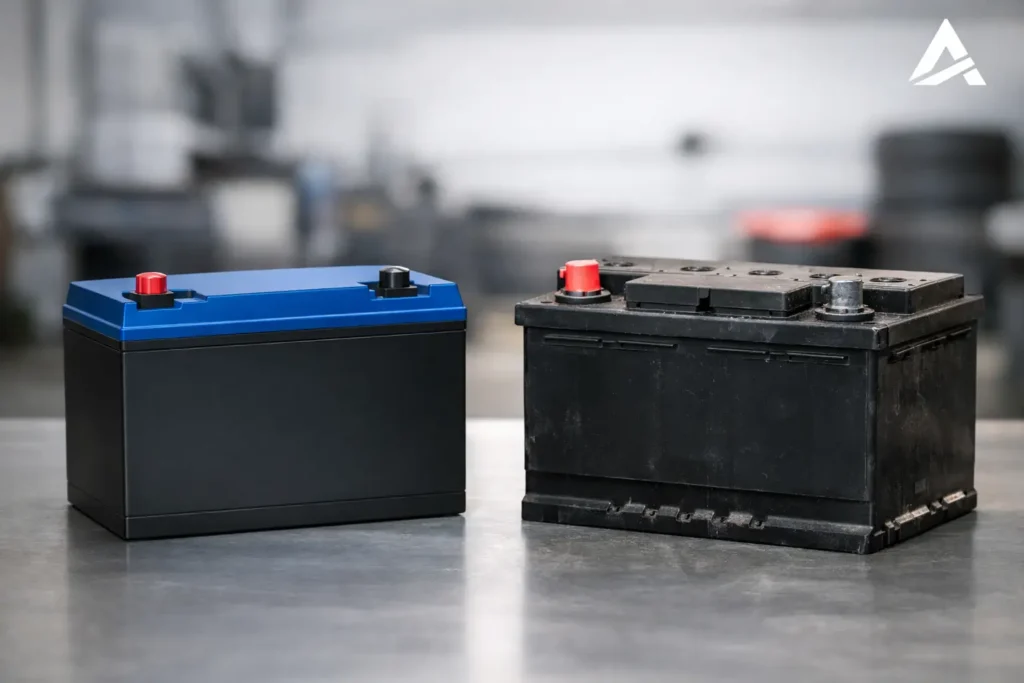
VRLA batteries are still common in standard applications, while lithium-ion batteries are increasingly preferred for more demanding requirements due to their longer lifespan, lower weight, improved space utilization, and lower operating costs when evaluated through TCO. However, lithium is not a universal solution for every location. Operating conditions, ambient temperature, cycling requirements, and required autonomy must all be considered.
Generators Solve Hours, Not Seconds
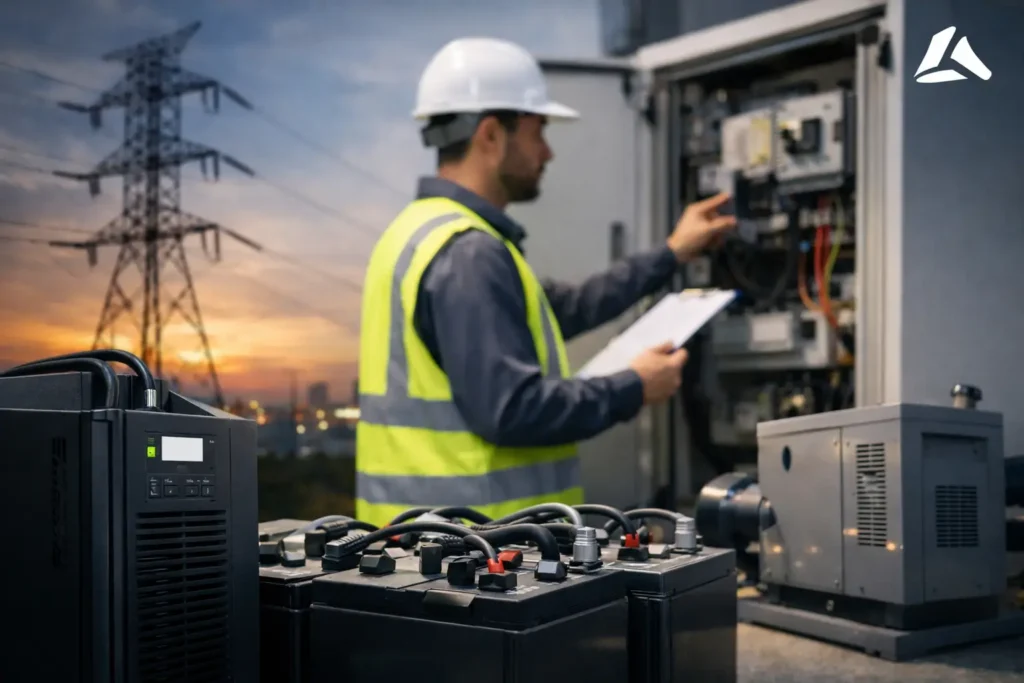
When an outage lasts longer than UPS autonomy, the generator takes over. Its purpose is not to replace the UPS but to assume the load after the initial transition period and allow operations to continue without shutting down critical systems. This is particularly important in manufacturing facilities, cold-chain operations, buildings with significant HVAC requirements, and telecommunications sites.
The biggest misconception is that a generator alone solves continuity challenges. It does not. Generators require startup and stabilization time, and during that interval sensitive systems may already fail. That is why UPS systems and generators must be designed as a single integrated solution, with coordinated transfer automation, testing procedures, and clearly defined load priorities.
This also introduces considerations such as fuel management, noise levels, ventilation requirements, servicing, and installation space. For some facilities, diesel generators remain the optimal solution. For others—particularly those seeking quieter operation or higher levels of energy optimization—battery energy storage may be a more suitable component of the overall strategy.
Battery Storage and Solar Are Changing the Logic of Power Protection
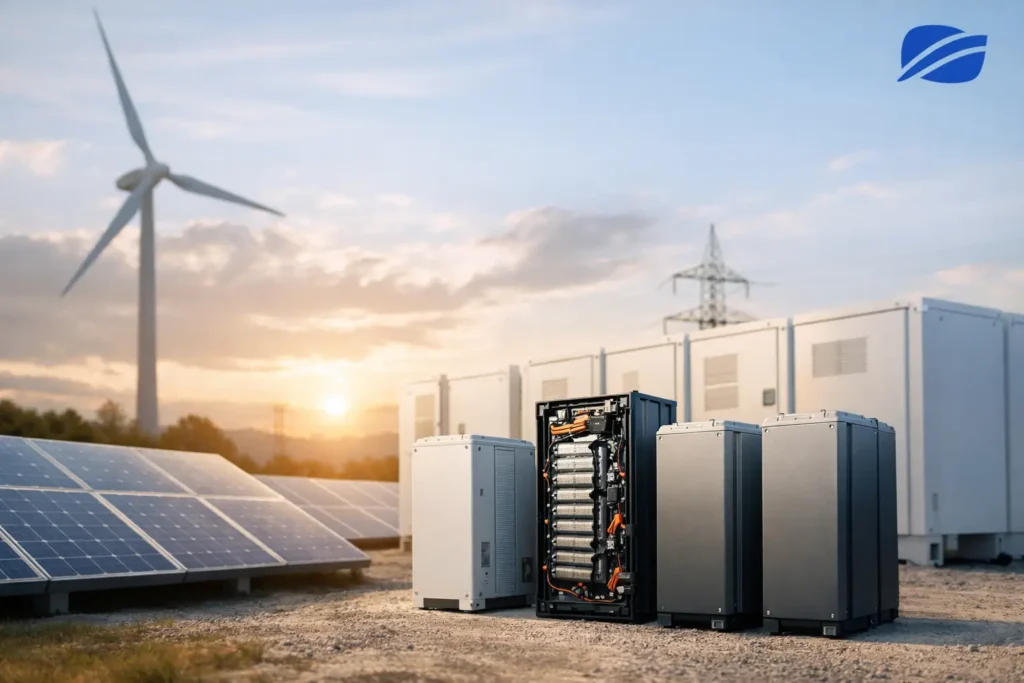
The traditional approach to backup power consisted of the grid, a UPS, and a generator. Today, that is no longer the only option. Companies seeking greater energy independence increasingly deploy BESS and solar power plants as part of an integrated energy system.
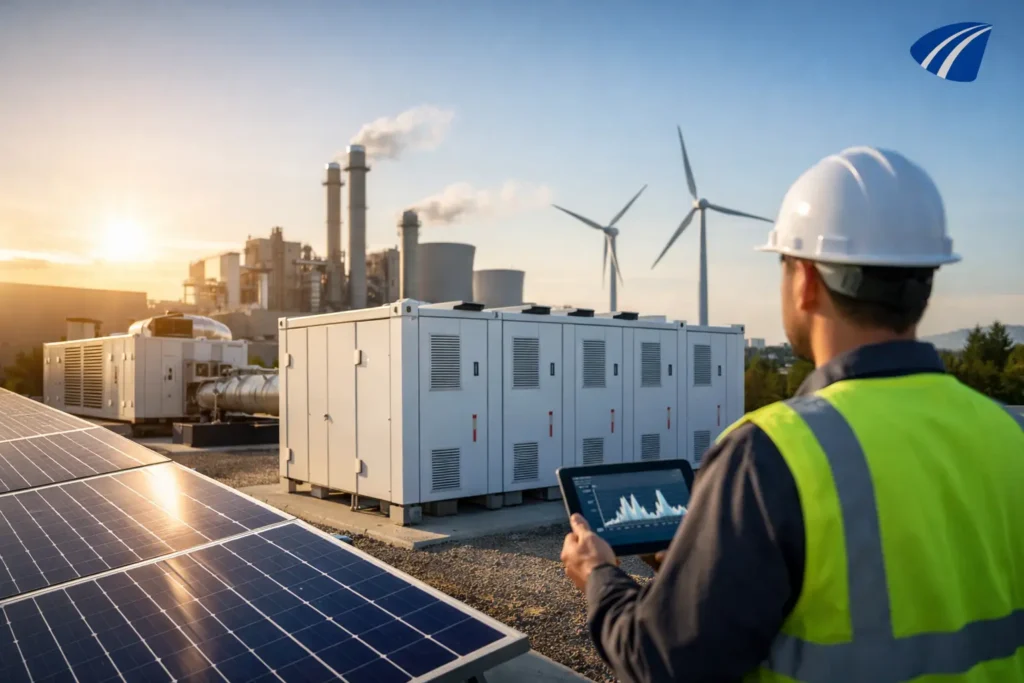
Solar power alone does not prevent outages in every situation. If a solar plant is grid-connected without the necessary battery and controller support, the system may shut down during a grid failure for safety reasons. However, when solar is combined with energy storage and properly engineered energy management, the result is much more than reduced electricity costs. It creates an additional layer of resilience.
Depending on the system configuration, BESS can cover short-duration outages, manage peak loads, and support partial island-mode operation. This means less dependence on generators, improved control over energy costs, and greater supply stability in facilities where downtime is expensive. This is where a systems integration approach creates the difference between expensive equipment and a functional energy infrastructure.
How Proper Engineering Prevents Power Outages
The most expensive outages often occur in companies that purchased equipment piece by piece. One contractor supplies the UPS, another handles distribution, a third installs the generator, and nobody takes responsibility for the complete system. The result is a setup that formally exists but is neither coordinated nor tested under real operating conditions and lacks a clear maintenance strategy.
Reliable solutions begin with a feasibility study and an energy analysis. It is necessary to determine which processes require protection, how much interruption is acceptable, how long critical loads must remain operational, what the local grid quality is, and what future business growth plans look like. Only then should technologies be selected.
For some facilities, the optimal solution may be a modular UPS with N+1 redundancy. For others, the key may be a generator with ATS and dedicated supply lines for critical loads. In another case, the best outcome may come from combining a solar power plant, BESS, and an advanced power management system. There is no universal package. There are only properly engineered solutions tailored to a specific load profile and risk scenario.
Maintenance Is Part of Reliability, Not an Additional Cost
Many systems fail not because of poor design, but because maintenance is neglected. Batteries age, electrical connections loosen, ventilation systems become dirty, automation systems require inspection, and generators must be regularly tested under load. Without these activities, backup power becomes an expensive illusion of security.
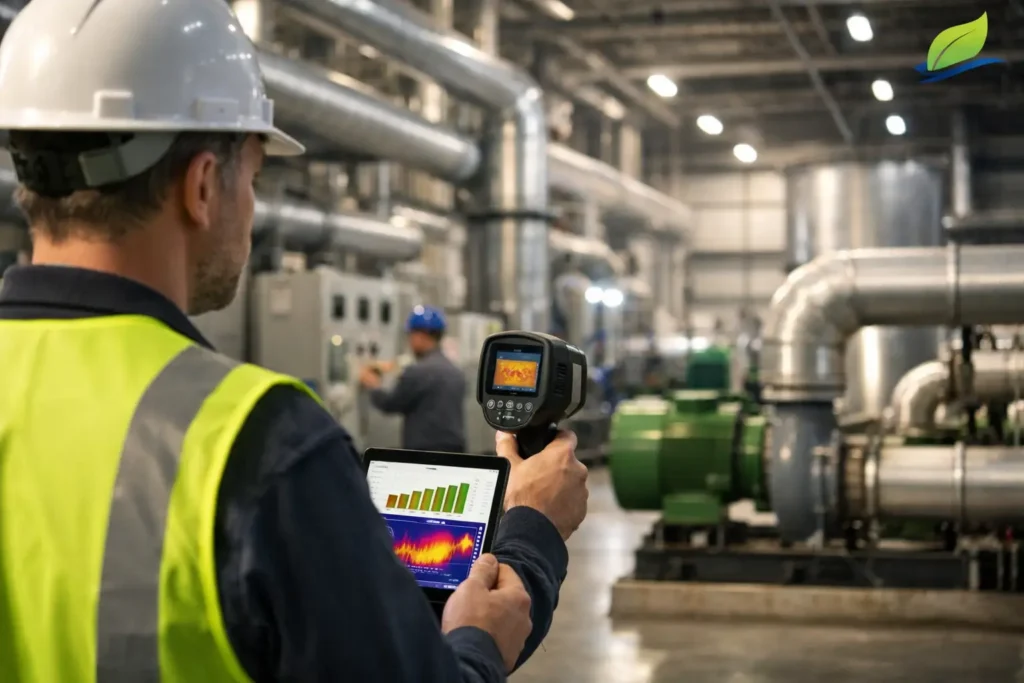
Preventive maintenance should include thermal imaging inspections, autonomy testing, power quality analysis, protection system verification, and periodic functional testing of the entire power chain. Only then can companies confirm that the system will perform when the grid fails—not just when reviewing technical documentation.
What Management Should Measure
If the goal is truly to reduce risk, the focus should not be limited to equipment cost. More important metrics include expected annual downtime, the cost of one hour of interruption, system availability, recovery time, service support quality, and total cost of ownership. This is the difference between procurement and investment.
In serious systems, decisions are not based on the lowest upfront price. They are based on the cost of future outages and the system’s ability to prevent them reliably. That is why leading companies choose partners capable of delivering the complete solution—from analysis and engineering to installation, integration, and maintenance. This approach centralizes responsibility and reduces operational risk.
For companies that cannot tolerate downtime, the question is not whether they should invest in power continuity, but how much longer they can afford to postpone the decision. If you want to design a system that protects production, data, and business continuity, Energize approaches the challenge as an engineering project with measurable outcomes—not as the sale of individual equipment.
The smartest investment in energy is often the one that goes unnoticed every day, but prevents the day when everything stops.