Electricity costs can be reduced in two fundamentally different ways, but the consequences of that decision can be felt for years. When an investor asks whether to choose an on-grid or hybrid system, the question is not merely technical. It is a decision about risk, operational continuity, energy management, and total cost of ownership.
For some users, a conventional grid-connected solar power system is a rational and entirely sufficient solution. For others particularly where a power outage can stop production, cause product losses, bring down IT systems, or interrupt critical processes a hybrid solution delivers far greater value than a simple comparison of equipment prices would suggest.
This decision should therefore not be reduced to cost per kilowatt. It should be based on how the facility actually consumes energy and how much a power outage truly costs.
On-Grid or Hybrid: What Is the Fundamental Difference?
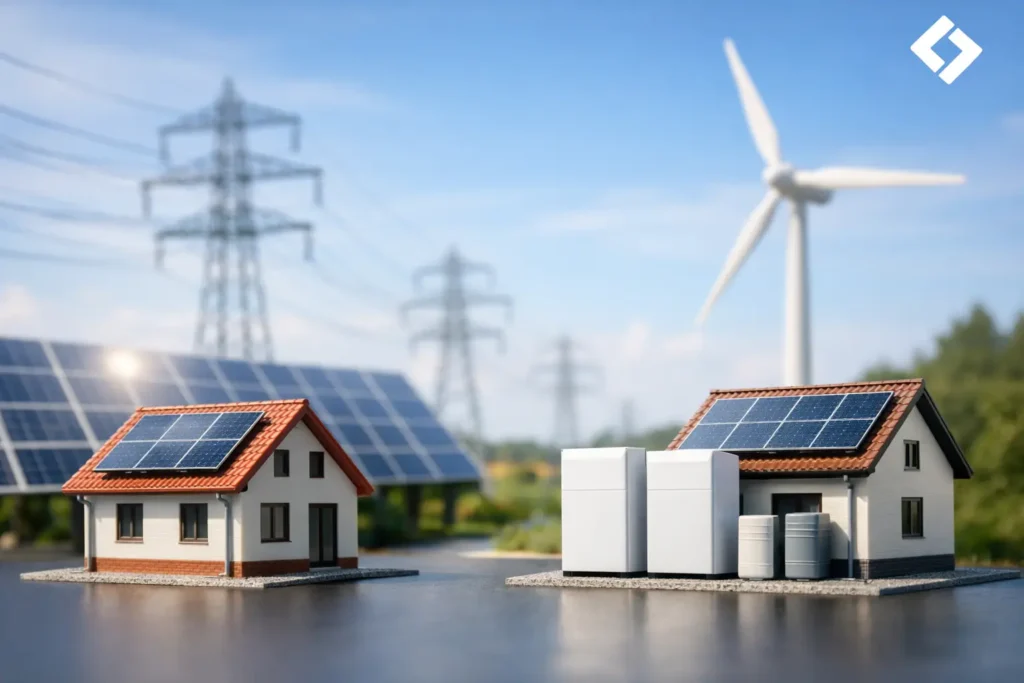
An on-grid solar power system is connected to the distribution network and operates without battery storage. Electricity generated by the solar panels first covers the facility’s own consumption, while any surplus is exported to the grid in accordance with the applicable settlement model and technical requirements.
This type of system is simpler, requires a lower initial investment, and usually offers a shorter payback period.
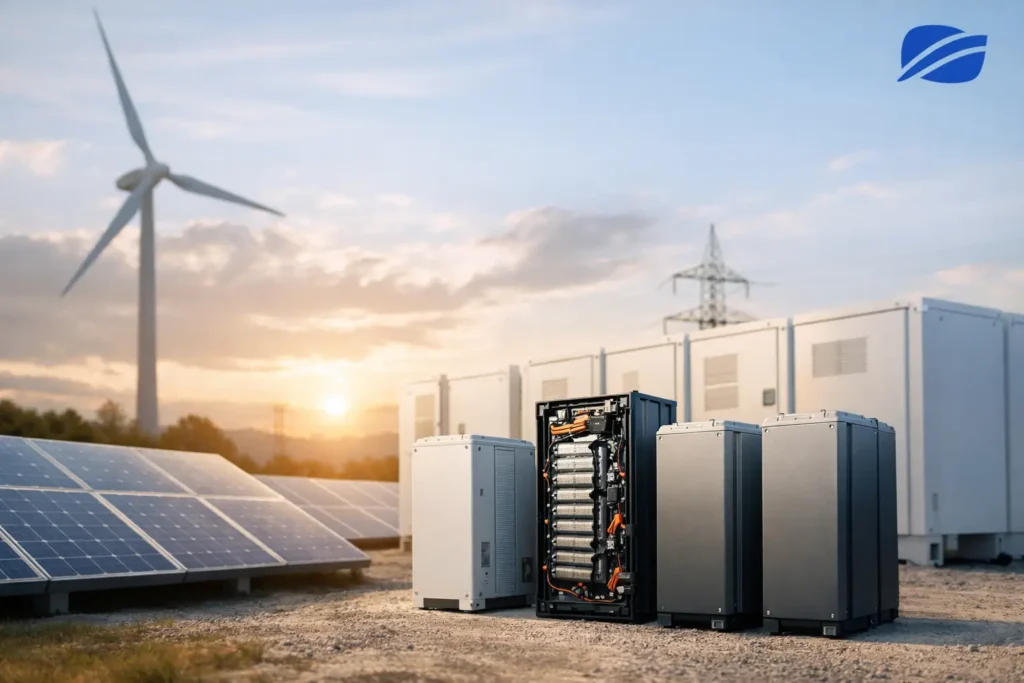
A hybrid solar power system, on the other hand, combines solar panels, an inverter, and batteries, and may also include an advanced energy management system.
Its main advantage is not simply the ability to store surplus electricity. It can also enable selected loads to continue operating when the grid fails.
This changes the purpose of the entire investment from a system designed primarily to generate savings into one that also strengthens energy resilience.
An important technical point is that a standard on-grid system will generally shut down during a grid outage for safety reasons. Many investors assume that the solar panels will continue supplying the facility, but this is not the case without an appropriate hybrid architecture and battery support.
This is one of the most common misconceptions when choosing between the two systems.
When an On-Grid System Is the Better Choice
If a facility has a stable grid connection, daytime consumption that aligns well with solar generation, and no critical processes requiring uninterrupted operation, an on-grid system is often the most cost-effective solution.
This particularly applies to manufacturing facilities operating mainly during the first shift, logistics centers with significant daytime demand, office buildings, retail properties, and some residential users.
The main advantage of an on-grid system is that most of the investment goes directly toward generation capacity.
Instead of investing in batteries, the investor can install more solar panels and achieve a higher annual energy yield.
In practice, this usually results in a stronger ratio between investment cost and annual savings, provided that the grid remains reliable and backup power is not required.
For businesses, this is often the most logical first step.
It reduces energy costs, improves the predictability of operating expenses, and makes productive use of available rooftop or land area without adding unnecessary system complexity.
When the primary objective is to reduce electricity bills rather than maintain autonomy during outages, an on-grid system usually offers a clear economic advantage.
When a Hybrid System Is Worth More Than a Lower Upfront Price
A hybrid solution is financially justified when the consequences of a power outage are disproportionately expensive.
This is typically the case in food production, cold storage facilities, data centers, telecommunications sites, facilities with sensitive equipment, automated production lines, and systems where restarting a process carries a significant operational cost.
In these environments, the calculation does not end with the value of each saved kilowatt-hour.
If even a brief interruption can stop production, damage work-in-progress, cause data loss, or trigger an unscheduled service intervention, the battery is no longer a luxury. It becomes part of the company’s operational protection.
In such cases, the value of a hybrid system lies not only in the energy it stores, but also in the time it preserves and the risks it removes.
Depending on the system configuration, batteries may also help manage peak loads.
In more advanced projects, they can take over part of the facility’s demand during periods of high tariffs or peak power, further improving cost optimization.
However, there is no universal rule. The financial effect depends on the consumption profile, grid connection capacity, operating regime, and the quality of the energy model developed before the investment.
On-Grid or Hybrid for a Business Is Not the Same Question as for a Home
For residential users, the choice is often driven by comfort and the desire for greater energy independence.
For businesses, the decision is more complex because it directly affects production, SLA obligations, delivery deadlines, and operational security.
The same answer cannot apply equally to a family home and a factory with a continuous production process.
For companies, the first step is to identify critical loads.
It is not always necessary to provide backup power to the entire facility.
In many cases, it is sufficient to protect a server room, refrigeration system, a specific section of the production line, pumping equipment, or automation systems.
A well-designed hybrid solution does not necessarily mean that every component must be larger and more expensive.
It means that the system must be sized according to the actual priority of the loads.
This is where the difference between equipment sales and an engineering approach becomes clear.
Investors do not need a generic answer. They need a calculation that takes into account hourly consumption, seasonal variation, available installation area, grid quality, expected component life, and the facility’s future development plans.
Only then does the comparison become meaningful.
What Has the Greatest Impact on Profitability?
The first factor is the consumption profile.
A facility that consumes most of its electricity during the day will generally use an on-grid system more effectively.
A facility with significant evening or nighttime consumption may benefit more from battery storage, but only if the capacity is correctly selected.
The second factor is grid stability.
If outages are rare and brief, it may be difficult to justify a battery system purely as backup.
If outages are frequent or their consequences are expensive, the economics change significantly.
The third factor is the cost of downtime.
For some users, one hour without electricity has a limited impact.
For others, it represents a direct financial loss.
The fourth factor is the settlement model for surplus energy and the applicable regulatory framework.
Solar projects should not be designed on assumptions. They must be aligned with current grid connection rules, network capacity, and the user’s legal and commercial status.
The fifth factor is future development.
If a company plans to expand capacity, electrify processes, install EV chargers, or increase production, the energy system should be designed to support that growth without costly later modifications.
The Most Common Mistakes When Choosing a System
The most expensive mistake is making a decision without analyzing metering data.
A monthly electricity bill is not sufficient to determine the optimal system.
A proper assessment requires visibility into interval-based load data, demand peaks, and critical operating points.
The second common mistake is purchasing batteries without defining their exact function.
A battery should solve a specific problem backup power, peak shaving, time-shifting, or a combination of several functions.
If its role is not clearly defined, the investment can easily become too expensive relative to the value it delivers.
The third mistake is underestimating integration.
Solar power, battery storage, UPS systems, generators, HVAC infrastructure, and energy management should not be treated separately when reliable power supply is essential.
In complex systems, the greatest value does not come from an individual component, but from how effectively all components operate together.
How to Make the Right Decision
The best answer to the question of on-grid or hybrid does not come from a product catalog.
It comes from a feasibility study.
The study should show expected energy production, the level of self-consumption, financial impact, system behavior during a grid outage, and the realistic payback period.
Without this, the investor is effectively comparing two assumptions rather than two properly defined solutions.
In practice, an on-grid system is often the best choice when the main objective is straightforward and rapid cost reduction.
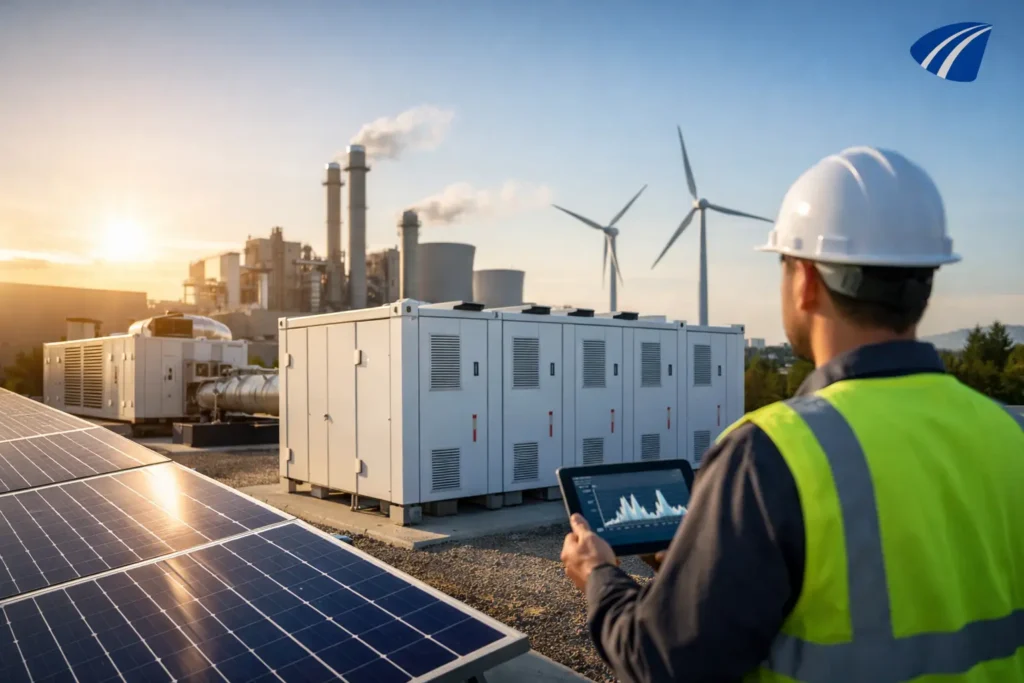
A hybrid system is the right choice when energy savings must be combined with operational continuity, energy security, and greater control over demand.
The issue is not which system appears more advanced on paper, but which one is better aligned with the facility’s business risk and energy profile.
This is why Energize approaches every project through consumption analysis, technical sizing, and total cost of ownership not by selling one more or one fewer piece of equipment.
When the system is designed around real data, the investment stops being a guess and becomes a predictable business decision.
When choosing between a lower initial cost and greater operational security, do not begin by asking how much the equipment costs.
Begin by calculating how much the wrong decision could cost.