When a base station loses power, the issue is not just a technical outage. It means service interruption, reduced network availability, field crew dispatch, pressure on SLA commitments, and direct operational cost. That is why 48V DC systems for telecommunications are the standard in designing reliable telecom energy infrastructure not out of tradition, but because in practice they deliver the best balance of reliability, efficiency, and controllability.
In telecom environments, there is little room for improvisation. Loads are often distributed across multiple locations, operating conditions range from climate-controlled technical rooms to remote outdoor cabinets, and the requirement is almost always the same 24/7 continuity. This is precisely why the 48V DC architecture has proven to be a rational choice for base stations, telecom nodes, radio links, access networks, and supporting IP infrastructure.
Why 48V DC Systems Are the Industry Standard
A nominal voltage of 48V DC did not become dominant by chance. This voltage level enables efficient power transmission with manageable current levels, a strong balance between safety and performance, and compatibility with a wide range of active telecom equipment. Historically, the standard has remained because it continues to be technically justified.
Compared to lower DC voltages, 48V reduces current for the same power level, simplifying cable sizing, protection, and busbar design. Compared to higher voltages, it remains more practical for telecom facilities with many loads, offering easier maintenance and wide equipment availability. For investors, this means lower integration risk and simpler capacity expansion planning.
Another key advantage is that a large portion of telecom equipment natively operates on DC power. When loads are already designed for 48V DC, additional AC/DC conversion at the device level is avoided reducing losses and potential failure points.
Core Architecture of a 48V DC System
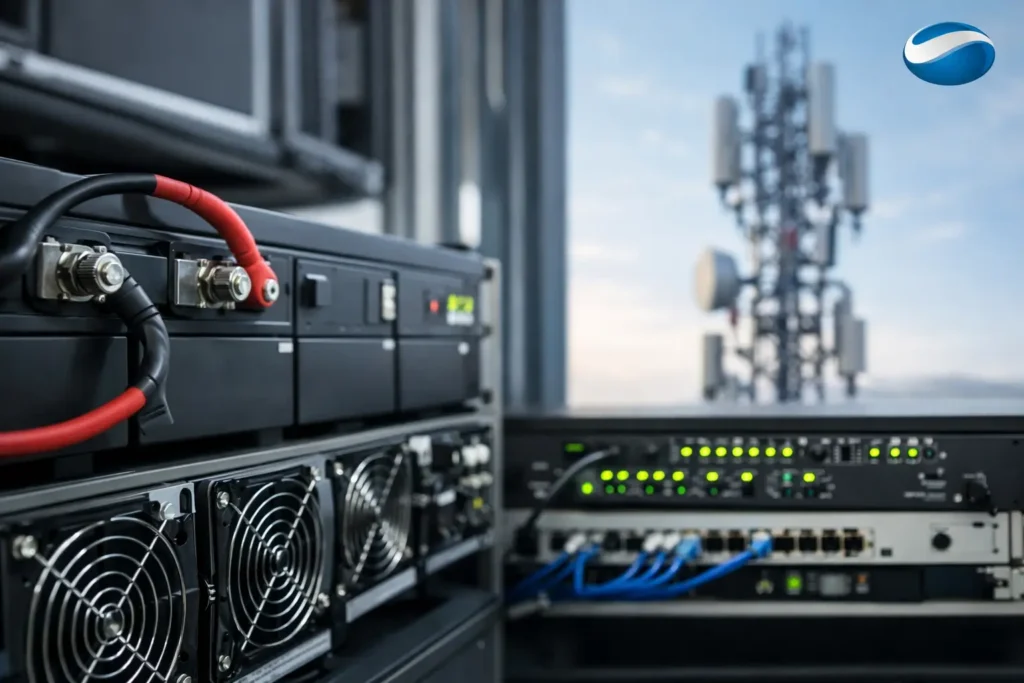
A well-designed 48V DC system is not just a rectifier and battery. It is a fully integrated system where each component has a defined role and capacity reserve. A typical configuration includes AC input, rectifier modules, DC distribution, battery banks, protection elements, a controller, and a monitoring system.
The rectifier converts grid power into stabilized DC voltage for both load supply and battery charging. Modular architecture is critical here, enabling N+1 or higher redundancy. If one module fails, the others continue operating without interruption. For telecom operators and critical infrastructure owners, this is not optional it is a baseline requirement.
The battery bank provides autonomy during grid outages or severe fluctuations. DC distribution routes power to individual loads, protected by fuses or circuit breakers. The controller manages charging, monitors system parameters, alarm states, temperature, and battery health, and is often integrated with remote monitoring platforms.
How Systems Are Sized in Real Conditions
A common early-stage mistake is sizing the system based only on the sum of nominal load power. This is insufficient. Telecom systems must account for peak loads, redundancy margins, expected traffic growth, environmental conditions, battery operating mode, and required autonomy.
If a site has stable grid supply and short outages, one design approach is sufficient. If it is a remote base station with frequent grid failures, the design logic changes completely. In such cases, battery capacity, charging mode, and the ratio between rectifier capacity and load demand become strategic decisions, directly impacting service availability and maintenance costs.
This is where engineering matters. The goal is not to install the largest possible system, but the right system for the specific operating scenario. Oversizing increases CAPEX unnecessarily, while under sizing almost always increases OPEX through more frequent interventions, accelerated battery degradation, and higher outage risk.
Batteries – AGM, GEL, or Lithium
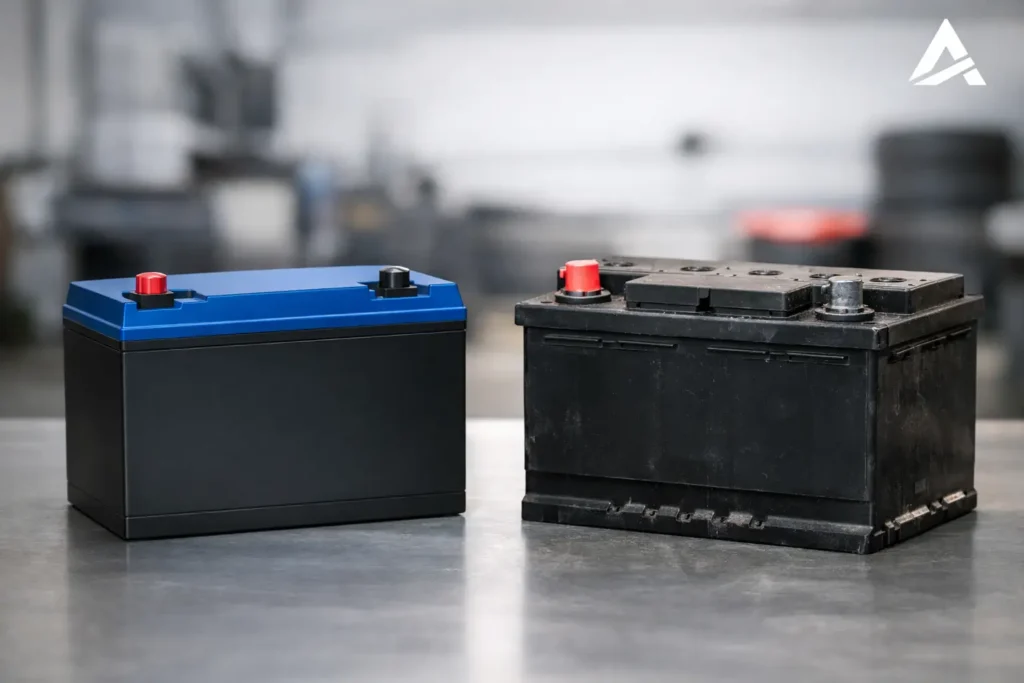
Battery technology selection depends on operating mode, ambient temperature, available space, and investment strategy. AGM and GEL batteries have long been standard due to predictable behavior, lower upfront cost, and widespread use. They still have a role, especially in stable environments with tight budgets.
Lithium batteries, however, increasingly offer better overall economics. They provide higher energy density, lower weight, faster charging, deeper cycling, and longer lifespan. While the initial investment is higher, total cost of ownership is often more favorable, especially at sites with frequent outages or high service costs. There is no universal solution but choosing batteries based solely on purchase price is a flawed approach.
Key System Requirements
In telecommunications, it is not enough for a system to perform under nominal conditions. It must also operate under stress high temperatures, phase loss, module failure, and post-idle battery cycling. System quality is measured by performance under these edge conditions.
The first requirement is availability. The second is redundancy capability. The third is real-time monitoring. Without proper monitoring, operators may not detect battery degradation, overheating cabinets, or overloaded modules until it is too late. At that point, the system is no longer infrastructure it is an incident waiting to happen.
Thermal management is also critical. A 48V DC system does not operate independently of HVAC, cabinet ventilation, or site microclimate. Elevated temperatures directly reduce battery lifespan and stress power electronics. The best results come when power supply, cooling, and monitoring are designed as a unified system.
Where Costs Really Arise and How to Avoid Them
In telecom energy systems, the highest costs rarely come from the most visible procurement item. They typically emerge later—through frequent battery replacements, emergency interventions, uncontrolled load growth, poor cabling, inadequate protection selectivity, or insufficient capacity margins.
That is why 48V DC systems should be evaluated through total cost of ownership. A lower-cost rectifier without proper monitoring may seem efficient during procurement, but if it complicates diagnostics and increases field interventions, the investment quickly loses value. The same applies to batteries that meet nominal specifications but fail to deliver autonomy under real operating conditions.
In serious projects, the focus is not only on equipment, but on integration alignment with existing loads, scalability, proper protection sizing, quality documentation, and a clear maintenance strategy. This is where the difference lies between a system that works and a system that remains reliable for years.
Integration with Renewables and Hybrid Systems
An increasing number of telecom sites, especially remote or infrastructure-limited ones are integrating grid supply, batteries, solar generation, and, when necessary, diesel generators. In such scenarios, 48V DC systems gain additional importance as the central energy management layer.
When properly integrated, solar can reduce grid consumption, relieve generators, and extend battery autonomy. However, integration must be carefully engineered. Not every site is suitable for the same model, and not every theoretical saving translates into operational stability. Consumption profiles, seasonal factors, solar irradiance, backup sources, and load priorities must all be considered.
For operators managing multiple sites, this approach enables lower OPEX and better energy control. With centralized monitoring, infrastructure can be managed at a portfolio level not site by site.
What to Expect from an Implementation Partner
In 48V DC telecom systems, equipment matters but the partner often matters more. Investors need a team that understands both the electrical side and telecom load behavior, as well as long-term project economics. This includes expertise in design, installation, commissioning, monitoring, and maintenance.
A strong partner does not offer generic solutions. They require data load profiles, site conditions, desired autonomy, battery space, backup strategy, and network expansion plans. Only then can the correct system configuration, battery type, redundancy level, and maintenance strategy be defined.
In a market where power loss equals service loss, a 48V DC system cannot be treated as auxiliary equipment. It is the backbone of network availability. When properly designed and integrated, it not only ensures continuity, but also reduces risk, stabilizes costs, and supports growth without energy uncertainty.
If you are planning a new telecom site or upgrading an existing one, the most cost-effective decision is to treat the energy system as a strategic investment not as a technical item to be minimized at the lowest price.