Technologies, Parameters and Selection
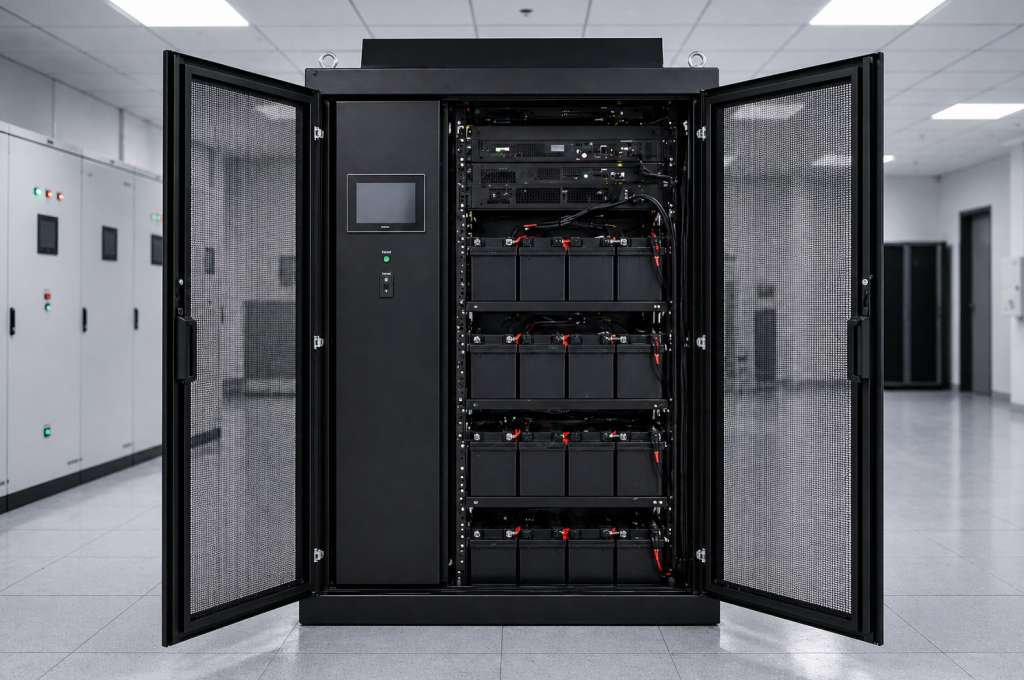
Before discussing chemistries, cycle life, and depth of discharge, it helps to establish the basic framework. The primary role of a UPS system is to provide immediate protection and continuity of power when the grid fails or becomes unstable. The primary role of a BESS system is to store energy and use it strategically for consumption optimisation, renewable integration, and greater energy flexibility within a facility. What connects these two systems is the battery itself: it is the common foundation and key component in both solutions.
A battery is not a component of a UPS or BESS system it is the system’s essence. Everything else inverters, rectifiers, control systems exists to ensure the battery is charged at the right moment, at the right temperature, and that it delivers its stored energy without fault when called upon. How long that lasts, how reliably, how economically and how safely depends entirely on which battery chemistry was chosen, how it was sized, and how it is managed. Translated into business language, battery selection directly affects system reliability, replacement frequency, operating costs, and the overall level of risk a company is willing to carry.
The market for stationary batteries is undergoing a transformation not seen since the introduction of VRLA technology four decades ago. Li-Ion batteries and within that category, LFP chemistry in particular are changing the economics of UPS and BESS systems in a fundamental way. Understanding that change means understanding why more and more engineers and financial directors are making different decisions than they were just five years ago. This is no longer only a technical shift, but one that affects CAPEX, OPEX, and the long-term viability of the entire project.
Four Technologies That Dominate the Market
VRLA — proven, but with a time limit
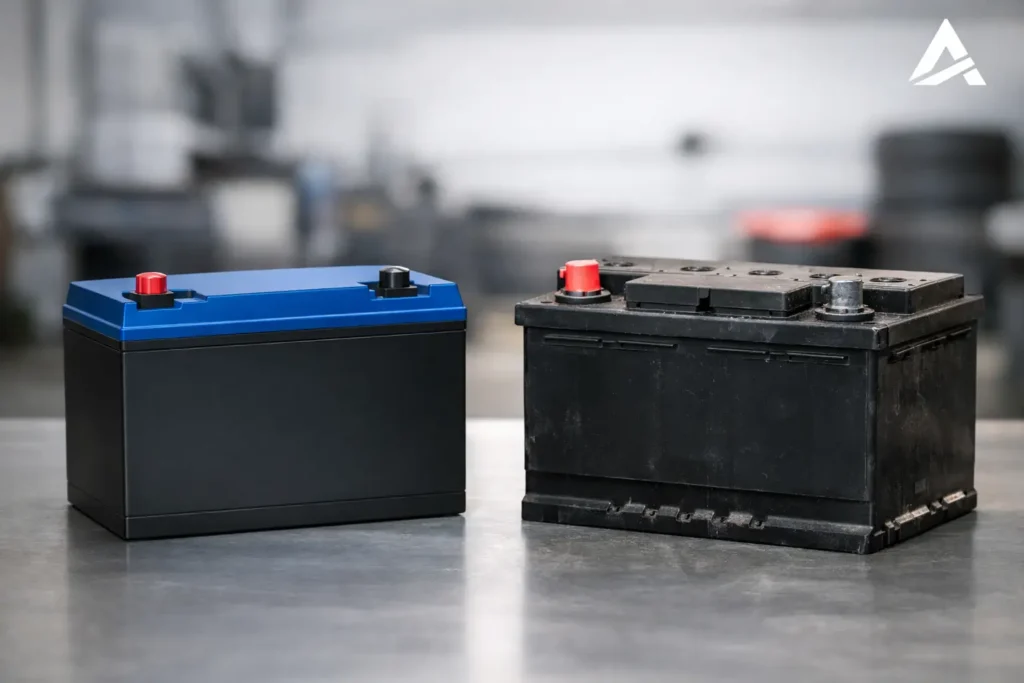
Valve-Regulated Lead-Acid batteries were the industry standard for UPS applications for decades, and for good reason: robust, relatively inexpensive, familiar to the service network, and requiring no special chemistry management. Two variants AGM (Absorbent Glass Mat) and Gel differ in internal construction but share the same fundamental profile: a design life of 5 to 10 years at the optimal 20°C, in practice 3 to 5 years in a typical industrial environment, and a depth of discharge limited to 50 percent of capacity without significantly accelerating degradation.
VRLA remains a legitimate option where budgets are constrained, cycling is infrequent, and an established service routine for replacement is already in place. In data centres, high-demand industrial installations, and wherever long-term OPEX is being planned, VRLA increasingly loses in the TCO analysis. For the client, this means that a lower upfront price does not automatically translate into the better long-term decision.
Li-Ion LFP — the new standard for stationary applications
Lithium iron phosphate (LiFePO₄, abbreviated LFP) is the chemistry that has changed the equation for stationary battery systems. A design life of 12 to 15 years means one procurement and installation cycle where VRLA requires three or four. A depth of discharge of 80 to 90 percent without degradation means that 100 kWh of LFP capacity effectively delivers 80 to 90 kWh of usable energy, versus 50 kWh from VRLA of the same nominal size. Cycle counts range from 4,000 to 8,000 which in a C&I BESS application with one cycle per day is sufficient for 11 to 22 years of operation.
The thermal stability of LFP chemistry is a particular advantage. The phosphate lattice structure of the cathode is chemically stable and does not undergo the thermal decomposition present in NMC chemistries. The result is a dramatically lower risk of thermal runaway making LFP the preferred choice for installations inside buildings, in proximity to IT equipment, or in environments with strict safety requirements. In practical terms, LFP often means lower safety risk, fewer replacements, and more predictable lifecycle cost.
Li-Ion NMC — energy density above all
Nickel-manganese-cobalt chemistry offers higher energy density than LFP 150 to 250 Wh/kg versus 90 to 160 Wh/kg making it attractive where physical space is critically constrained. Compact UPS systems for edge data centres, mobile applications, and space-limited facility installations use NMC precisely for this reason. The trade-off is a lower cycle count (1,000 to 3,000) and a higher thermal risk that demands more careful thermal management. For certain applications this can be justified, but the choice of NMC should be driven by clear design constraints, not just by nominal performance figures.
Nickel-cadmium — for extreme environments
NiCd batteries are not the typical choice for new installations, but remain irreplaceable in specific industrial scenarios. They operate at temperatures from -40°C to +70°C without significant performance degradation making them the only reliable option for outdoor oil and gas facilities, railway signalling, arctic installations, and any application where the operating temperature range excludes Li-Ion. Higher CAPEX and regulatory restrictions due to cadmium limit their application to cases where no alternative genuinely exists. In other words, NiCd is not a broad market solution, but a specialised answer to extreme operating conditions.
Key Technical Parameters: What Each Means in Practice
Capacity and depth of discharge (DoD)
The nominal capacity of a battery in kWh or Ah is not the same as usable capacity. VRLA batteries are designed for a maximum depth of discharge of 50 percent discharging below that threshold accelerates degradation and shortens service life. LFP batteries tolerate 80 to 90 percent DoD without statistically significant impact on cycle count. The practical implication: to extract 50 kWh of usable energy from a VRLA system, you need to install 100 kWh of nominal capacity. With LFP, 60 kWh nominal delivers the same 50 kWh usable in a smaller footprint, with lower weight, and at lower total cost. That is an important distinction for the buyer, because nominal capacity alone does not show how much energy the system can actually deliver in useful terms.
Cycle count and service life
The charge-discharge cycle is the fundamental measure of battery degradation. A VRLA battery designed for 500 cycles at 50% DoD may serve 3 to 5 years in a UPS application where full cycles are infrequent but in a BESS application with one cycle per day, the same batteries would be economically exhausted in less than two years. An LFP battery with 5,000 cycles at 80% DoD in the same BESS application lasts 13 to 14 years. Chemistry selection directly determines project economics. This is where the difference appears between a battery that merely works and one that makes long-term business sense for the actual operating model.
C-rate: charge and discharge speed
C-rate describes how quickly a battery can be charged or discharged relative to its capacity. C/1 means charging or discharging in one hour, C/5 in five hours, 2C in 30 minutes. For UPS applications, where the battery must discharge at a power level significantly higher than normal over a short period, a high discharge C-rate is a critical parameter. For BESS applications with long cycles, C-rate is less critical than cycle count and capacity. VRLA batteries typically tolerate C/5 to C/10 charging without serious degradation; LFP batteries routinely operate at C/1 or higher. This means the battery must be selected according to the real operating profile of the system, not simply according to whichever technology appears most popular at the time.
Temperature and its effect on service life
Every engineer who has worked with VRLA batteries knows the rule: service life halves for every 10°C above the reference temperature of 20°C. A battery room that warms to 35°C during summer reduces the effective VRLA service life from 5 to 2.5 years while cooling costs and the energy to drive that cooling are charged to the project. LFP batteries are considerably more tolerant: stable operation across a range from -20°C to +60°C, with far smaller cycle-count impact from temperature. This directly affects HVAC costs in the battery space, and the thermal management design of the entire system.
At 35°C, a VRLA battery with a 5-year design life reaches end of useful life in approximately 2.5 years. The same thermal exposure has negligible impact on LFP chemistry. For a data centre that raises the battery room climate setpoint by just 5°C, the difference in VRLA replacement costs over 15 years amounts to one entire additional replacement cycle.
Battery Management System
A modern Li-Ion battery without an advanced BMS is potential without control. The Battery Management System monitors voltage, current and temperature at the level of each individual cell in real time, performs charge balancing between cells, protects the system from overcharge, deep discharge and thermal runaway, and maintains a complete record of every cycle throughout the battery’s operating life.
In a UPS context, the BMS ensures the battery is always in optimal state of charge for intervention — neither overcharged nor below minimum capacity. In BESS systems with daily cycling, the BMS optimizes the charge-discharge strategy to maximize useful battery life, not just immediate capacity. Advanced BMS systems use machine learning algorithms to predict degradation in individual cells and generate alerts days or weeks before capacity drops below the operational threshold.
Integration of the BMS with higher-level management systems EPMS, DCIM, SCADA is not a luxury. It is a prerequisite for serious infrastructure management. An operator who knows the state of each cell in the system, who receives predictive alerts, and who plans replacements within a scheduled service window rather than reacting to failures, operates at a fundamentally different level of reliability than one who treats the battery as a black box. This is exactly where the difference becomes clear between a basic system and one that is truly ready for serious infrastructure.
EU Regulation: Battery Regulation 2023/1542
The European Batteries Regulation (EU 2023/1542) brings structural changes to the way batteries are procured, used, and disposed of across Europe. The most significant requirements for industrial and stationary batteries include: a Digital Battery Passport documenting material origin, carbon footprint, and performance data throughout the battery’s service life; minimum percentages of recycled content in new batteries from 2030 onwards; and requirements for declaring capacity and end-of-life capacity.
For buyers companies integrating batteries into UPS and BESS systems this regulation means that supplier transparency becomes a commercial criterion. A supplier who cannot provide a Digital Battery Passport, who does not document the critical mineral supply chain, or who offers no end-of-life take-back plan, becomes a regulatory risk for projects within the EU. This is particularly relevant for companies that file ESG reports or apply for EU funding. In other words, battery and supplier selection is no longer only about price and technical parameters, but also about compliance with market and regulatory requirements that can affect the entire project.
Safety and Standards for Battery Systems
Large-capacity battery systems carry specific safety risks that require a systematic approach from spatial planning through to fire suppression. IEC 62619 defines safety requirements for stationary Li-Ion battery systems; EN ISO 6469 and the IEC 62040 series define requirements for UPS systems incorporating Li-Ion batteries. In Germany, VdS 3103 guidelines for battery systems have become the reference standard for insurers and investors across the wider region.
Battery room design must account for: ventilation and gas detection (particularly for VRLA), fire suppression systems matched to the battery chemistry, space thermal management, capacity segmentation to limit the scope of any potential incident, and access routes for service and emergency personnel. LFP chemistry is considerably less demanding in all these categories than NMC, and substantially less demanding than older VRLA installations in terms of ventilation and gas management.
How to Make the Right Decision
Battery selection is not a catalogue exercise it is an engineering and financial process. It starts with the load profile: how often the battery is cycled, how long it must sustain power, what temperature environment it operates in, and what space it is housed in. Then comes the economic analysis: not just the purchase price, but TCO across the projected system lifetime, including replacement costs, service windows, and unavailability risk.
In UPS applications with infrequent cycles and a controlled environment, VRLA remains a legitimate option where budgets are constrained and a planned service replacement schedule is in place. In all other situations data centres, BESS systems, healthcare facilities, telecommunications LFP is the chemistry that delivers the investment return that VRLA mathematically cannot match over a 10 to 15-year horizon.
The most important thing that can be said about batteries in the context of modern energy infrastructure is this: a battery is a strategic asset, not a consumable. Treating it as such in procurement, in design, in management, and in end-of-life planning means building infrastructure that genuinely performs when performance matters most.
When designed properly, UPS and BESS do not have to remain separate stories. In practice, they are increasingly integrated with solar systems and broader facility energy management, where UPS protects continuity for critical loads and BESS optimises energy use and increases system flexibility. That is why battery selection is not just a technical question about one product, but part of a broader strategy for how a facility consumes, stores, and protects energy.
For that reason, batteries should not be selected by habit, but according to the role the system is expected to play in the business. When that decision is made correctly, the battery stops being a hidden component in the background and becomes one of the key elements of reliability, financial performance, and long-term development of the energy infrastructure.