How Does a Distribution Board Actually Work in a Building or a Factory?
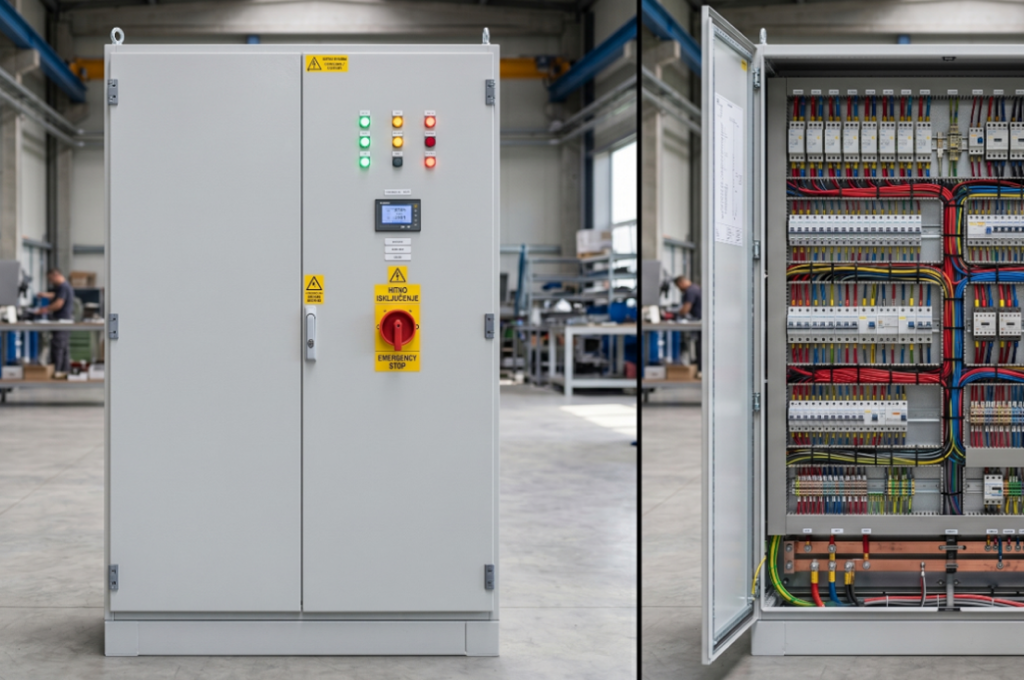
A distribution board represents the central point of control and distribution of electrical energy within any facility. Its primary function is to safely receive electrical energy from the distribution grid, divide it into smaller, controlled circuits, and provide system protection against potential faults. Whether it is a residential building or a complex industrial plant, the operating principle is based on the same engineering rules, with the difference that technical requirements and safety standards in industry are significantly stricter and more complex.
The Entry Point: Main Power Supply and Busbars
Distribution of energy within the board starts at the main power supply. While standard conductors are used for transmission in residential installations, industrial systems and larger facilities utilize busbars. These massive copper profiles are designed to withstand high current loads without overheating. Energy is routed and distributed via busbars to individual consumers, from basic lighting circuits in a building to powerful drive motors in production halls.
Network and Personnel Protection Elements
The safety of the entire system relies on carefully sized protection elements.
- Miniature Circuit Breakers (MCB): These devices have completely replaced traditional melting fuses, providing dual protection. The thermal principle responds to network overloads by breaking the circuit due to the heating of a bimetallic strip, while the magnetic mechanism ensures instantaneous circuit interruption in the event of a short circuit.
- Residual Current Devices (RCD): While circuit breakers protect the infrastructure, RCDs protect people. This device constantly monitors the difference between the current entering and leaving the circuit. Upon detecting even the slightest deviation, which indicates an insulation breakdown or current leakage to the ground, the device instantly cuts off the power supply. In industry, advanced, adjustable RCDs are often applied to ensure network selectivity and prevent unplanned shutdowns of entire production lines.
Industrial Automation: Contactors and PLC Devices
Industrial distribution boards go beyond the basic function of distribution and protection, taking on the role of managing technological processes. The control of powerful industrial machines is performed via contactors—electromagnetic switches that allow high-power systems to be controlled using low-voltage commands.
The operation of these components is most commonly managed by Programmable Logic Controllers (PLC). These industrial computers process information from sensors, monitor the operating parameters of process equipment, and communicate with central monitoring systems, thereby ensuring a high level of automation, equipment protection, and absolute continuity of work processes.
Surge Protection Devices (SPD)
An indispensable segment of protection is surge protection devices (SPD), whose role is to protect sensitive electronic equipment and industrial robotics from atmospheric discharges and sudden voltage spikes in the distribution grid. In the event of an overvoltage, these devices quickly and safely route the excess energy to the grounding system, protecting the infrastructure before permanent component damage occurs.
Causes of Distribution Board Failures
The most common cause of failures in distribution boards is not the electrical energy itself, but inadequate contact at the connections. Loose connections on protection elements and busbars lead to increased contact resistance, which causes localized heating. Over time, the elevated temperature leads to the degradation of insulating materials and can result in equipment damage or fire. For this reason, regular connection inspections are implemented in practice, including mechanical tightening and thermographic (thermal imaging) testing, to identify potential problems in a timely manner and prevent system downtime.
Conclusion
Whether implemented in residential buildings or heavy industrial plants, distribution boards are the backbone of a stable and safe electrical power system. They are the place where rigorous engineering calculations regarding voltage drops, short-circuit currents, and adequate protection coordination are applied. A properly designed, expertly installed, and regularly maintained distribution board is not just a technical norm; it is a long-term investment that guarantees uninterrupted equipment operation, process optimization, and the complete safety of your business.