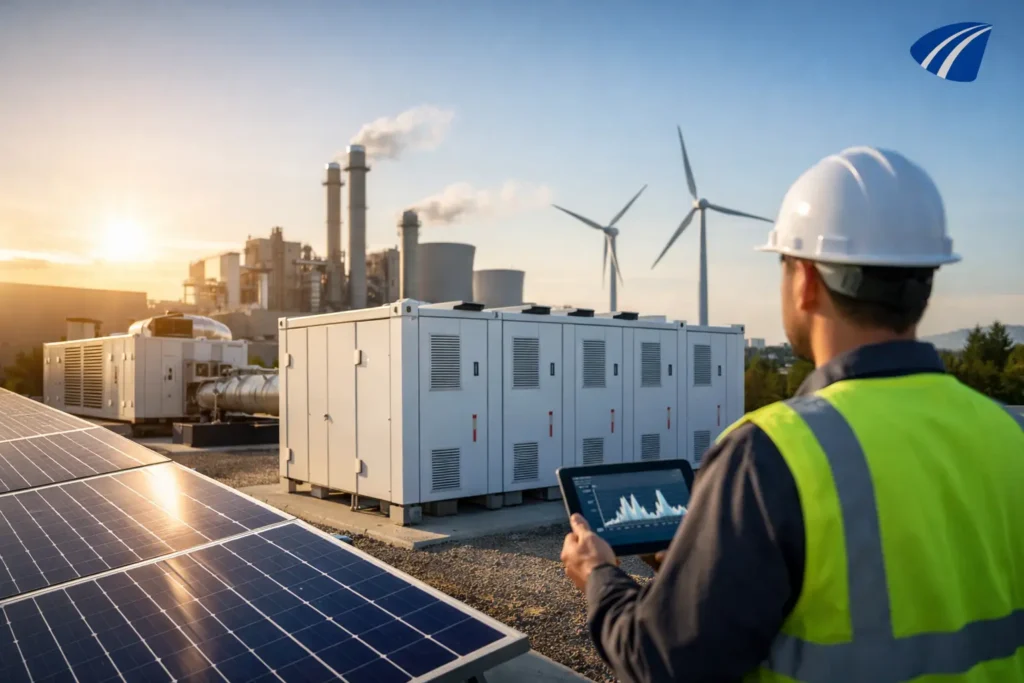

An electricity bill in a factory rarely increases because of one major issue. More often, it is driven up by ten smaller ones poorly distributed loads, high power peaks, outdated equipment, uncoordinated operation between HVAC systems and production, and the absence of precise monitoring. That is why the question of how to optimize energy consumption in a factory is not about implementing a single measure, but about developing a complete energy strategy.
In industry, there is no room for superficial assumptions. If a facility operates in three shifts, if downtime is expensive, and if power quality directly affects production, energy optimization must be viewed through total cost of ownership, not only through a lower monthly electricity bill, but through operational stability, cost predictability, and system resilience.
How to Optimize Factory Energy Consumption Without Making the Wrong Investments
The most expensive mistake is investing before understanding where energy is actually being consumed. Many factories know their total monthly consumption, but have no visibility into which production lines, compressors, cooling systems, or HVAC zones generate the largest loads. Without that insight, every investment becomes partially speculative.
The first step is energy mapping of the facility. This includes measurements at key consumption points, load analysis by hour and shift, and understanding the relationship between active energy, reactive energy, and peak demand. In practice, peak loads are often responsible for disproportionate costs. A factory may have relatively stable monthly consumption while still paying high demand charges due to short but intense power spikes.
That is why it is important to distinguish between three separate goals: reducing total energy consumption, reducing peak demand, and increasing energy reliability. Sometimes these goals align, and sometimes they do not. For example, a battery storage system may significantly reduce peak demand and improve operational continuity, even though it does not always reduce total annual consumption. On the other hand, replacing motors or optimizing compressed air systems may directly reduce kilowatt-hour consumption without necessarily solving peak demand issues.
Start with Measurements, Not Assumptions
If you are not measuring energy consumption by zones and processes, you are not managing energy, you are simply reacting to the electricity bill. Serious optimization requires real-time data or, at minimum, load profiling over a representative period.
The greatest value usually comes from monitoring the main grid connection and several critical systems: production lines, compressor stations, refrigeration systems, HVAC infrastructure, charging stations, process water systems, and auxiliary facilities. Only once you identify where peaks occur, how much base load exists overnight, and which systems operate unnecessarily can a meaningful optimization plan be created.
At that point, it often becomes clear that the problem is not where management initially expected it to be. In some factories, the largest losses come from compressed air leakage. In others, they originate from large motors operating without variable frequency control. In food processing and cold storage facilities, refrigeration systems and poorly optimized HVAC operation are often the key issue. In logistics and distribution centers, an increasing share of consumption comes from charging infrastructure and temperature management systems.
Where Factories Most Commonly Lose Energy
In industrial environments, energy losses rarely come from one spectacular failure. They are usually the result of everyday operational habits and systems that have operated for years without serious revision.
A common issue is simultaneous startup of multiple large consumers. Another is equipment running outside active production periods, especially during nights and weekends. Additional problems include poor coordination between technological requirements and HVAC or refrigeration management. Other frequent inefficiencies include poor power factor, outdated lighting systems in auxiliary halls, inefficient UPS operating modes, and backup systems that are not integrated into the broader energy management strategy.
Particular attention should be paid to processes that were originally designed correctly for a certain production volume, but are no longer optimal for current capacities. Factories that expanded gradually often have energy systems that evolved reactively rather than strategically. This is a typical scenario where energy costs increase faster than production output.
Peak Load Management Delivers Fast Results
When discussing how to optimize factory energy consumption, management often first thinks about equipment replacement. While this is an important direction, in many cases the fastest results come from controlling peak demand.
If multiple large consumers start within the same time window, the grid experiences a major load spike and costs increase. The solution is not necessarily reducing production, but smarter sequencing, automation, and load distribution. In some facilities, simply reorganizing startup logic is enough. In others, advanced energy management systems are required to dynamically monitor loads and prevent unnecessary peaks.
It is important to remain realistic here. If the production process requires simultaneous operation of several energy-intensive systems, operational reorganization alone may not be sufficient. In such cases, solutions involving battery energy storage, on-site solar generation, or modernization of specific consumers are considered. The correct approach depends on tariff structures, operational regimes, and process criticality.
Solar and BESS Only Deliver Full Value When Properly Sized
A rooftop or ground-mounted solar power plant can significantly reduce energy costs, but only if the project is based on the real consumption profile of the factory. If the system is oversized relative to daytime demand, project economics may weaken. If it is undersized, part of the potential remains unused.
Even more importantly, solar power alone does not solve every problem. If the factory experiences its highest peaks early in the morning, late in the afternoon, or at night, photovoltaic production will not cover the critical periods without additional storage. This is where BESS systems deliver their full value. They enable energy shifting, peak demand reduction, improved utilization of solar production, and greater resilience against grid disturbances.
For industrial users, the most profitable approach is often not “more equipment,” but precise integration. This means solar generation, storage systems, UPS infrastructure, generators, HVAC systems, and critical loads must be viewed as one unified energy system. When designed separately, part of the savings is lost and operational risk increases. When designed together, the result is greater control, backup capability, and stronger financial predictability.
When Solar Is Not the First Priority
There are situations where solar is not the first step, even though it may still be part of the long-term solution. If a factory has major internal losses, poor measurement infrastructure, and frequent power quality issues, the foundation must first be stabilized. Otherwise, new energy generation is simply added into an inefficient system.
The same applies to facilities with limited roof load capacity, complex operating regimes, or low daytime consumption during solar production hours. In such cases, feasibility studies must be more detailed and include comparison of multiple scenarios. A serious partner will not push a single solution at any cost, but will recommend the model that makes both technical and economic sense.
Equipment Matters, but Energy Management Makes the Difference
Replacing outdated motors, implementing variable frequency drives, LED lighting, more efficient chillers, and smarter HVAC control all deliver measurable improvements. However, in factories with variable loads, the greatest difference occurs when equipment becomes connected to a broader decision-making system.
In other words, efficient components alone are not enough if they operate without coordination. Energy management systems must know when it is economically beneficial to charge batteries, when to reduce grid demand, when to shift processes, and how to prioritize critical loads during disturbances. This becomes especially important in industries where downtime means raw material loss, production interruptions, or compromised temperature-controlled processes.
That is why serious optimization does not end with equipment procurement. It includes engineering, integration, commissioning, performance monitoring, and periodic review. This is precisely where the difference emerges between purchasing products and building energy infrastructure that actively supports the business.
Financial Analysis Must Consider the Bigger Picture
The weakest investments are often those that appear inexpensive initially but become costly during operation. In industry, it is necessary to evaluate not only CAPEX, but also OPEX, downtime costs, equipment lifespan, service support, warranties, and future scalability.
For example, a cheaper component without proper integration may look attractive in a tender process, but if it communicates poorly with the rest of the system or requires frequent intervention, the real cost quickly increases. The same applies to solutions that reduce energy consumption on paper while introducing operational limitations that reduce production flexibility.
That is why factories with a long-term perspective increasingly choose models in which one partner takes responsibility for feasibility studies, engineering, delivery, installation, and maintenance. This approach reduces fragmented responsibility and accelerates decision-making, especially for complex systems combining solar generation, storage, and backup power.
If your team is currently evaluating how to optimize factory energy consumption, do not begin with equipment catalogs. Start with measurements, load profiles, and business objectives. Only then does the investment stop being an expense and become a tool for more stable production, lower operational risk, and greater control over energy in the years ahead.