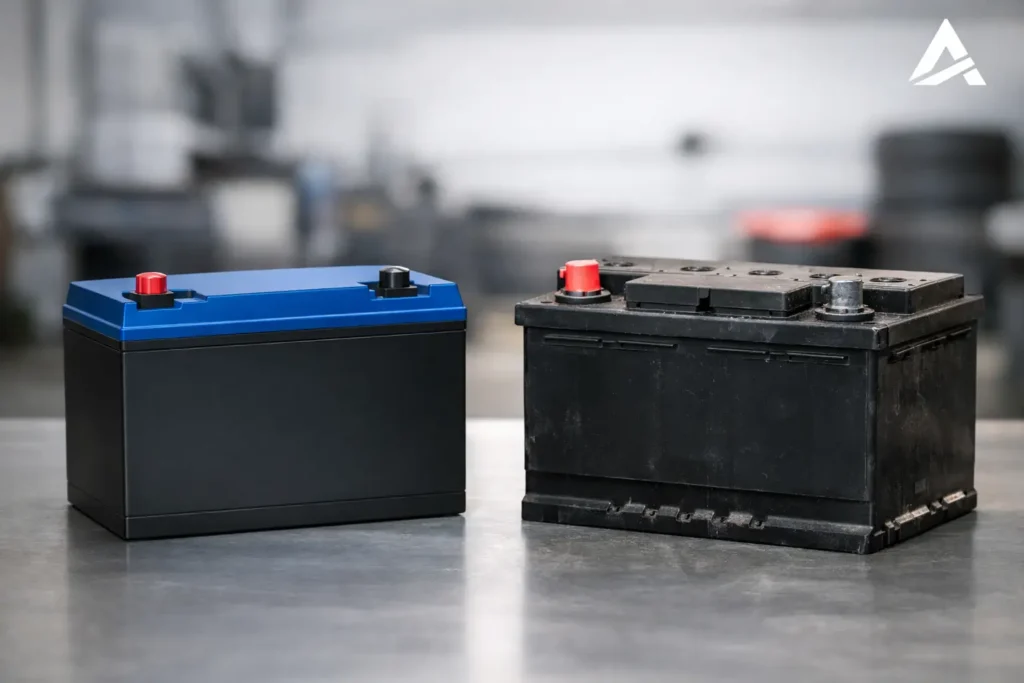

When production stops for 15 minutes, the conversation about industrial battery prices stops being a procurement issue and becomes a question of lost revenue, contractual deadlines, and operational risk. That is why a serious battery system evaluation does not begin with the unit price, but with an analysis of load requirements, autonomy, operating режим, and total cost of ownership throughout the system lifecycle.
For industry, logistics, telecommunications, data centers, and energy infrastructure, a battery is not a consumable product. It is part of a critical power system. If the wrong technology is selected from the start, or if the investment is driven solely by the lowest initial price, the consequences usually appear later, through shorter lifespan, higher maintenance costs, more frequent replacements, and reduced system availability when it is needed most.
What Determines the Price of Industrial Batteries
There is no universal market price because industrial batteries are designed according to application requirements. The difference between a UPS battery for an office building, a battery bank for a substation, a storage system integrated with a solar power plant, and a traction battery for forklifts is not only capacity, but completely different operating demands.
The first key factor is technology. The most common options are VRLA, gel, OPzS, OPzV, and lithium-ion batteries. VRLA batteries have a lower entry cost and are often a good choice for standard UPS applications with shorter autonomy requirements. OPzS and OPzV systems offer longer design life and higher reliability in demanding industrial environments, but require a larger initial budget. Lithium-ion solutions have the highest upfront cost per kWh, but in many scenarios they provide the best balance of performance, depth of discharge, cycle life, and space efficiency.
The second factor is capacity, the amount of energy the system must provide. Clients often focus only on nominal Ah or kWh values, but that alone is not enough. Depth of discharge limits, operating temperature, peak load requirements, and actual available energy throughout the system lifecycle are equally important. A 100 kWh battery on paper is not necessarily the same as 100 kWh of usable energy under real operating conditions.
The third factor is system power. Some facilities require relatively short autonomy but extremely high instantaneous power during grid failures. Others require longer bridging times with stable and predictable discharge profiles. Sizing based on power requirements directly affects battery bank configuration, number of modules, cabling, protection systems, and supporting equipment.
Why the Lowest Price Is Often Not the Cheapest Solution
In industrial projects, the key issue is TCO — Total Cost of Ownership. This includes procurement, engineering, installation, commissioning, monitoring, servicing, replacements, and operational losses throughout system operation. If a system has a lower upfront cost but requires earlier replacement or more frequent interventions, the real cost becomes higher than that of a higher-quality solution with a greater initial investment.
A practical example is the choice between lead-acid and lithium batteries for facilities with frequent charge and discharge cycles. If the system operates occasionally, such as supporting a UPS with rare activations, lead-acid batteries may be a rational choice. If the battery is used daily together with a solar system, peak shaving strategy, or energy optimization, lithium solutions very often justify the higher investment through longer lifespan, lower losses, and better usable capacity.
Space requirements are another important factor. In manufacturing facilities, distribution centers, and technical rooms, every square meter has value. A more compact system that occupies less space, requires less cooling, and integrates more easily into existing infrastructure may be a better business decision than a cheaper battery solution that introduces additional construction and mechanical costs.
Industrial Battery Prices by Technology
If you are looking for a realistic framework rather than random pricing estimates, it is useful to understand how technologies differ in terms of investment logic. VRLA batteries are typically the entry point for many standard applications. Their advantage is lower initial investment and simple UPS integration. Their limitation is shorter lifespan under demanding conditions and lower tolerance to deep cycling.
OPzS batteries are used when reliability, long lifespan, and stable operation in industrial systems are the priorities. They have a strong reputation in energy, telecom, and infrastructure applications, but require more installation space and specific maintenance conditions. OPzV systems follow a similar long-life philosophy while offering sealed construction and reduced servicing requirements.
Lithium-ion batteries are currently the most attractive option where high cycle count, high efficiency, fast charging, advanced BMS functionality, and precise operational control are required. Their price is higher, but the economics become increasingly favorable as system usage intensity grows. They are especially relevant in BESS projects, hybrid solar systems, and facilities where operational continuity and peak demand management directly impact electricity costs.
That is why it is incorrect to ask only how much a single battery costs. The real question is: how much does a system cost that reliably solves a specific problem over the next five, ten, or fifteen years?
What Is Included in the Price Besides the Battery Itself
A serious offer does not include only battery modules. The price also covers cabinets or rack solutions, BMS or monitoring systems, fuses, breakers, DC distribution, cables, connectors, mounting structures, ventilation or cooling systems, and integration with UPS systems, inverters, generators, or existing energy infrastructure.
For larger systems, engineering, fire protection, parametrization, functional testing, commissioning, and user training are also included. In some facilities, it is necessary to adapt electrical infrastructure or resolve construction-related requirements. All of this impacts the total investment. That is why quick indicative prices are useful only as an initial reference point, never as a basis for decision-making.
Warranty conditions are also an important part of the total cost. There is a significant difference between purchasing equipment without serious technical support and investing in a complete solution backed by a partner capable of taking responsibility for system performance. In practice, the most expensive failures are the ones nobody can resolve quickly.
How to Evaluate Whether an Offer Is Realistic
A quality industrial battery proposal must answer several business-critical questions. What is the projected lifespan under the intended operating regime? How many cycles can the system realistically handle? What is the allowed depth of discharge? How does temperature affect performance? What is the charging and discharging efficiency? What happens in the event of a module or cell failure? What does the service network and response time look like?
If this information is missing, the price alone says very little. Particular caution is required with offers that emphasize only nominal capacity without showing actual operating conditions. In industry, the gap between specifications and real-world operation is often where an investment loses profitability.
A reliable partner will request data about loads, consumption profiles, autonomy requirements, environmental conditions, and future facility expansion plans. This is not unnecessary complication, it is the only serious way to size the system correctly. Companies that think long term understand the difference between purchasing equipment and investing in energy security.
When Does the Investment Pay Off the Fastest?
Return on investment depends on the application. In UPS and backup scenarios, profitability is usually measured through avoided downtime losses, equipment protection, and business continuity. In storage and hybrid solar systems, the calculation also includes peak demand reduction, improved use of generated energy, and lower exposure to electricity price increases.
The fastest return is typically achieved in facilities where downtime is extremely costly, grid instability is frequent, consumption peaks are pronounced, or energy independence is strategically important. Manufacturing plants, cold storage facilities, data centers, telecom sites, and logistics centers all have particularly clear business incentives. In these cases, the battery is not an additional expense, but a tool for risk and cost control.
That is why serious investors do not ask only what industrial battery prices are today. They ask how much one hour of downtime costs, how often power disturbances occur, and how much energy can be optimized through a properly engineered system. Only when these three factors are placed on the table does the price gain real meaning.
There will always be a cheaper option on the market. The real question is whether that option will still be cheaper once the system enters its third, fifth, or eighth year of operation. When battery solutions are viewed as part of a broader energy infrastructure, together with UPS systems, solar power plants, generators, and energy management, the decision becomes more precise and the investment more secure. That is where the difference emerges between procurement and strategic energy planning.