The most important part is not the one you see from the road
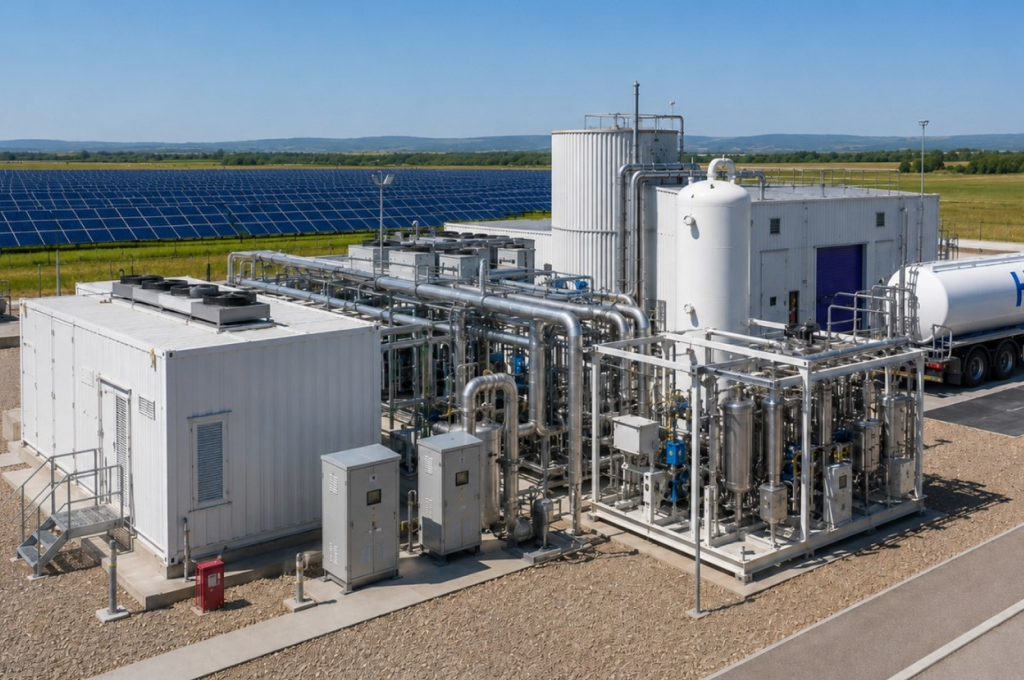
Most people considering connecting a solar park to an electrolyzer for the first time picture a simple sequence. Panels produce electricity, a cable runs it to a box that makes hydrogen, the hydrogen is sold. In reality, between the first panel and the first molecule of hydrogen sit six different technical systems, two kinds of water, three separate safety loops and a business process that the EU regulator watches closely.
That does not mean the project will not work. It means it will not work by skipping steps. A solar park owner in Serbia with curtailment, a medium-voltage output and an industrial buyer within thirty kilometers has all the ingredients for a serious project. The only question is the order in which to assemble them.
Step 1 — what the park actually produces outside the windows the grid will take
Before any equipment is ordered, the work is in data, not assumptions. How many hours of curtailment occurred last year, how many hours the price dropped below the profitable threshold, how much value was eventually lost. Second, what that surplus looks like across the year — hydrogen produced over one hundred days has a fundamentally different economics from hydrogen produced over three hundred days. Third, the voltage configuration of the park output, the SCADA system in place, the physical room available for additional equipment. And fourth, the distance to the nearest potential buyer or gas pipeline.
These four numbers decide whether the project makes economic sense or remains an expensive demonstration for visitors. In context, curtailment in Serbia has already passed several percent of annual production on some parks — and that is precisely the energy that costs zero euros and is being thrown away today.
Step 2 — the electrolyzer does not follow the park, it follows the surplus
The electrolyzer does not have to match the size of the solar park. For a 10 MW park, the economically optimal electrolyzer is typically between 1 and 3 MW. Enough to absorb the midday surplus, not so large that empty hours appear when the park is not producing. The rule is simple — size the electrolyzer to the surplus profile, not to the peak power of the park. The smaller it is relative to the park, the more hours per year it runs at full load, which directly improves the economics.
PEM technology is currently the best choice for solar. It starts and stops in seconds to minutes, allowing it to track the variable output of the panels. It operates efficiently when load jumps up and down. It has a smaller physical footprint per megawatt and integrates more easily into an existing SCADA system. Alkaline electrolyzers are cheaper per MW but less flexible — they belong with applications that have a stable power source, most often the grid or a hydropower plant.
Step 3 — water is not a side issue
Producing 1 kilogram of hydrogen requires around 9 liters of water. But not just any water. The electrolyzer demands demineralized water with conductivity below 0.1 µS/cm — cleaner than the best bottled water on the market. In practice, the site needs a water treatment system (reverse osmosis plus EDI or equivalent), continuous quality monitoring, and pretreatment if the source is the municipal water network or a well.
The majority of projects that fail in the first year do not fail because of the electrolyzer. They fail because of water. Poor quality permanently damages the membranes and shortens the lifetime of a stack that accounts for more than thirty percent of the total investment. Savings on the water preparation system reliably come back in the form of a bill that was not in the original projection.
Step 4 — compression and storage
Hydrogen leaves the electrolyzer at low pressure, usually between 5 and 30 bar. For sale or transport, pressures of 200 to 700 bar are required. The compressor is the single largest line item — both capital and operational — and its selection dictates the future operating regime of the plant. A wrongly sized compressor either runs too long or starts too often, and both scenarios shorten mechanical life and raise OPEX.
On-site storage is not optional, it is a requirement, even when the buyer is only 200 meters away. Typically these are cylindrical pressure vessels (Type I through Type IV) or, for larger volumes, underground storage. The size depends on the buyer profile. Continuous offtake and batch offtake demand different storage architectures, and choosing the wrong concept is paid for every month in additional compressor cycles.
Step 5 — safety is not negotiable
Hydrogen is not as broadly explosive as the popular imagination suggests, but it is difficult enough to demand a serious safety infrastructure. ATEX zoning of the entire facility footprint. Hydrogen sensors with redundancy and automatic alarms. Passive and active ventilation in every enclosed space. Electrical equipment certified for the appropriate Ex zones. HAZOP analysis before commissioning and renewed every two to three years.
The reason hydrogen has been used for decades in refineries and the chemical industry without making headlines is not luck. It is the result of consistent application of the same procedures that are now being adopted in green projects. The team taking over the project has to bring experience from the process industry, not only from the renewable energy sector — a difference that regulators and insurers identify very quickly.
Step 6 — operations and maintenance
Practical annual obligations look like this:
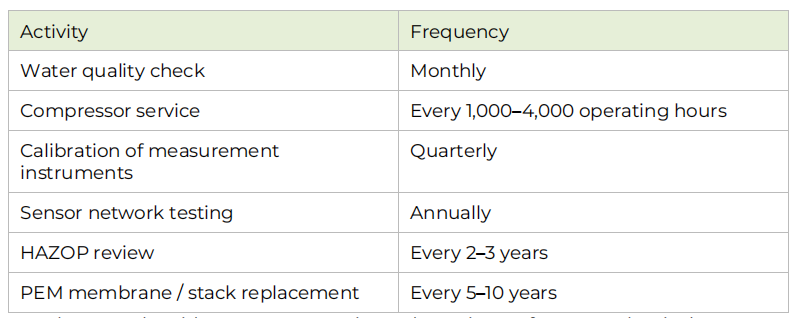
On the people side — one experienced engineer from mechanical or process background plus a rotating shift of operators for continuous oversight. For smaller systems, daily supervision can be remote with periodic on-site visits, but HSE responsibility stays on location regardless of how the monitoring is organized. This is the point where reliability is most often compromised — when HSE is delegated to someone who is formally in charge but practically 300 kilometers away from the plant.
What a PV park owner in Serbia can do today
The first practical step does not cost millions. It costs a few months of serious thinking and a few clear actions. Collect the production data of the park for the previous year, paying particular attention to curtailment and low-price periods. Identify the three nearest potential industrial hydrogen buyers within a 20 to 30 kilometer radius — petrochemicals, refineries, the chemical industry, steelworks under pressure to source low-carbon feedstocks.
Commission a pre-feasibility study from an engineering firm with process industry experience, with a budget between 30,000 and 80,000 euros. If the study shows the project makes economic sense, contact EU grant mechanisms — the European Hydrogen Bank first, then national funds and the Innovation Fund — before a single compressor is ordered. The reason is prosaic: public support requested after equipment has been purchased is often no longer available or no longer applicable.
Solar is infrastructure, hydrogen is the upgrade
A solar park without hydrogen is a producer of electricity. A solar park with hydrogen is a producer of fuel, feedstock and a strategic asset. The technology is already on the market and can be bought any Monday. What cannot be bought is the experience of the right sequence — and that is what separates a profitable plant from an expensive monument to good intentions.