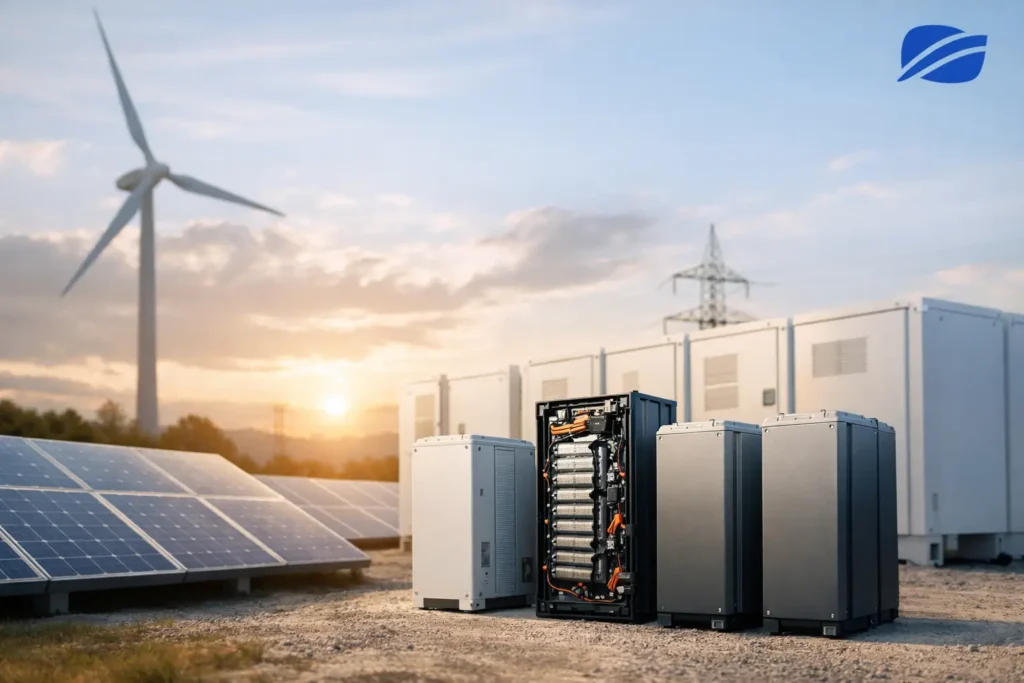
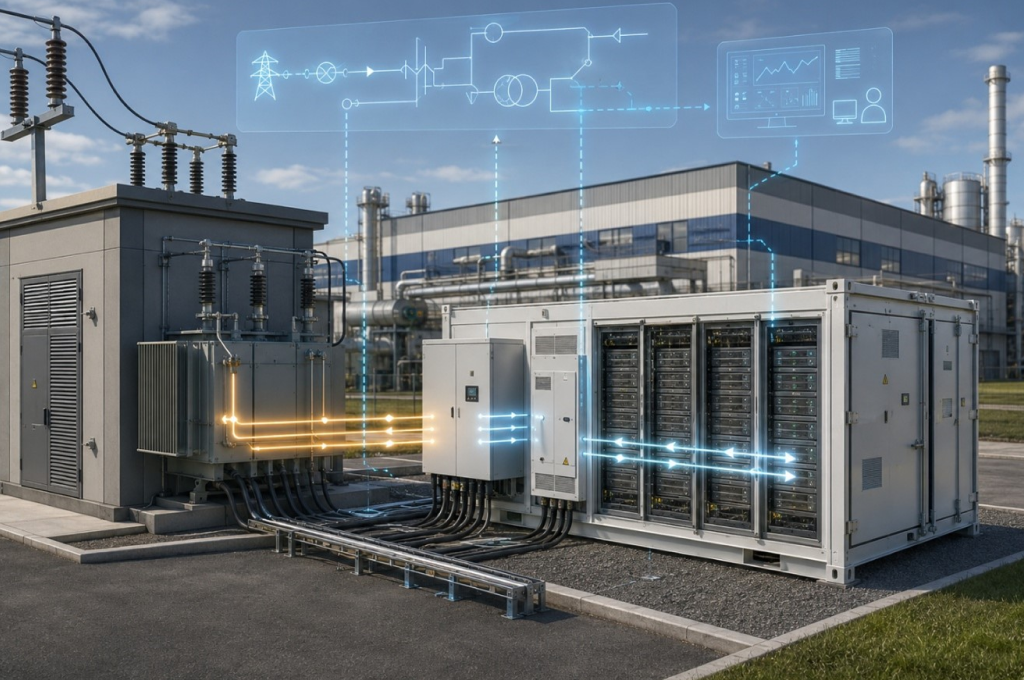
Battery energy storage systems, known by the abbreviation BESS, represent one of the most rapidly developing segments of modern electrical infrastructure and are increasingly becoming an integral part of industrial and commercial installations. Although BESS is often perceived as standalone equipment that can be added at any stage of the development of an energy system, practice demonstrates that optimal results emerge exclusively through the coordinated design of the BESS system together with the transformer substation to which it will be connected. Understanding the architecture, technical requirements and economic mechanisms of the combined BESS and transformer substation solution is becoming essential knowledge for every investor planning a modern energy infrastructure prepared for the challenges of the coming decade.
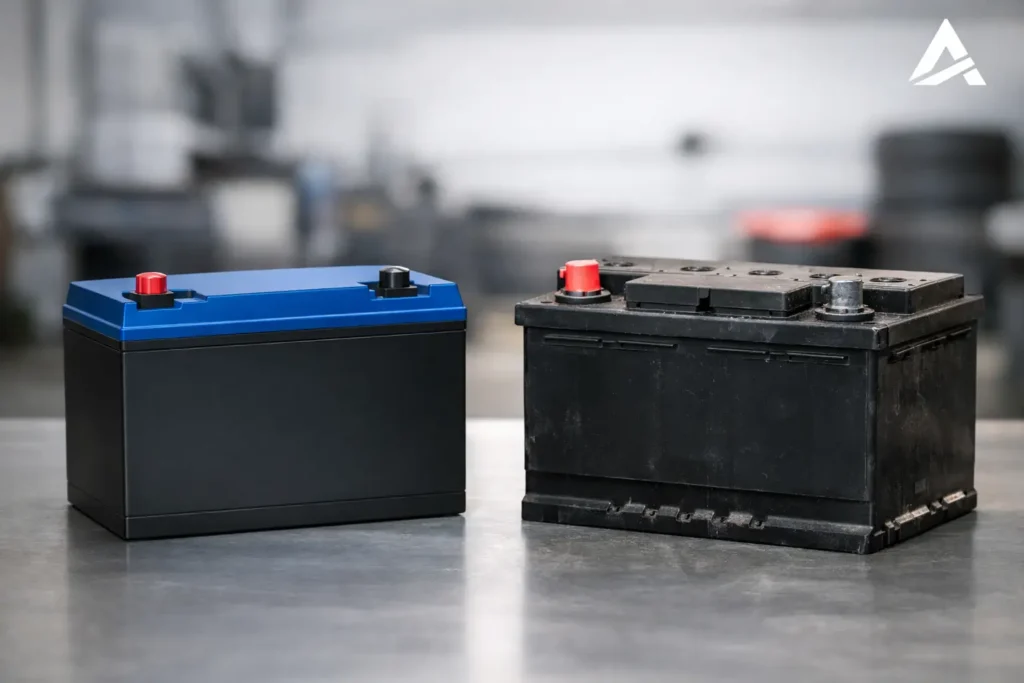
From a technical standpoint, a BESS represents a complex system composed of battery modules, a power conversion system, an energy management system, protective elements and communication infrastructure. The dominant technology in modern industrial BESS systems is lithium iron phosphate, known as LFP chemistry, which offers exceptional thermal stability, a long service life exceeding six thousand operating cycles and a high degree of safety compared with other lithium chemistries. The key parameters of every BESS system are nominal power, expressed in kilowatts or megawatts, and nominal capacity, expressed in kilowatt-hours or megawatt-hours. The ratio between power and capacity directly determines the applications for which the system can be used, since short-duration functions such as peak shaving require high power with relatively low capacity, while long-duration storage of energy from solar power plants requires the opposite ratio.
The architecture of a combined BESS and transformer substation system depends on the size of the installation and the specific application. In smaller commercial installations, BESS is usually connected to the low-voltage side of the transformer substation, which simplifies the system and reduces the cost of converters and protection. Larger industrial systems with a capacity above one megawatt-hour are increasingly connected directly to the medium-voltage side, thereby reducing cable losses and simplifying the management of energy flow. The Power Conversion System, known as PCS, represents the heart of the BESS installation as it performs the conversion between the direct current of the batteries and the alternating current of the system, and must be sized in accordance with the characteristics of the transformer substation and the intended applications. In addition, the entire system must be integrated through an Energy Management System, which makes real-time decisions on charging, discharging and the optimisation of energy flow.
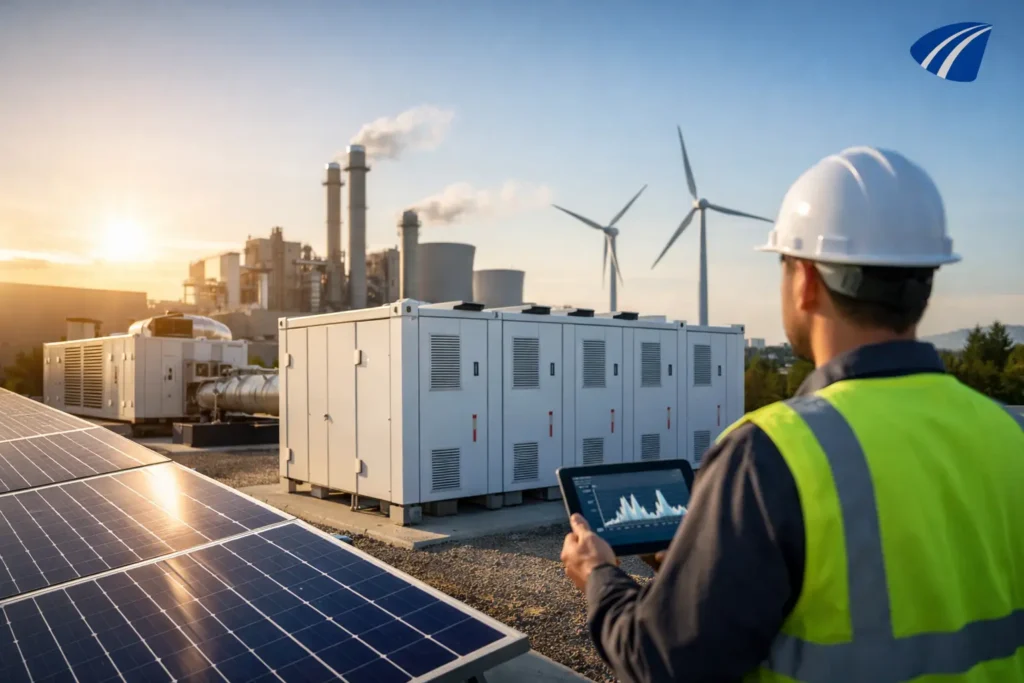
The applications of BESS systems in industrial facilities extend far beyond the basic function of energy storage. The most significant economic application is peak shaving, where the BESS supplies energy at moments of maximum consumption, thereby reducing the metered peak demand and the associated charge in electricity bills. A similar application is load shifting, where energy is stored during periods of low tariffs and used during periods of high tariffs, generating significant savings in tariff structures with differentiated prices. BESS can also serve as an uninterruptible power supply for critical processes, as support for power quality through fast reactive compensation and voltage regulation, and as an integral part of solar power plants operating on the self-consumption principle, where it enables the use of surplus generated energy during evening hours or in cloudy weather.
The integration of a BESS system with a transformer substation imposes a series of specific technical requirements that must be considered at the design stage. The transformer substation must be equipped for bidirectional energy flow, which entails appropriate protection, measuring instruments and control systems that at every moment recognise the direction of energy flow and its associated parameters. The function of island operation represents a particular technical challenge, since in the event of a distribution network outage the BESS may continue supplying the facility in the so-called islanding mode, which requires precise coordination of protection systems and automatic circuit breakers. In addition, the integration of a BESS system into the transformer substation must comply with all relevant standards for the connection of renewable and decentralised sources, particularly with regard to functions such as fault ride-through, reactive support and automatic disconnection in the event of a network fault.
The control system represents the element that separates an average BESS installation from one that genuinely delivers the expected value. A modern Energy Management System uses predictive algorithms based on historical consumption data, solar generation forecasts, tariff structures and the specific characteristics of production processes, enabling real-time decisions on the optimal operation of the BESS system. Communication with the solar inverter, the distribution meter, climate sensors and the control systems of production machinery enables comprehensive optimisation that greatly exceeds the results of simple systems based on fixed rules. The SCADA platform connects the BESS with the central monitoring of the transformer substation and the entire facility infrastructure, while remote access enables the rapid identification of problems, predictive maintenance and analysis of performance throughout the service life of the system.
The proper sizing of a BESS system requires a detailed analysis of the consumption profile and the priorities of the investor. The power of the system, expressed in kilowatts or megawatts, determines how much energy the system can supply at any given moment and is usually sized according to the peak load that is to be reduced or the critical power that must be ensured in backup mode. The capacity of the system, expressed in kilowatt-hours, determines how long the system can supply energy and is sized according to the expected duration of peak demand or according to the quantity of surplus energy expected from the solar power plant. The depth of discharge, the number of expected cycles per year and the projected service life of the system, which for LFP technology typically ranges between eight and fifteen years, directly affect the final sizing and the economic viability of the entire investment.
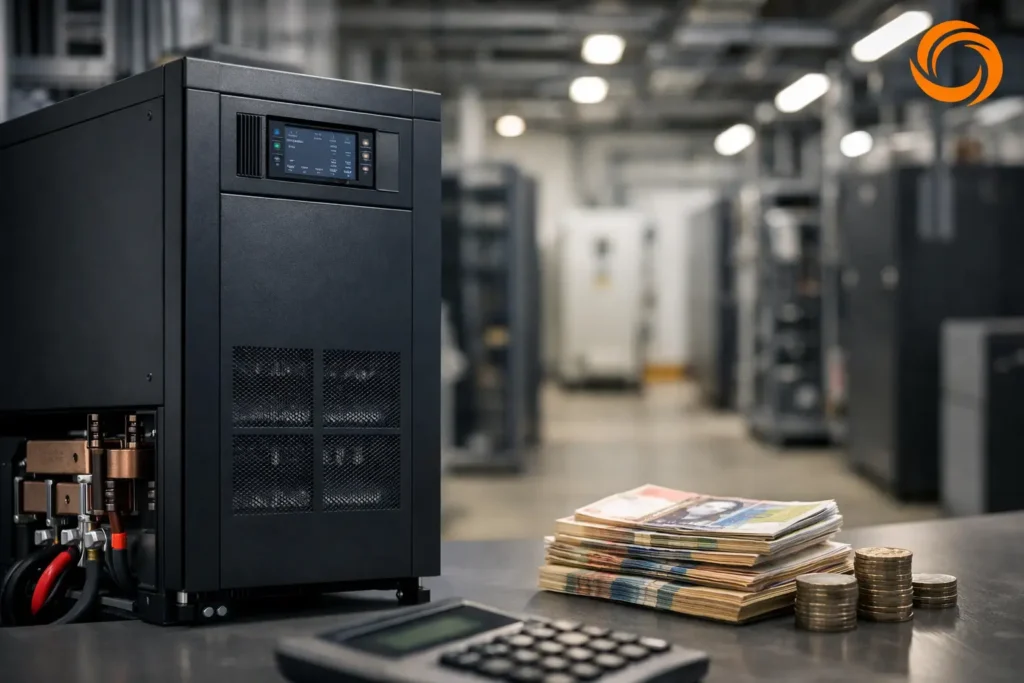
From an economic standpoint, BESS investment in an industrial context generates value through several parallel mechanisms. The reduction of peak power brings direct savings on monthly electricity bills, which for large industrial consumers may amount to several thousand euros per month. Load shifting through tariff arbitrage generates additional savings that accumulate over years of operation. Integration with a solar power plant raises the level of self-consumption from a typical thirty to forty percent to seventy percent and above, which significantly increases the economic value of the solar investment. The typical payback period for an industrial BESS system ranges between six and ten years, although this period may be considerably shorter in facilities with a combination of a solar power plant, high peak loads and differentiated tariff structures.
The combination of a transformer substation and a BESS system does not represent the sum of two independent elements but an integral system in which each component directly influences the performance of the other. A properly designed and synchronised system opens possibilities that individual components cannot provide, ranging from the optimisation of tariff costs to complete energy autonomy in critical processes. Collaboration with an expert team that understands both the characteristics of transformer substations and the specifics of BESS technology is essential for the realisation of a project that delivers the expected economic value over twenty or more years of operation. Investment in such a combined solution represents a strategic shift towards a modern, resilient and economically efficient energy infrastructure that is at the same time prepared for further development through the integration of solar power plants, vehicle charging infrastructure and other technologies that will define the next decade in the sector of distributed energy.