When an industrial facility shuts down for 15 minutes, the loss is not measured solely in undelivered goods. It also includes production downtime, equipment resets, failures of sensitive systems, customer penalties, and the additional cost of restarting operations. This is why industrial batteries for backup power are a matter of operational security, not merely technical equipment installed in an electrical room.
For companies that depend on uninterrupted operations including manufacturing facilities, logistics centers, data centers, telecommunications, the food industry, and critical infrastructure a battery system must be designed according to actual load requirements, the required backup duration, and operating conditions. Selecting the wrong battery chemistry, capacity, or charging regime can later result in a shorter service life, unplanned replacements, and a higher total cost of ownership.
Where Industrial Batteries for Backup Power Make the Greatest Difference
Not all backup power systems serve the same purpose.
In some facilities, batteries only need to bridge the few seconds required for a generator to start. In others, they must provide tens of minutes or several hours of autonomy for critical circuits, server rooms, protection systems, automation equipment, signaling systems, or control centers.
This distinction is fundamental because it determines how the entire system should be sized.
If the objective is only short-term bridging, the focus is on reliable instant response and high availability. If longer autonomy is required, the key considerations become capacity, thermal conditions, depth of discharge, cyclic operation, and integration with UPS systems, rectifiers, BESS solutions, or solar power plants.
In industrial environments, the most expensive mistakes are rarely visible on the day the system is commissioned. They become apparent only during the first serious power disturbance, when the batteries fail to deliver the designed backup duration.
For this reason, backup power design should not begin with a product catalog. It should begin with an analysis of connected loads, load priorities, and potential failure scenarios.
How to Select the Right Battery Type
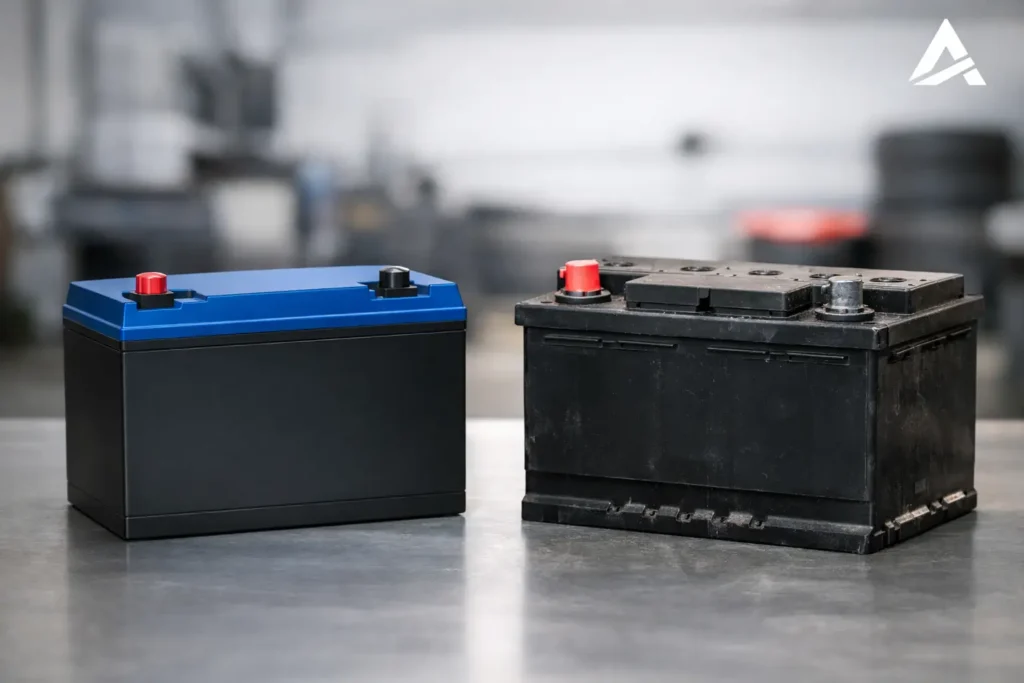
One of the most common questions is whether to choose VRLA, GEL, AGM, or lithium-ion technology.
There is no universally superior option. There is only the technology that best suits the specific facility, operating regime, and investment horizon.
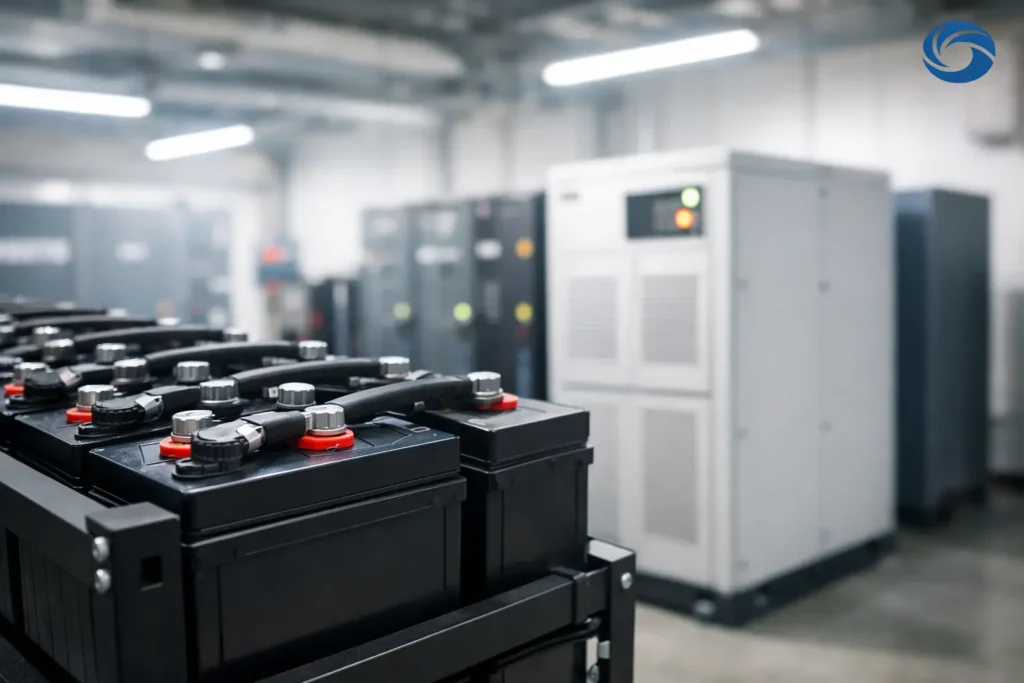
VRLA batteries have long been the standard in UPS and telecommunications applications due to their proven technology, stable performance, and lower initial investment. For facilities with limited budgets and predictable operating conditions, they can be a practical solution.
However, their shorter service life under demanding thermal conditions and the impact of deep discharge cycles on long-term capacity must be taken into account.
Lithium-ion batteries require a higher upfront investment, but they often provide a better total cost of ownership. They offer lower weight, a higher number of cycles, faster charging, and greater usable capacity.
In systems where space is limited, frequent cycling is expected, or batteries are combined with renewable energy sources and peak demand management, lithium-ion technology increasingly offers a clear economic advantage.
However, lithium is not automatically the right solution for every facility.
A high-quality Battery Management System, compatibility with the wider energy infrastructure, properly engineered protection, and competent system integration are all essential. If these elements are neglected, the technological advantages can quickly be lost.
Capacity and Unit Price Are Not the Only Deciding Factors
Purchasing batteries based solely on the lowest price per unit of capacity usually leads to the wrong decision.
Far more important factors include ambient temperature, the expected number of cycles, permitted depth of discharge, design life, charging time, and maintenance requirements.
Two batteries with similar nominal specifications can perform very differently in real operating conditions.
One may operate reliably for years in a controlled environment, while another in the same nominal category may lose capacity much sooner if the system is poorly sized or exposed to elevated temperatures.
System Sizing: Where Mistakes Most Often Occur
The most common mistake is adding together the nominal power of all connected loads without understanding how those loads actually behave.
Not all loads operate simultaneously. Some have high starting currents, some are highly sensitive to voltage dips, and others can be disconnected without any serious operational consequences.
Backup power systems should therefore be designed according to load priorities, not assumptions.
Another common mistake is failing to account for battery autonomy at the end of the system’s service life.
A system that provides the required 30 minutes of backup today may no longer meet the same requirement several years later unless it was designed with sufficient reserve capacity.
A professional design therefore accounts for capacity degradation, operating temperature, and realistic load scenarios.
The third issue is treating the batteries as separate from the rest of the power infrastructure.
Industrial batteries do not operate in isolation. Their performance depends on the quality of the UPS, charger, rectifier, protection systems, ventilation, monitoring, and load management logic.
When several contractors deliver different parts of the system without unified responsibility, the risk of incompatibility rises significantly.
Industrial Backup Batteries and Total Cost of Ownership
In a serious industrial environment, the correct measure is not the purchase price but the total cost of ownership over the system’s entire service life.
This includes procurement, installation, cooling, maintenance, replacement, efficiency losses, downtime, and the consequences of potential failure.
A less expensive battery bank may appear to be a good purchasing decision. However, if it requires more frequent replacement, occupies more space, charges more slowly, or cannot withstand the required operating regime, its total cost may ultimately be higher.
Conversely, a more expensive technology may deliver stronger economics if it extends service life, reduces space requirements, and increases overall system availability.
This is particularly important in sectors where downtime has a direct commercial cost.
In the food industry, the consequence is not only production interruption but also a potential risk to the cold chain.
In a data center, every second of downtime affects service-level agreements and reputation.
In automated manufacturing, the problem is not only the interruption itself, but also the uncontrolled shutdown of critical processes.
Integration with UPS Systems, Generators, and Solar Power
Backup power is increasingly no longer treated as an isolated protective system.
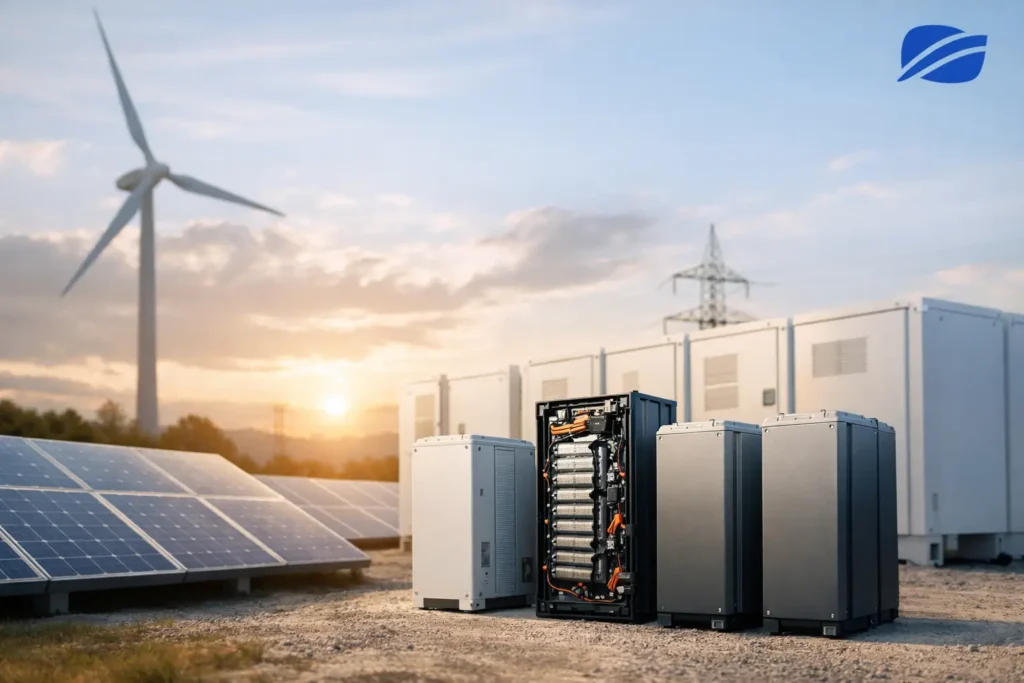
Instead, it is becoming part of a wider energy architecture in which UPS systems, diesel generators, battery storage, solar power plants, and energy management systems operate together.
This integration changes the role of the batteries.
They are no longer only a passive reserve for grid outages. They can become an active resource that stabilizes loads, reduces short-duration demand peaks, and improves the use of self-generated electricity.
However, caution is required. Not every backup power system is automatically suitable for cyclic operation or advanced Energy Management System strategies.
A professional approach therefore requires several questions to be answered during the planning stage:
- Will the batteries be used exclusively for backup, or also for energy optimization?
- Will the generator start automatically, and after how many seconds?
- Is future expansion with a solar power plant or BESS planned?
- How will the system be controlled under normal and emergency operating conditions?
The answers directly affect the choice of battery technology and control strategy.
Companies that plan several years ahead usually make better investment decisions than those that focus only on the immediate problem of power outages.
This is where the difference between purchasing equipment and engineering an energy system becomes clear.
Maintenance and Monitoring Are Essential for Reliability
Industrial batteries may appear to be a stable and silent part of the infrastructure, but their reliability should never be assumed.
Without regular monitoring of cell condition, temperature, state of charge, internal resistance, and operating patterns, problems are often discovered only when it is too late.
Preventive maintenance extends system life and reduces the risk of unexpected failure.
More importantly, it provides a basis for scheduling replacements before capacity falls below a safe operating threshold.
In practice, this means fewer emergency interventions and more accurate budget planning.
In larger systems, battery monitoring should be integrated into the facility’s wider infrastructure management platform.
When management has a clear overview of power system condition and performance, it can make better decisions regarding priorities, modernization, and capital allocation.
This is why backup power is increasingly viewed as part of overall business resilience rather than merely electrical equipment.
What Management Should Expect from a Project Partner
When selecting industrial batteries for backup power, do not look only for a product.
Look for a partner capable of assessing the load profile, identifying critical consumers, aligning the solution with the existing infrastructure, and assuming responsibility for the final result.
This should include a feasibility study, system design, equipment supply, commissioning, and a long-term maintenance plan.
There are many battery suppliers on the market, but far fewer companies capable of delivering a complete energy solution.
When backup power is designed together with UPS systems, generators, energy storage, and potentially a solar power plant, the result is greater reliability, fewer interface risks, and a clearer investment case.
This is the approach Energize applies when delivering projects for clients for whom power interruption is not an option.
The best decision is not necessarily the most expensive or the least expensive one.
It is the solution that ensures operational continuity, predictable costs, and an energy system capable of supporting the future growth of your business and its evolving energy requirements.