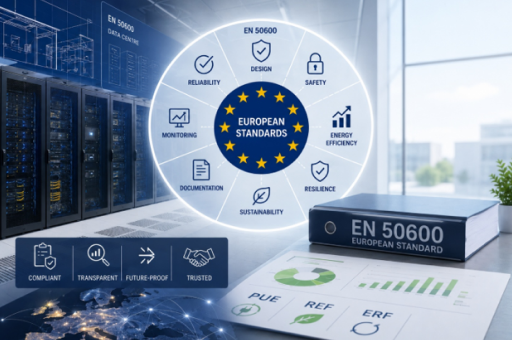
When data centers come up in conversation in Serbia, the Uptime Institute Tier classification is almost always the first reference. That is understandable. Tier I through Tier IV has been the de facto language of the industry for decades, short and easy for any investor to grasp. But in Western and Central Europe, a more demanding framework runs in parallel, one that has long stopped being optional in tender documentation: EN 50600.
EN 50600 is the European standard that prescribes how a data center is designed, built and operated across its full lifecycle. The Tier system addresses the entry-level question of availability and redundancy. EN 50600 goes considerably further. It covers physical security, telecommunications infrastructure, cooling, power, lifecycle management, energy efficiency and reporting. In other words, it is not an assessment of an existing facility, but a methodology that guides a project from an empty plot to an operational data center.
For an investor planning a project in Serbia, this matters for one reason. If the facility is meant to host EU clients, enter EU tenders, or be offered to EU operators on longer-term contracts, EN 50600 becomes a central document. Without references to that standard, serious clients usually will not continue the conversation.
What EN 50600 actually prescribes
The standard is organized in several modules. EN 50600-1 provides the basic principles and classifications. The second part, EN 50600-2-X, addresses individual systems — building construction, power distribution, environmental control, telecommunications infrastructure and physical security. The third part deals with operational processes and management. The fourth part covers key performance indicators, including energy metrics.
For anyone choosing a UPS system, the most relevant section is EN 50600-2-2, which addresses power distribution. It defines four availability classes, from Class 1 to Class 4. Class 1 corresponds to basic infrastructure without redundancy. Class 4 requires fully duplicated power paths together with the ability to maintain the system without interrupting operations. The difference compared to the Tier framework is that EN 50600 demands documented methodology for design, testing and operational validation, not just architecture on paper.
In practical terms, Class 4 under EN 50600 is not obtained simply by purchasing a 2N UPS system. It must be demonstrated through project documentation, FAT and SAT testing, operational procedures and a maintenance program.
One section of the standard that tends to be overlooked in Serbia is EN 50600-4, which defines the KPI metrics. It covers PUE (Power Usage Effectiveness), REF (Renewable Energy Factor), ERF (Energy Reuse Factor) and several other indicators. Why does that matter? Because the EU regulator is gradually introducing mandatory energy reporting for data centers, and EN 50600 is the technical foundation of that reporting.
A data center built today without considering EN 50600-4 may, within a few years, find itself in a position to measure retroactively, report and in some cases modify infrastructure to meet regulatory requirements. The cost of those modifications on an already operational facility regularly far exceeds the cost of doing it right at the design stage.
Investment in equipment that already supports those metrics becomes a strategic decision rather than a technical one.
What the standard means for choosing a UPS
Class 1 calls for basic protection: a single UPS and a single distribution path. Class 2 requires redundant components, which corresponds to N+1 architecture. Class 3 requires the ability to maintain the system without interrupting IT operations, which in practice means two independent paths, dual-corded equipment and concurrent maintainability. Class 4 allows no single point of failure and requires the ability to withstand any single fault while maintaining full functionality, which leads to 2N or 2(N+1) architecture.
UPS modularity becomes a practical advantage precisely in the EN 50600 context. The standard demands documented capability for maintenance without shutdown. With a modular architecture, that means hot-swap modules without interrupting power. A system that does not support this simply cannot claim Class 3 or Class 4, regardless of its nominal capacity.
What the investor gains by designing to the standard
The difference between a project that follows EN 50600 and one that relies on a Tier reference alone shows up in three areas. First, the documentation is more complete, which substantially reduces the effort when the facility is sold, refinanced or offered to an EU client under concession. Second, operational processes are defined in advance, which lowers training, service and management costs in the first years of operation. Third, energy KPIs are measured from day one, which makes it easier to qualify for EU incentive programs and to report to clients with ESG requirements.
For a design firm and a system integrator, EN 50600 is not a bureaucratic burden. It is a framework that draws a clear line between serious projects and those handled “somewhere along the way.” In tender processes in Germany, the Netherlands, Austria and Scandinavia, referencing EN 50600 classes is already standard practice. In Serbia it is not yet mandatory, but any investor planning to offer a data center to the EU market must factor in that requirement.