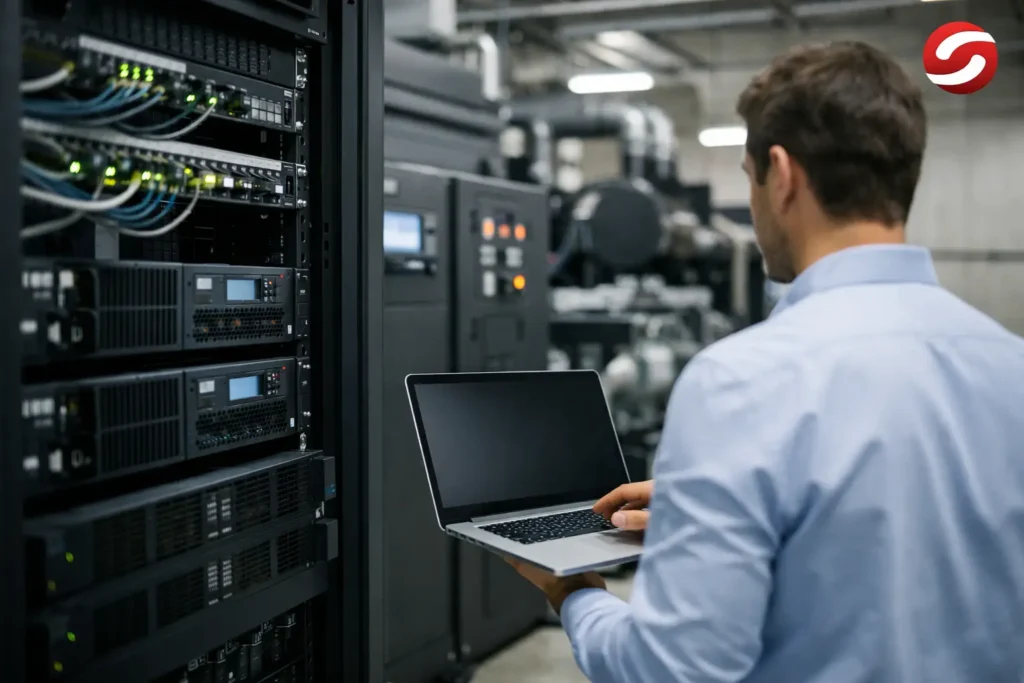
In a data center, HVAC is not a comfort issue. It is a continuity issue. Servers, networking equipment, UPS systems, and supporting infrastructure need stable conditions, without sudden changes in temperature, humidity, or airflow. When cooling is not properly designed, the consequences are not limited to higher energy bills. They can include overheating, equipment stress, and interruption of digital services.
Data centers now consume around 415 TWh of electricity per year, or approximately 1.5% of global electricity consumption, with demand growing by around 12% annually. Cooling and environmental control can represent about 7% of total electricity use in highly efficient facilities and more than 30% in less efficient enterprise data centers. This makes HVAC one of the key energy and operational systems in a data center, not a supporting installation.
Stable temperature is the basis of reliability
IT equipment does not simply require a low temperature. It requires predictable conditions. Excessive cooling increases consumption, while insufficient or poorly distributed cooling increases the risk of local overheating. The recommended inlet air temperature range for most IT equipment is 18°C to 27°C, with defined humidity and dew point limits. The goal is not to keep the data center as cold as possible, but to maintain controlled conditions in which equipment can operate reliably.
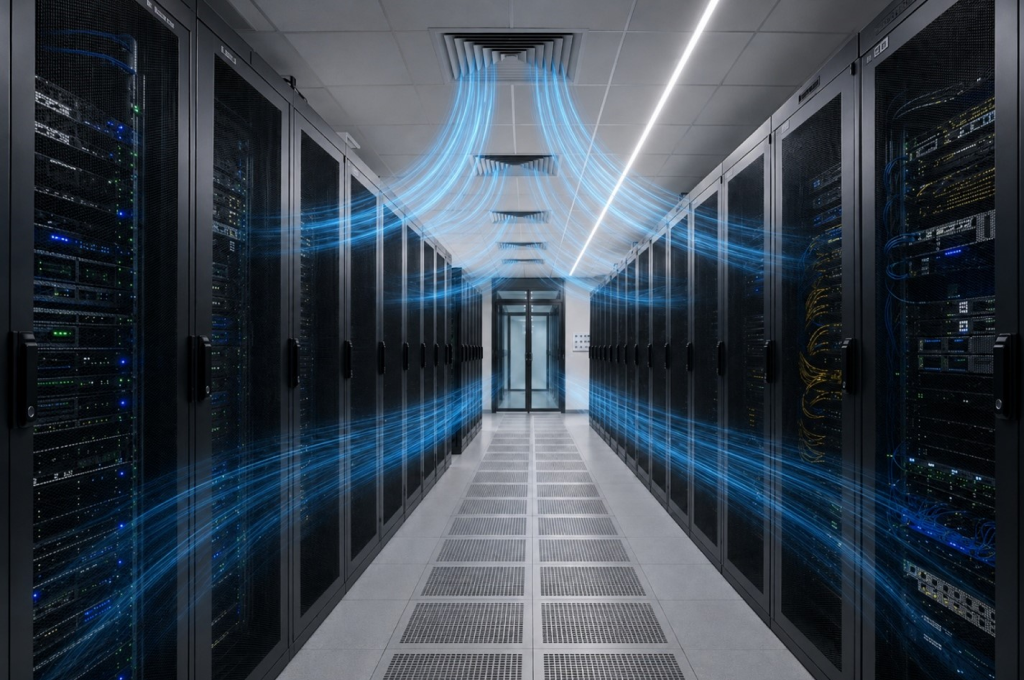
In practice, major problems appear when the room is treated as one uniform space. A server room rarely has equal loads everywhere. One rack row may have higher heat output, another lower, while AI or HPC zones may require a different approach from standard IT loads. Air distribution, hot and cold zone control, and precise temperature monitoring therefore matter as much as cooling capacity itself.
Cooling must follow load density
Data centers are changing. In the past, average rack loads were lower and were easier to manage with conventional air cooling. Today, with the growth of AI, HPC, and high-performance applications, equipment density is increasing. When heat load per rack rises, a standard approach is often no longer enough.
In these conditions, HVAC needs to be scalable. This does not mean every data center immediately needs the most advanced or most expensive solution. It means the system must be able to follow future loads. If capacity, airflow distribution, and redundancy are planned only for the current situation, the facility can quickly become a limitation for future requirements.
At higher densities, more precise zoning, optimized airflow, hot- or cold-aisle containment, advanced monitoring, and, in specific cases, liquid cooling play a larger role. The key point is that cooling should not be planned separately from IT load, but as part of the same development strategy.
Continuity depends on the whole system
In a data center, HVAC does not operate in isolation. Its reliability depends on power supply, UPS systems, automation, sensors, spare capacity, and the service strategy. Major data center outages are still most often linked to power, which accounts for around 45% of reported impactful incidents. This does not mean cooling is the main cause of outages, but it shows how connected the systems are: if power, cooling, and control do not work together, risk increases.
That is why data centers are assessed not only through efficiency, but through resilience. Spare capacity, redundant components, alarms, monitoring, and preventive maintenance are not additional luxuries. They are part of the basic logic of the facility. A data center may have a good PUE, but if the system cannot respond reliably to failure, load changes, or operating shifts, efficiency alone is not enough.
Energy efficiency must be carefully managed
The industry’s average annual PUE has remained around 1.54 in recent years, which shows that many simple efficiency gains have already been captured, while further optimization requires more precise control, better infrastructure, and careful planning.
Efficiency in a data center does not mean aggressively reducing cooling. That can compromise equipment stability. Real optimization means using energy where it is needed, avoiding overcooling, reducing the mixing of hot and cold air, and operating the system according to real load.
A well-adjusted HVAC system can reduce unnecessary consumption, but only if thermal stability and continuity of operation are preserved. In a data center, savings should never be evaluated separately from risk.
What a good HVAC choice needs to provide
Good HVAC for a data center must provide stable temperature, controlled humidity, proper airflow distribution, monitoring of critical zones, and the ability to scale. It needs to be aligned with load density, IT equipment type, operating mode, and the facility’s development plans.
The most common mistakes include selecting cooling capacity without analyzing real IT load, weak airflow control, insufficient redundancy, neglecting future growth, and treating HVAC separately from power and monitoring. In a data center, these mistakes can be expensive because their impact is not limited to comfort. They can affect service availability.
HVAC in a data center should therefore be treated as part of critical infrastructure. When properly planned, it does not only cool the space around servers. It protects the stability of digital services, reduces energy pressure, and supports the continuity of a facility that needs to operate without interruption.