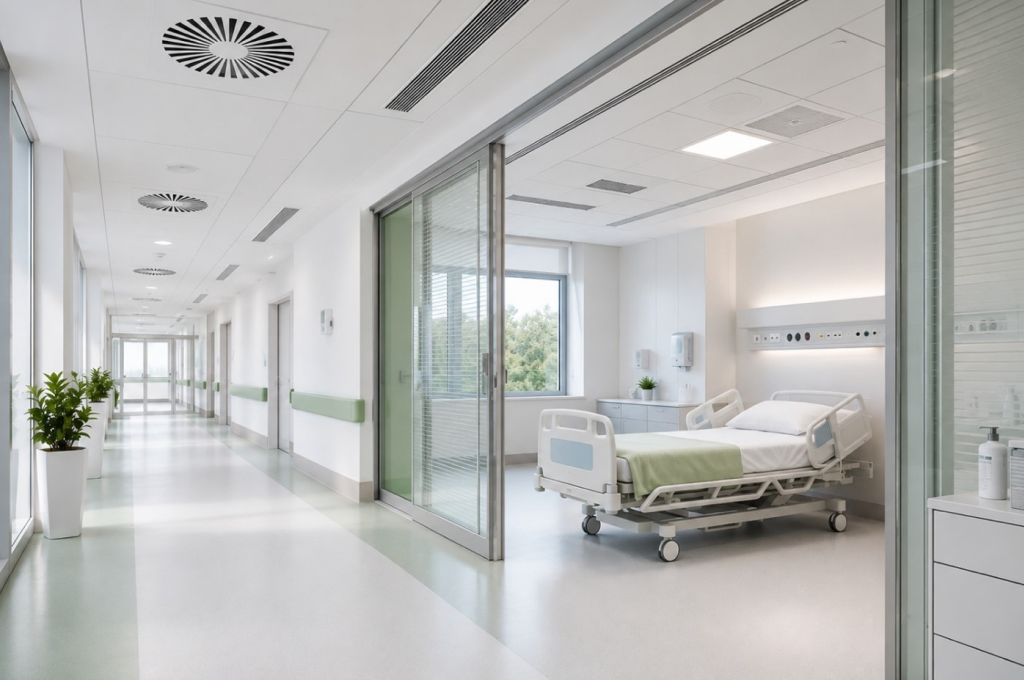
In hospitals and healthcare facilities, HVAC does not have the same role as in standard commercial buildings. It is not only about temperature and comfort, but about hygiene, air control, operational stability, and the safety of patients, staff, and visitors. In healthcare, HVAC supports filtration, ventilation, humidity control, pressure relationships between rooms, and the removal of contaminated air.
Healthcare buildings are energy-intensive because they operate for long hours, often continuously, and include many zones with different operating requirements. Some analyses show that healthcare buildings represent around 4% of commercial floorspace, but use around 9% of commercial-building energy. This shows why HVAC in healthcare is at the same time a hygiene, technical, and energy issue.
A hospital is not one uniform space
The main difference between a hospital and a standard building is the number of functional zones. An operating room, patient room, intensive care unit, waiting area, laboratory, examination room, sterilization area, pharmacy, and administration cannot operate under the same indoor conditions.
In one zone, patient comfort is the priority. In another, infection control matters most. In a third, the main requirement is preventing air from carrying contaminants from one space into another. That is why hospital HVAC must be designed according to the function of each room, not only according to its size.
Pressure relationships between rooms play a particularly important role. In some areas, air needs to move from cleaner zones toward less clean zones. In others, the goal is to keep potentially contaminated air contained within the space. These relationships are not visible to the eye, but they are critical for risk control.
Hygiene depends on ventilation and filtration
In healthcare buildings, hygiene does not depend only on surface cleaning. Air is an important part of overall control. HVAC filters, dilutes, and removes contaminants, while in specific zones it helps prevent their spread.
In spaces with special ventilation requirements, air changes, filtration, and pressure differences need to be monitored. In certain situations, high-capacity HEPA filtration units are used to support the removal of respirable particles, and in some cases they are recommended to provide the equivalent of at least 12 air changes per hour.
Filtration must be correctly installed and maintained. If a filter is not properly fitted, part of the air can bypass it, reducing system protection. That is why filter maintenance, airflow measurement, and air balancing in healthcare buildings are not treated as routine tasks, but as part of hygiene safety.
Temperature and humidity must remain stable
Patients, medical staff, and equipment require stable indoor conditions. Excessive temperature, high humidity, or uneven airflow can reduce comfort, make work harder for staff, and increase the risk of indoor-environment problems. In certain healthcare zones, temperature, humidity, ventilation, and pressure are controlled together because all of them affect how the space functions.
Humidity is especially important. Too much moisture can contribute to condensation and microbial growth, while overly dry air can be uncomfortable for patients and staff. That is why hospital HVAC needs to provide stable conditions, not only occasional heating or cooling.
In healthcare, energy efficiency must never compromise environmental control. Reducing ventilation without a clear assessment can undermine the function of a space. Real optimization means the system operates rationally, but within the requirements for hygiene, filtration, and safety.
Reliability is part of the healthcare function
A hospital cannot operate as a building where HVAC is checked only after a failure occurs. The system needs to be monitored, serviced, and tested. Faulty sensors, dirty filters, weak airflow, or incorrect pressure relationships between rooms can compromise conditions long before users notice an obvious problem.
In healthcare buildings, monitoring, preventive maintenance, and clear procedures have particular value. The system should allow the facilities team to track filters, pressure, temperature, humidity, and the operation of critical zones. In spaces with special requirements, it is necessary to periodically verify that the system is actually operating as designed.
Reliable HVAC in healthcare does not only reduce repair costs. It reduces operational risk and helps medical processes remain stable.
Energy efficiency without compromising hygiene
Healthcare facilities consume significant energy because they operate for long hours and have strict air requirements. Still, this does not mean consumption has to be uncontrolled. Certified energy-efficient hospitals can use around 35% less energy on average than typical buildings of the same type, showing that hygiene and efficiency can be aligned when the system is well planned.
The greatest potential lies in better controls, proper maintenance, ventilation optimization by zone, heat recovery where allowed, and energy monitoring. However, every optimization in healthcare must begin with the function of the space. An operating room, isolation room, waiting area, and administrative zone cannot follow the same operating mode.
HVAC in hospitals and healthcare buildings should be seen as part of the hygiene and safety system, not only as a technical installation. When ventilation, filtration, pressure relationships, temperature, and maintenance are properly aligned, the building becomes safer for patients, more stable for staff, and more rational for long-term operation.