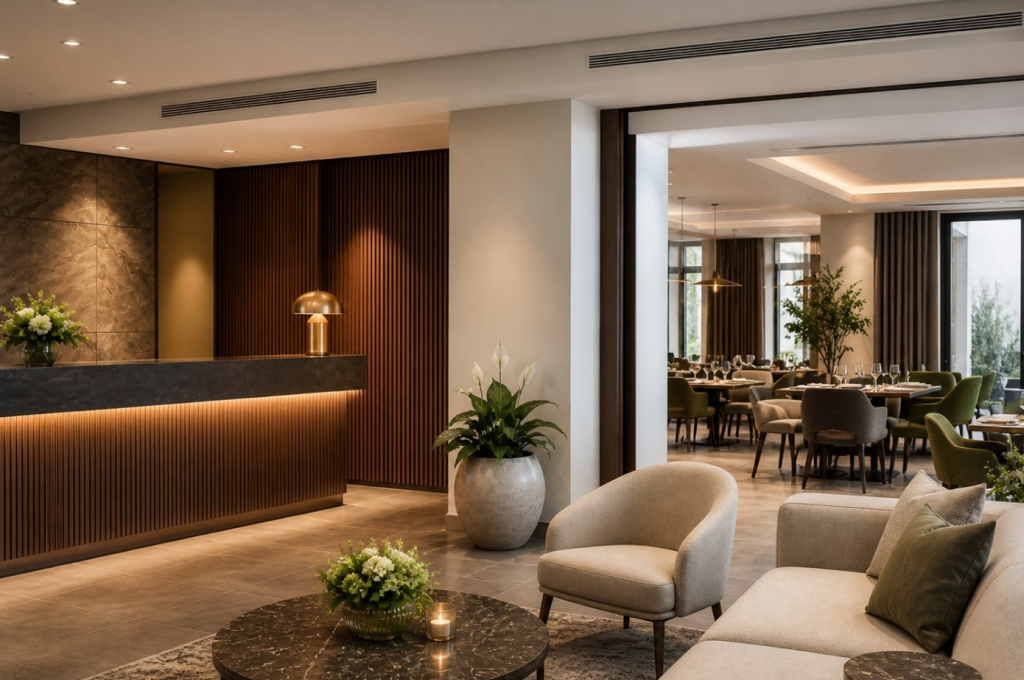
In hotels, restaurants, and hospitality venues, HVAC directly affects the guest experience. Temperature, odors, air freshness, noise, and the overall feel of the space become part of the impression. A guest may not analyze the installations, but they will notice a stuffy room, an overheated restaurant, or a space where kitchen odors spread where they should not.
That is why HVAC in hospitality is not only about heating and cooling. It protects comfort, atmosphere, reputation, and the operational stability of the property.
Hotels require quiet and flexible control
A hotel room needs to provide a sense of private comfort. Guests have different habits and expectations, so individual temperature control matters. One room may be empty, another occupied, a third exposed to sun, and a fourth in cleaning mode. If everything is managed with the same logic, more energy is used and stable comfort is harder to maintain.
For hotels, quiet operation, reliability, simple controls, and central monitoring are especially important. The system must give the guest control, while also giving property management insight into consumption and operating mode. In buildings that operate 24/7, every inefficiency becomes a constant cost.
Air quality further affects the guest’s stay. A room may be well designed, but if the air is stale or humidity is present, the overall impression quickly declines.
Restaurants have a completely different problem
A restaurant is not only a dining area. It includes a kitchen, dining room, bar, often a terrace, storage areas, and a changing number of guests. The biggest challenge is balancing guest comfort in the dining area with intense conditions in the kitchen.
Kitchen ventilation needs to effectively remove heat, steam, grease, and odors. If it is not well designed, odors move into the dining area, temperature rises, and staff work in harder conditions. On the other hand, ventilation that is too strong or poorly balanced can create drafts, noise, and unnecessary energy losses.
In the dining area, HVAC should be almost unnoticeable. Guests do not want cold air blowing directly above the table, ventilation noise, or sudden temperature changes. Good air distribution often makes the difference between a space where guests stay comfortably and one that feels unpleasant.
Energy cost is a constant item
Hotels and restaurants operate for long hours, often every day. HVAC is therefore not an occasional consumer, but a constant part of operating costs. Good temperature management can reduce annual heating and cooling costs by up to 10%, while zoning and smart controls provide additional value in buildings with changing occupancy.
In hotels, the greatest savings are often achieved when rooms do not operate in the same mode while empty, and when common areas are managed separately. In restaurants, the key is coordinating kitchen ventilation, dining-area conditioning, and the daily rhythm of service.
Reliability is part of the service
An HVAC failure in hospitality is not only a technical problem. In a hotel, it can mean poor guest experience and a negative review. In a restaurant, it can affect guest comfort, staff performance, and service quality. That is why a service plan and fast maintenance are just as important as equipment selection.
A good hospitality HVAC solution connects comfort, atmosphere, odors, noise, energy consumption, and reliability. In a hotel, it must support a calm stay and individual guest needs. In a restaurant, it must separate the reality of the kitchen from the experience in the dining room. When that difference is handled well, the system is not noticed, but its effect is felt through a more pleasant stay, more stable operations, and better cost control.