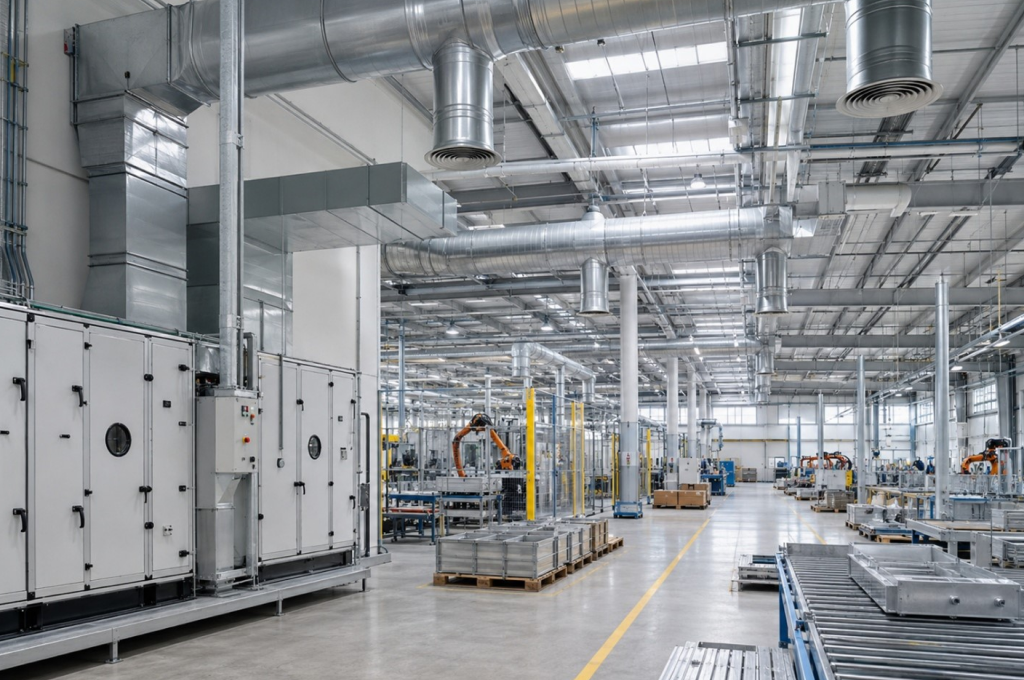
HVAC in industrial halls does not have the same role as in residential or standard commercial buildings. In manufacturing, it is not only about providing a pleasant temperature for employees, but about maintaining stable conditions for machinery, product quality, worker safety, and process continuity.
An industrial hall is a demanding environment. Large areas, high ceilings, open doors, heat-generating machinery, dust, humidity, fumes, and different working zones make HVAC much more complex than in an office or apartment. That is why the system cannot be selected only by floor area. The process, equipment layout, number of employees, operating schedule, and required production conditions are more important.
In manufacturing buildings, HVAC is part of operational stability. When it is poorly selected, the consequences appear through high energy consumption, uneven temperature, poor air quality, employee discomfort, and a higher risk of downtime.
An industrial hall is not one single zone
One of the most common mistakes in industrial buildings is treating the entire hall as one zone. In practice, a production facility rarely has the same conditions in all areas. A machinery zone has one type of load, an assembly area another, storage a third, while offices or control rooms have completely different requirements.
In halls with high ceilings, heat distribution is especially important. Warm air naturally rises, so energy can easily be lost in the upper parts of the space while the working zone remains insufficiently heated. In large buildings, this can lead to significantly higher consumption without a real improvement in comfort.
That is why industrial HVAC is planned by zones. The goal is not to treat the whole hall equally, but to provide the required conditions where work takes place, where people are present, and where processes are sensitive to temperature, humidity, or air quality.
Ventilation is often more important than temperature
In industrial environments, ventilation often plays a greater role than heating or cooling. Production processes can generate dust, smoke, odors, humidity, fumes, or excess heat. If these elements are not removed properly, the space becomes uncomfortable, unsafe, or unsuitable for consistent production quality.
In some facilities, the priority is removing heat from machinery. In others, humidity control is important because of materials, packaging, or finished goods. In the food, pharmaceutical, chemical, or electronics industries, air quality can have a direct impact on production standards and process control.
Poor ventilation does not only mean lower comfort. It can increase the risk of condensation, contamination, corrosion, odor spread, and health-related issues for employees. That is why industrial HVAC must be designed around the process, not only around perceived temperature.
Energy cost can be significant
Industrial buildings often operate in long shifts, sometimes 24/7. HVAC then becomes a constant operating cost. If the system is not properly sized or if it operates without zoning, energy is used even where there is no real need.
In large halls, the difference between an average and a well-designed solution quickly becomes visible through energy consumption. Proper settings, zoning, air destratification, heat recovery, and automatic control can significantly reduce unnecessary losses. In buildings with high ceilings, better management of warm-air movement alone can bring visible savings during the heating season.
Industrial HVAC should therefore not be treated only as a cost that has to be accepted. It is also an area for optimization. When properly designed, it can reduce consumption, relieve equipment load, and extend system lifespan.
Employee comfort affects productivity and safety
In production facilities, working conditions directly affect people. Excessive heat, poor ventilation, humidity, dust, or unpleasant air reduce concentration and increase fatigue. In physically demanding work, thermal comfort is not a luxury, but an important factor for safety and shift stability.
The working zone should be the priority. It is not always necessary to condition the entire hall in the same way, but it is important to provide stable conditions where people actually work. Local ventilation, targeted cooling, heating of work zones, and proper air distribution often deliver better results than trying to treat the whole space equally.
Good industrial HVAC reduces employee complaints, makes work in demanding conditions easier, and contributes to a more stable workflow. This is especially important in facilities operating in shifts, involving physical effort, or exposed to fast changes in conditions due to the production process.
Different industries require different approaches
HVAC for a metalworking hall, food production facility, pharmaceutical plant, printing facility, textile factory, or electronics assembly site cannot follow the same logic. Each industry has its own relationship with temperature, humidity, particles, odors, process heat, and hygiene requirements.
In the food industry, hygiene, humidity control, and stable temperature conditions are often important. In pharmaceutical and electronics production, filtration, particle control, and more precise indoor conditions play a larger role. In metalworking, the focus may be on heat removal, ventilation, and equipment durability. In combined warehouse-production facilities, additional challenges include gates, loading areas, and large temperature variations.
That is why industrial HVAC starts with process analysis. Only after that does it make sense to choose equipment type, capacity, controls, and maintenance strategy.
System reliability is part of production continuity
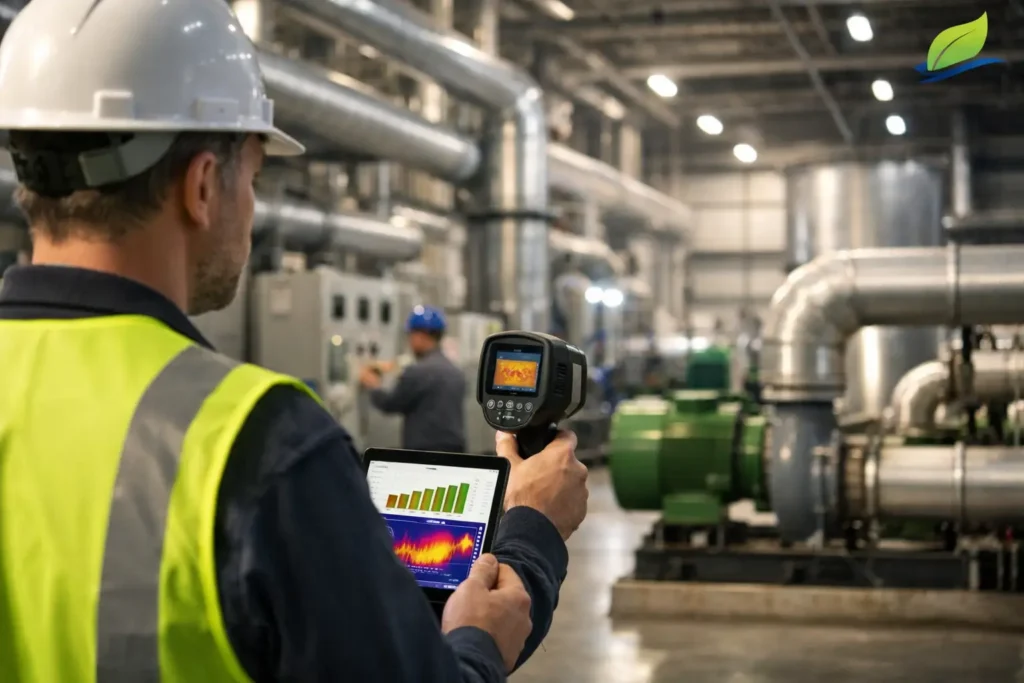
An HVAC failure in industry can be much more serious than a temporary drop in comfort. In some facilities, it can affect product quality, machine operation, delivery deadlines, or employee safety. That is why servicing, monitoring, and preventive maintenance play a major role.
A regularly maintained system consumes less energy, operates more reliably, and is easier to control. Dirty filters, poor airflow, faulty sensors, or unbalanced ventilation can increase consumption and reduce performance long before a serious failure occurs.
Industrial HVAC should be designed as part of the facility’s infrastructure. When it is aligned with the process, working zones, and production schedule, it supports lower costs, more stable conditions, and a lower risk of interruption. In industry, a good HVAC solution is not just a technical installation, but support for production that needs to run reliably day after day.