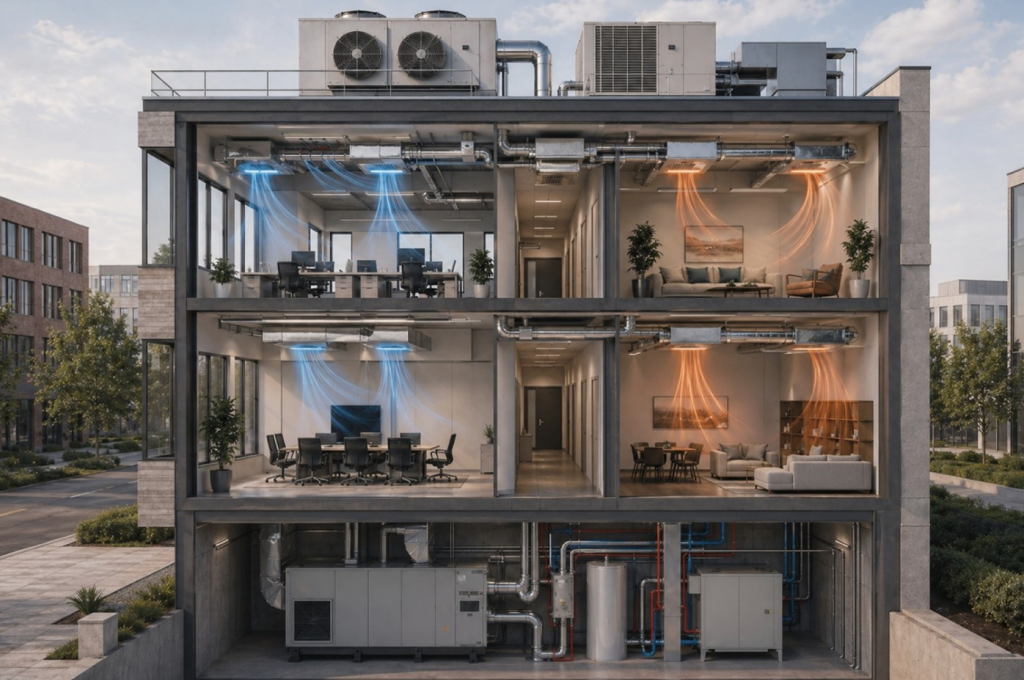
HVAC stands for Heating, Ventilation and Air Conditioning. In practice, this term covers much more than an air conditioner or a heating source. HVAC refers to a set of solutions that manage temperature, fresh air, humidity, and the overall quality of indoor space.
Its basic role is to make a space comfortable, stable, and healthier to occupy. It provides heating in winter, cooling in summer, and ventilation and air control throughout the year. That is why HVAC is increasingly seen as one of the key elements of a functional building, especially in buildings where people spend a lot of time or where indoor conditions affect work, equipment, goods, or user experience.
Modern buildings are better insulated than before, which reduces energy losses but also reduces natural air exchange. People spend around 90% of their time indoors, while concentrations of some pollutants can be 2 to 5 times higher indoors than outdoors. That is why quality HVAC is not only about comfort, but also about a healthier and more stable indoor environment.
Three functions that need to work together
HVAC is most often viewed through three core functions: heating, ventilation, and cooling. Heating provides the required temperature during colder periods. Cooling keeps the space comfortable in summer or in buildings with high internal heat loads. Ventilation brings in fresh air, removes used air, and helps control humidity, odors, and pollutants.
When these functions are well aligned, the space is easier and more predictable to use. Temperature is more even, the air feels better, and equipment does not need to operate constantly under heavy load. When they are treated separately, problems often appear: one room is too warm, another too cold, the air is stale, energy use increases, and users constantly adjust devices manually.
That is why HVAC is not only the selection of equipment. It is the way the entire space is thermally and aerodynamically organized.
Why HVAC affects building quality
A well-designed HVAC solution directly affects everyday building use. In an apartment or house, this is most visible through comfort, fresh air, humidity, and energy bills. In offices, it affects concentration, productivity, and how employees feel during the day. In hotels and restaurants, it affects the guest experience. In industry, logistics, data centers, or healthcare facilities, it can also be important for equipment, processes, goods, or continuity of operation.
That is why HVAC is not selected only by floor area. Area matters, but it is not enough. The choice also depends on the building’s purpose, number of people, room layout, insulation, sun exposure, ceiling height, operating schedule, and expected comfort level.
An 80 m² apartment, an office of the same size, and a small restaurant do not require the same approach. In an apartment, quiet operation, simple control, and rational energy use are important. In an office, the number of people, meeting rooms, and air quality throughout the working day matter. In a restaurant, odors, kitchen ventilation, and changing guest numbers become additional factors. The same area can require a completely different HVAC solution.
Temperature is not enough for a good indoor space
A space can have the right temperature and still not feel pleasant. If there is not enough fresh air, if humidity is too high or too low, if air is poorly distributed, or if the system is noisy, the user experience is weaker.
Ventilation is especially important in modern buildings. Good insulation reduces energy losses, but the space then depends more on controlled air exchange. Without it, stuffiness, excess humidity, condensation, unpleasant odors, and lower air quality can appear more easily.
That is why quality HVAC needs to provide more than heating and cooling. It should maintain stable temperature, proper ventilation, acceptable humidity, and a pleasant indoor feeling throughout the day.
Efficiency depends on the whole solution
HVAC energy efficiency does not depend only on the device’s energy class. Proper sizing, equipment position, insulation quality, room layout, control strategy, and regular maintenance all matter.
An oversized system can operate in short cycles, use more energy, and control humidity less effectively. An undersized system can run constantly under load, reach desired conditions more slowly, and have a shorter lifespan. A system without good control can heat or cool a space even when there is no real need for it.
Good settings and smart control can bring significant savings. Proper thermostat use alone can reduce annual heating and cooling costs by up to 10%, while more advanced control in commercial buildings further helps ensure energy is used only where it is needed.
HVAC as part of everyday comfort
The best HVAC solutions are not the ones users notice the most, but the ones that work steadily in the background. The user does not think about temperature, does not constantly open windows because of stuffiness, does not adjust the unit every hour, and does not feel major differences between rooms.
That is where the value of a well-planned system becomes clear. It does not only solve the immediate problem of heating or cooling; it shapes how the space is used for years. In residential buildings, this means more pleasant living and more rational costs. In commercial buildings, it means better working conditions and fewer user complaints. In technically demanding facilities, it means greater stability and safer operation.
HVAC is therefore one of the basic elements of indoor-space quality. When properly selected, it connects comfort, healthier air, efficient energy use, and the long-term functionality of the building.