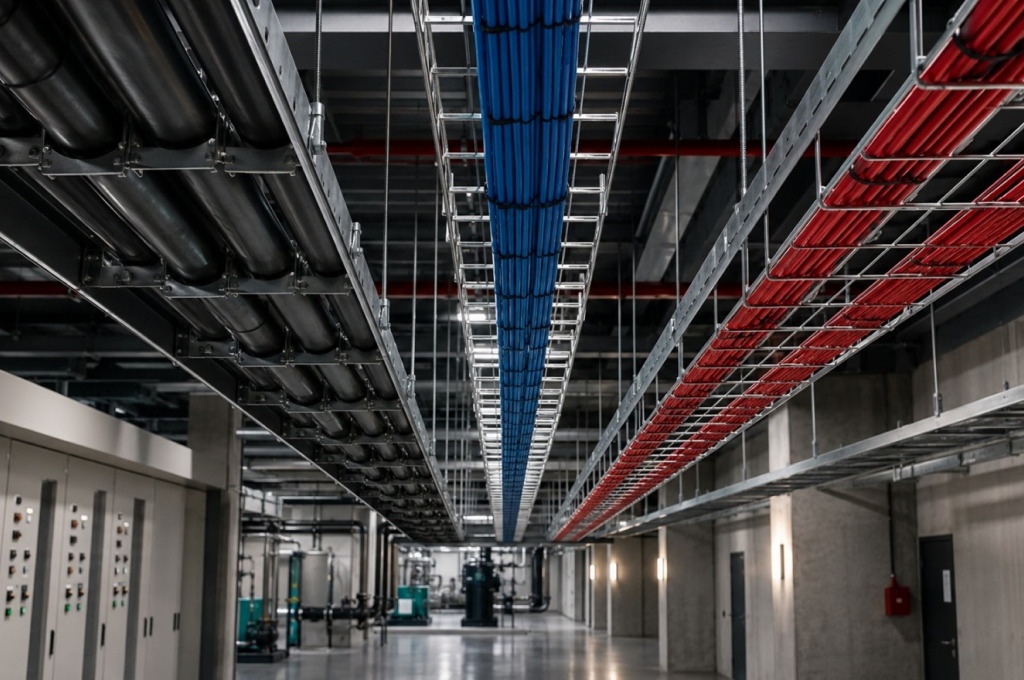
A glance above the suspended ceiling of a modern office building or inside the switchgear cabinet of an industrial facility reveals hundreds of metres of various cables that to the untrained eye appear as a chaotic tangle of plastic and copper. In reality, these cables perform completely different functions within the overall infrastructure of the facility, and it is precisely the understanding, proper sizing and mutual separation of these systems that represent one of the most significant factors in the reliability, safety and operational efficiency of the modern electrical and information system. Mistakes in this segment, which frequently arise from insufficient understanding of the mutual influences of different types of cable systems, can result in data loss, false alarms, faults in sensitive equipment and, in extreme cases, fires and serious safety incidents.
From a functional standpoint, the cable infrastructure of every modern industrial or commercial facility is divided into three clearly defined groups that simultaneously function as the bloodstream, nervous system and reflex mechanisms of the entire technical organism. Power cables transmit the electrical energy required for the operation of all loads within the facility, from lighting and climate control units to industrial motors and complex production lines. Telecommunications cables transmit data between computers, servers, telephone systems and devices that enable the company to communicate with the outside world. Signal and command cables transmit control and measurement signals within automation systems, enabling machines, sensors and controllers to exchange the information necessary for the coordinated operation of the entire facility.
Power cables represent the fundamental component of every electrical installation and are designed for the transmission of energy with the smallest possible losses and the highest level of safety. The voltage levels at which they operate range from 230V for single-phase systems to 400V for three-phase installations, while industrial facilities often use significantly higher voltage levels for powering large loads. The key engineering parameter that determines the choice of a power cable is the cross-section of the conductor, expressed in square millimetres, which must be properly sized in accordance with the power of the load, the length of the run and the anticipated loading. An improperly sized power cable results in excessive voltage drop at the end of the line, overheating of the conductor, premature ageing of the insulation and, in critical cases, serious safety risks. For this reason, power cables have robust insulation, most often of polyvinyl chloride or cross-linked polyethylene, which simultaneously provides resistance to heat, mechanical damage and chemical influences.
Telecommunications cables have an entirely different role, since they transmit information rather than power. They operate at extremely low voltages but at very high frequencies, which demands a completely different engineering approach to their design and installation. Copper telecommunications cables, known under the designations UTP and FTP, consist of twisted pairs that simultaneously reduce electromagnetic interference and enable high data transmission speeds. Optical fibres represent the most advanced category of telecommunications cables, as they transmit information through light pulses and are completely immune to any electrical interference from the surroundings. For this reason, optical fibres represent the standard for the backbone of every serious information and communications infrastructure, as well as for connections between distributed elements within Smart Grid architecture systems.
Signal and command cables represent the third category that is often confused with telecommunications cables, although their role has clearly defined differences. The function of signal cables is the transmission of control, measurement and command signals within automation systems, which includes communication between sensors, programmable logic controllers, climate and ventilation systems, frequency converters and industrial machines. They operate at low direct-current voltages, most often 12V or 24V, and transmit either analogue signals of the standard 4mA to 20mA, or digital signals up to 9V. Although they carry small currents and simple electrical impulses, signal cables are extremely sensitive to electromagnetic interference from the surroundings, which makes them the most vulnerable type of cable infrastructure in industrial facilities. For this reason, almost all modern signal cables feature a copper braid that functions as a Faraday cage and protects the internal conductors from external electromagnetic influences.
The most important physical phenomenon that determines the rules of cable route design in modern facilities is electromagnetic interference, known by the abbreviation EMI. The electrical current that flows through a power cable creates around itself an alternating magnetic field that extends through the surrounding space and has the ability to induce voltages in every conductor located within its reach. When a signal or telecommunications cable is installed in the immediate proximity of a power cable, the magnetic field created by the power cable induces so-called parasitic or false voltages in the neighbouring conductors, which depending on intensity can completely disrupt the operation of sensitive equipment. This phenomenon is particularly pronounced in industrial facilities with large motors and frequency converters, where the currents flowing through the power cables reach values that generate extremely strong magnetic fields in their surroundings.
From the physical foundations of electromagnetic interference arises the basic rule of cable route design that every serious project must observe. Power cables must never be installed in the same cable tray as signal or telecommunications cables without a physical barrier that provides adequate protection from electromagnetic influence. Standard engineering practice requires a minimum distance between power and signal routes, which depends on the magnitude of the current in the power cables and the sensitivity of the signal systems, and in critical applications can amount to several hundred millimetres. Where routes must cross, regulations require that the crossing be performed at an angle of ninety degrees, in order to minimise the length of parallel routing and, consequently, the intensity of the electromagnetic influence between the systems.
The consequences of ignoring the rules on the separation of cable systems in practice manifest through a series of problems that often remain mysterious until the true cause is established. Computer networks slow down and lose data packets, which for modern companies means direct losses in productivity and reliability of communication. Sensors in industrial facilities send false readings to programmable logic controllers, which results in incorrect decisions by automatic systems, unplanned stoppages of production lines and, in critical cases, the causing of damage to equipment and products. Industrial climate and ventilation systems lose precision in maintaining set parameters, which directly affects the quality of the production process in facilities with strict requirements regarding temperature and humidity. In extreme cases, a strong electromagnetic surge from a power cable can completely disable sensitive control electronics, which generates costly component replacements and prolonged downtime in system operation.
The stability and reliability of every modern industrial and commercial facility directly depend on the proper design and execution of the cable infrastructure, which must simultaneously meet the requirements for reliable power supply, rapid data transmission and precise control of automated processes. The correct understanding of the functional differences between power, telecommunications and signal cables, adherence to the rules on mutual separation of routes and precise sizing of every type of cable in accordance with the specific requirements of the system, represent the fundamental principles of every serious project. Collaboration with an expert team that understands both the technical specifics of all types of cable systems, and their mutual influences in real-world operating conditions, is essential for the design of infrastructure that, over twenty or more years of operation, supports all the functions of modern business and industrial operations without problems. Investment in properly designed cable infrastructure is not an item that can be reduced to a minimum, but the foundation on which the reliability of the entire technological system of a modern facility is built.