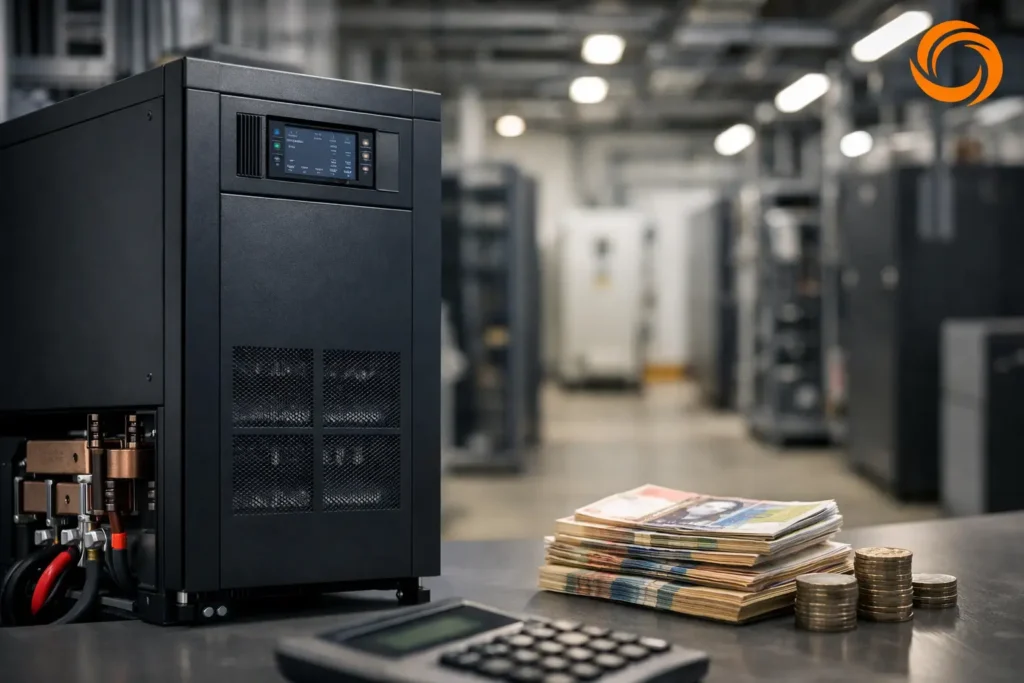
The monthly electricity bill in every industrial and commercial company contains items that appear to be standard operational costs, but within their structure there is often a significant element that most companies pay without a clear understanding of its origin and, more importantly, the possibility of its elimination. This is the charge for excessive reactive energy drawn from the distribution network, which in the case of non-optimised industrial consumers can amount to between ten and thirty percent of the total invoice, while this energy performs no useful work in the facility. Understanding the physical nature of reactive energy, the way it is generated in modern industrial facilities and the technical solutions for its compensation represents one of the fastest and most reliable paths to reducing operational costs across the entire operation of a modern company.
From a technical standpoint, the electrical energy delivered to industrial consumers consists of two components that simultaneously flow through the system but perform completely different functions. Active energy, expressed in kilowatts, represents the energy that performs useful work, turning motors, powering computers, generating light and heat, and it is the reason for which the power supply system exists in the first place. Reactive energy, expressed in kilovolt-amperes reactive or kVAr, does not perform useful work but is essential for creating electromagnetic fields in inductive loads such as motors, transformers, frequency converters, fluorescent lighting and industrial automation. The total energy that the network must deliver, expressed in kilovolt-amperes or kVA, represents the vector sum of the active and reactive components, and it is on the basis of this value that cables, breakers and transformers are sized, as well as a portion of the electricity bill calculated.
Reactive energy represents a problem not only for the individual consumer but also for the entire distribution system. The circulation of the reactive component between the distribution network and the consumer unnecessarily loads cables, transformers and switchgear, which increases ohmic losses in the system, intensifies the heating of insulation and shortens the service life of equipment. In addition, the loading of the system with the reactive component reduces the available capacity for the transmission of useful active energy, which forces distributors to build more robust infrastructure than would be necessary for the same useful consumption. For these reasons, distribution companies increasingly apply strict tariff regimes that penalise industrial consumers with significant reactive energy consumption, thereby creating direct economic pressure on companies to implement compensation systems.
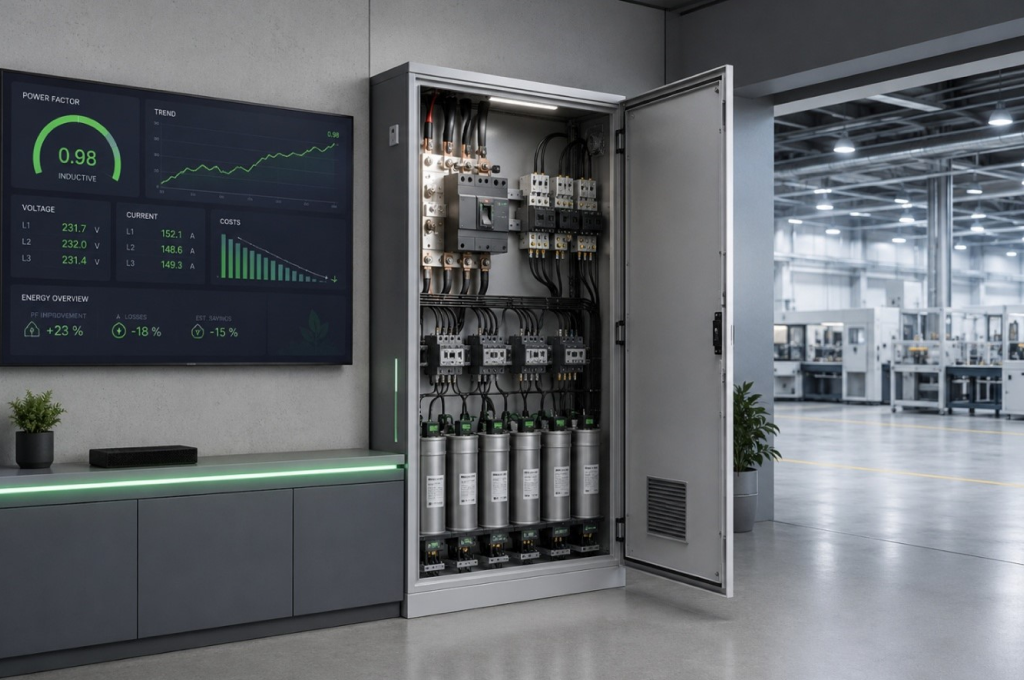
Penalties for excessive reactive energy consumption represent a standard item in the industrial tariffs of most European distributors, including operators in Serbia, Bosnia and Herzegovina, Croatia and the surrounding region. The magnitude of the penalty depends on the specific tariff structure, but in unfavourable cases it can reach thirty percent of the total monthly invoice, which for industrial facilities with significant consumption means several thousand euros of additional costs per month. This charge is calculated according to the power factor, which represents the ratio of active to apparent power and is expressed as a value between zero and one. A power factor value below the common threshold of zero point ninety-five triggers reactive energy charges, while industrial consumers with older or non-optimised installations often have a power factor in the range of 0,70 to 0,85 which directly corresponds to high monthly charges.
The technical solution for eliminating reactive energy from the distribution network is provided by capacitor banks, which are installed in switchgear cabinets or in dedicated installations within the facility. The principle of capacitor bank operation is based on the fact that capacitors and inductive loads generate reactive energy of opposite character, which means that in a system with a properly sized capacitor bank the reactive component is contained within a local loop between the load and the capacitor, without circulating through the distribution network. From the standpoint of the distributor, a facility with compensated reactive energy represents a pure consumer of active energy, which completely eliminates the basis for charging the reactive component. From the standpoint of the investor, this solution delivers visible savings on the monthly electricity invoice practically immediately.
Systems for reactive energy compensation today come in several different configurations, tailored to the specific characteristics of the loads and the load profile of the facility. Static capacitor banks with fixed capacity represent the simplest solution, suitable for facilities with stable and predictable reactive energy consumption. Automatic compensation banks, equipped with a power factor controller, dynamically switch individual capacitor groups on and off in accordance with current consumption, thereby ensuring an optimal power factor across all operating regimes. The most advanced solutions, known as active harmonic filters, simultaneously compensate reactive energy and filter harmonic distortion, which is particularly significant in modern facilities with a high proportion of frequency converters and other non-linear loads.
Beyond the direct economic benefit through the elimination of penalties on the electricity bill, reactive energy compensation also brings a range of technical advantages that positively affect the overall reliability of the facility’s electrical system. The reduction of reactive component circulation through cables and transformers reduces the thermal loading of equipment, thereby extending its service life and reducing the probability of faults. Voltage stabilisation within the facility, which is a consequence of the reduced overall loading of the distribution installation, positively affects the operation of sensitive equipment, reduces wear on motors and extends the life of machines with electronic control. In addition, the freeing of capacity within the existing installation enables the connection of additional loads without the need for costly upgrades to cables, the transformer substation or the distribution connection.
From the standpoint of economic viability, reactive energy compensation represents one of the fastest investments in the field of energy efficiency. The typical payback period for investment in a compensation bank for a medium-sized industrial facility ranges between six and twelve months, which is an unusually short time frame in the field of energy projects. The investment value of compensation systems ranges from several thousand to several tens of thousands of euros, depending on the size of the facility and the type of solution, while monthly savings in industrial facilities with poor power factors regularly exceed amounts from several hundred to several thousand euros. In addition to the rapid return of the initial investment, compensation systems also provide continuous long-term savings that accumulate throughout the entire service life of the equipment.
Reactive energy represents one of the few segments of operational costs in which precise engineering analysis and properly selected technical solutions deliver measurable financial results almost immediately. The compensation of the reactive component is no longer a matter of choice or an additional convenience, but a standard component of modern industrial electrical infrastructure that is expected in every serious facility. Collaboration with an expert team that understands both the technical specifics of the loads in the facility and the specific tariff structures of the distributor represents the key to designing a compensation system that fully realises its economic potential. Investment in properly sized reactive energy compensation returns within twelve months and then continues to deliver continuous savings throughout the entire service life of the installation, which represents a classic engineering decision that simultaneously delivers financial, technical and operational value.