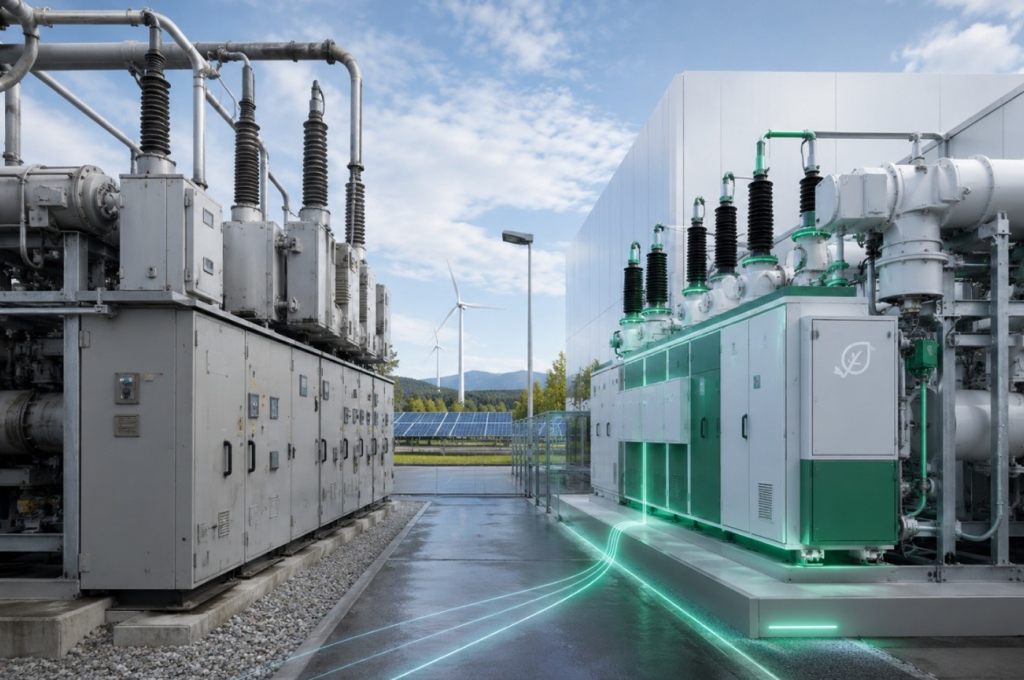
Sulphur hexafluoride, or SF6, has for decades represented the standard insulating and switching medium in medium-voltage equipment. Its exceptional ability to extinguish electrical arcs, high dielectric capacity and chemical stability have enabled the design of extremely compact and reliable switchgear, which over the past fifty years has become an industrial standard worldwide. However, contemporary environmental realities and increasingly stringent European Union regulations are placing this gas under significant pressure, initiating a transition that will substantially reshape the entire medium-voltage equipment sector over the next decade. Understanding this process, its technical implications and the available alternatives is becoming essential information for every investor planning to build or refurbish energy infrastructure in the coming years.
From an environmental perspective, SF6 represents one of the most problematic synthetic gases ever introduced into industrial use. Its global warming potential is approximately twenty-three thousand five hundred times greater than that of carbon dioxide, meaning that every kilogram of SF6 that reaches the atmosphere is equivalent to the emission of more than twenty tonnes of carbon dioxide. An additional problem is its pronounced atmospheric stability, as SF6 molecules in the atmosphere persist for more than three thousand years, rendering the gas practically non-degradable across any relevant time horizon. Although equipment containing SF6 is hermetically sealed, annual leakage under realistic operating conditions ranges between zero point one and one percent of volume, which at the level of the entire medium-voltage industry generates a significant cumulative contribution to climate change.
In March two thousand and twenty-four, the European Union adopted a new regulation on fluorinated gases, known as F-Gas Regulation 2024/573, which establishes a clear and ambitious path towards the gradual phase-out of SF6 use in the medium-voltage sector. The regulation provides for the prohibition of new equipment up to twenty-four kilovolts in cases where an environmentally acceptable alternative exists, with the scope of the ban expanding in subsequent years to higher voltage levels. By two thousand and thirty-two, practically all new equipment in the medium-voltage distribution sector will have to be designed without SF6, while existing equipment may continue to be operated until the end of its service life, subject to strict emission control and mandatory reporting. These legal frameworks are not subject to debate but represent a defined timeline to which manufacturers, distributors and investors throughout the European Union must adapt.
The most mature environmental alternative to SF6 in the medium-voltage sector is vacuum technology, which has been used for decades in circuit breakers within the voltage range of six to thirty-six kilovolts. Vacuum circuit breakers exploit the fact that an electric arc in a vacuum extinguishes very rapidly, as there is no medium through which it can be sustained. This technology is reliable, has an exceptionally long service life that often exceeds twenty thousand operating cycles, does not require periodic gas refilling and practically leaves no environmental footprint during operation. The main drawback of vacuum technology is the somewhat larger equipment size and a more complex manufacturing process, but in modern variants these challenges have largely been overcome and the dimensional difference has been reduced to a minimum.
With regulatory developments, alternative solutions based on dry air and mixtures of natural gases have also emerged. These systems use purified and dried air, optionally enriched with carbon dioxide, as the insulating medium. The global warming potential of such mixtures is reduced to a value below one, which makes them environmentally neutral compared with SF6. Major manufacturers, including ABB, Siemens, Schneider Electric and several specialised European firms, already offer commercial solutions with dry air in medium-voltage switchgear up to thirty-six kilovolts. The price of such systems is currently higher than that of classic SF6 variants, but this difference is being continuously reduced as production volumes and the number of installed units increase.
A particular category of alternative solutions consists of synthetic gases developed specifically with the aim of replacing SF6, the most significant of which is the C4-fluoronitrile molecule combined with carbon dioxide. This mixture, known under commercial names such as AirPlus and similar, has dielectric characteristics very close to SF6 but with a global warming potential approximately twelve times lower. Although their global warming potential is not yet negligible, they represent a significant improvement and enable the production of compact equipment with substantially reduced environmental impact. This technology is currently most widely used in circuit breakers and switchgear of higher voltage classes, where the requirements for equipment compactness are particularly significant.
The transition to environmentally acceptable solutions brings with it a number of technical challenges that will need to be addressed in the coming period. SF6-free equipment requires partially different approaches to design, installation and maintenance, which entails the obligation to train the technical personnel of companies engaged in the construction and servicing of medium-voltage installations. The compatibility of new equipment with existing installations requires careful analysis, particularly in refurbishment projects where new solutions must be integrated into systems that have operated for years with classic SF6 equipment. In addition, the dimensions of environmental variants remain on average ten to twenty percent larger than their SF6 equivalents, which in projects with spatial constraints requires earlier planning and more precise coordination with the architectural solutions of the facility.
From an economic standpoint, the transition to environmental alternatives carries several different dimensions of costs and benefits. The initial purchase price of the new generation of equipment is currently typically ten to twenty percent higher than that of classic SF6 variants, but this difference is being continuously reduced as production volumes grow. On the other hand, operational costs are significantly lower, since environmental equipment does not require periodic gas inspection and refilling, nor specialised procedures during disassembly and disposal at the end of the service life. Beyond direct costs, the regulatory risk associated with investment in SF6 equipment is becoming increasingly significant, as in the coming years this technology will transition from the status of an industrial standard to that of legacy equipment, with potential restrictions on maintenance, repair and resale.
The transition of the medium-voltage industry towards environmentally acceptable solutions represents one of the most significant technological shifts in this sector in the past several decades. It is not solely a regulatory obligation but a strategic direction that changes the way energy infrastructure is designed, manufactured and maintained. Investors who in the coming period plan to build or modernise transformer substations and switchgear must anticipate this trend and select equipment that will comply with regulation throughout the entire service life of the installation, which often exceeds twenty-five years. Collaboration with partners that follow European standards, understand the regulatory dynamics and possess experience in working with the latest generations of environmental solutions becomes a strategic advantage, both for reducing regulatory risk and for positioning the company in the context of ESG reporting and the broader green transition.