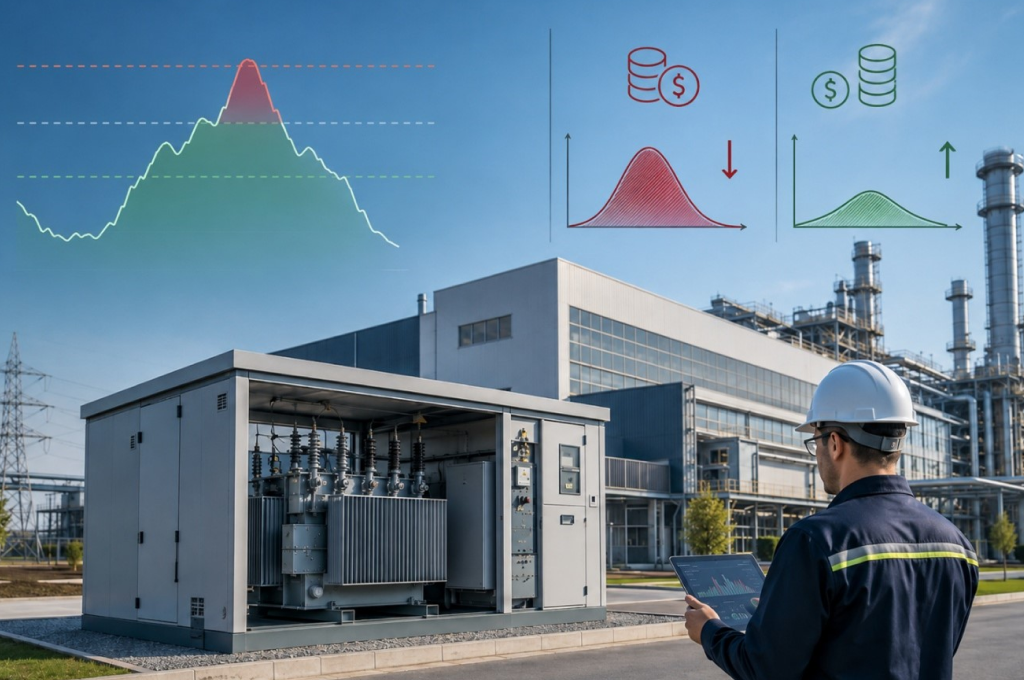
A transformer substation represents one of the most significant capital and operational elements of any industrial facility. Its nominal capacity, type of transformer and switchgear configuration directly determine not only the initial investment costs but also all operational expenses related to powering production processes over twenty or more years of operation. Errors in sizing, particularly when they are discovered only after the facility has been commissioned, can generate additional costs that often exceed the entire value of the original investment. For this reason, sizing a transformer substation for industrial use is not solely a technical task but a strategic business decision that requires a thorough analysis of the company’s current and future requirements.
The sizing process itself involves far more than the mere calculation of the transformer’s nominal capacity. It entails a comprehensive analysis of the load schedule, load profile, planned production expansions, integration of renewable energy sources and specific technical requirements of every individual process. In addition, sizing includes the selection of the transformer type, the definition of the medium-voltage switchgear configuration, the design of the low-voltage distribution panels and an assessment of the required capacity for backup power. The end result of a well-executed process is a transformer substation that, at every moment, delivers the appropriate power with minimal losses, optimal efficiency and sufficient capacity for growth without the need for costly equipment replacement.
The starting point of every sizing exercise is a detailed analysis of all loads that will be connected to the transformer substation. The list includes drive motors, frequency converters, compressors, ventilation systems, lighting, office equipment and other technical units. For each load, the rated power, power factor, simultaneity coefficient and starting characteristics are defined. One of the most common mistakes in sizing is the simple summation of the rated powers of all loads, which almost invariably produces an exaggerated picture of the actual demand. In industrial processes, the simultaneity coefficient rarely exceeds seventy percent, and in certain sectors it may fall below fifty, which means that the actual peak load amounts to only a fraction of the sum of the rated powers of all connected consumers.
The load profile represents an equally significant parameter as the peak power itself. Industrial facilities rarely exhibit uniform consumption throughout the day or week, which directly influences the choice of transformer type and its nominal characteristics. Processes with continuous production, such as chemical plants, foundries and cold-storage facilities, require a transformer substation with excellent thermal stability and the capacity for prolonged operation close to nominal loading. On the other hand, processes with pronounced variations in load, such as machining shops, press lines or induction furnaces, demand a transformer substation that tolerates frequent start-up cycles and short-term overloads without losing its operating characteristics or experiencing premature ageing of the windings.
Proper sizing also requires an understanding of the starting characteristics of large loads. Induction motors with capacities above one hundred kilowatts, when started directly, can draw currents that exceed their nominal value by up to seven times, which causes voltage dips throughout the entire system and adversely affects sensitive electronics, frequency converters and information and communication equipment. Similarly, induction furnaces and arc machines generate pronounced reactive components and harmonic distortion, which must be neutralised through appropriate compensation and filtration systems. A transformer substation that is not prepared for these specific demands quickly becomes a source of problems rather than a reliable power supply, which significantly increases operational costs and reduces the availability of production capacity.
A particularly important aspect of modern sizing is the consideration of the company’s future requirements. A transformer substation designed exclusively for current consumption often proves inadequate within five to seven years, which entails costly replacement or additional reconstruction work. A strategic approach involves the analysis of the company’s development plans, the anticipated expansion of production capacities, the planned integration of solar power plants on the facility, the possible installation of energy storage systems and the increasingly common need for electric vehicle charging infrastructure. A transformer substation with a reserve capacity of twenty to thirty percent above current consumption almost always represents an economically justified choice, particularly when one considers that subsequent expansion is many times more expensive than the initial installation of additional capacity.
The integration of renewable energy sources places additional demands on the sizing of a transformer substation. Solar power plants designed for self-consumption require a transformer substation capable of bidirectional energy flow and able to manage changes in the direction of energy flows efficiently at every moment. This aspect becomes critical in facilities operating on the principle of self-consumption with zero feed-in to the grid, where the precise matching of generation and consumption at the substation level directly determines the economic viability of the entire solar system. Furthermore, energy storage systems and fast-charging infrastructure for electric vehicles demand specific equipment characteristics that must be anticipated at the sizing stage, since subsequent adjustments involve serious interventions and high costs.
From an economic perspective, the costs of oversizing and undersizing operate on entirely different scales. A transformer substation that is fifteen to twenty percent more powerful than the required capacity represents a one-off additional expense that is normally amortised through more reliable operation and the avoidance of costly upgrades in subsequent years. An undersized transformer substation, on the other hand, generates continuous costs through equipment overheating, accelerated ageing of the windings, more frequent supply interruptions, distributor penalties for exceeding the contracted power, and the need for premature transformer replacement at the end of the typical service life. In industrial processes with continuous production, a single day of downtime caused by a substation failure often outweighs the entire saving achieved through the initial decision to install cheaper and weaker equipment.
Optimal sizing of a transformer substation for industrial use is not the result of a simple calculation but of a thorough analysis of the technical, operational and business parameters of every specific project. It requires an understanding of the character of the production processes, the company’s development plans, the specifics of the selected equipment and the possibilities of integrating renewable energy sources into the supply system. Investment in expert analysis and consultation with an experienced engineering team during the design phase pays back many times over through twenty or more years of reliable operation without unforeseen costs. A transformer substation is not merely a component of the electrical system, but a strategic investment that, if properly sized, becomes a stable foundation for the growth and development of every industrial company.