HVAC in warehouses and logistics centers is often underestimated because these buildings are not usually seen as high-comfort spaces. Still, indoor conditions in a warehouse directly affect people, goods, operational stability, and the cost of using the building. In logistics, it is not enough for the space to be only heated or ventilated. The system needs to follow how goods move, how often doors open, where employees work, and which zones have specific requirements.
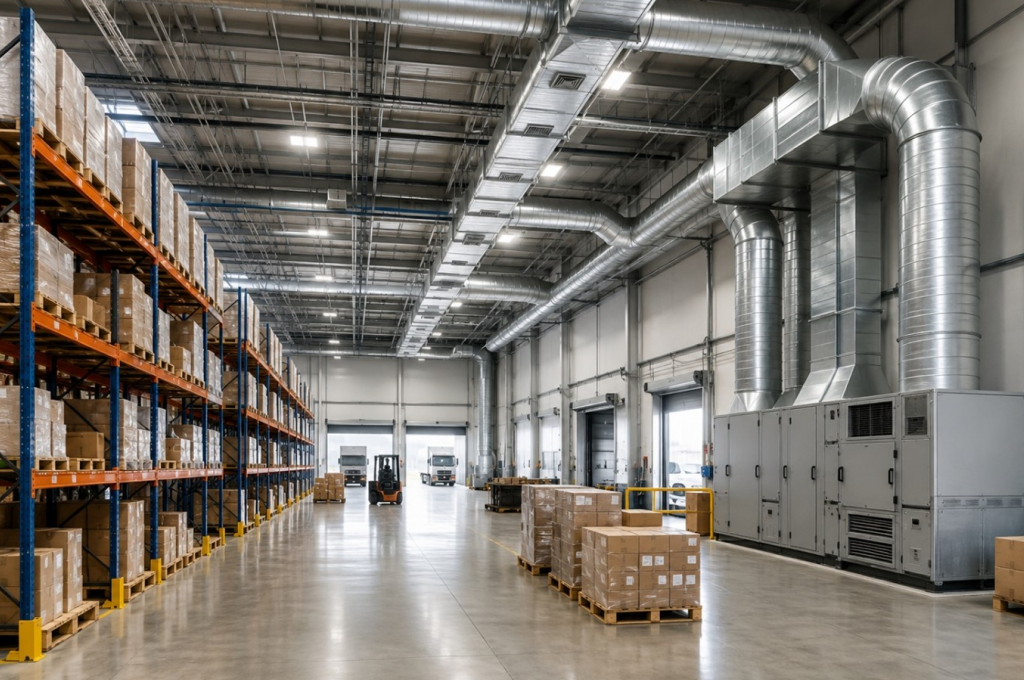
Warehouses and logistics centers often include large floor areas, high ceilings, loading docks, office sections, picking zones, and different operating modes. That is why HVAC cannot be selected only by square footage. Air volume, number of doors, logistics intensity, type of goods, working hours, and differences between zones are much more important.
In these facilities, a good HVAC solution reduces unnecessary losses, improves working conditions, and helps energy be used only where there is a real need.
A large space does not mean the same conditions everywhere
One of the most common mistakes in warehouses is treating the entire space as a single zone. At first glance, a warehouse hall may seem like one large open area. In practice, conditions are not the same near entrance doors, at loading docks, in racking areas, in packing zones, at workstations, and in office sections.
In high buildings, heat distribution is an additional challenge. Warm air rises, so energy can easily remain in the upper part of the hall while the working zone stays colder. If the system does not manage air circulation and distribution properly, consumption can be high while working conditions remain uneven.
That is why warehouse HVAC should be planned by zones and activities. Not every part of the facility needs to be treated with the same intensity. It is more important to provide stable conditions where people work, where goods are prepared, where there is intensive goods flow, and where temperature-sensitive products are stored.
Doors, docks, and goods movement change the load
Logistics centers have a dynamic operating pattern. Doors and docks open frequently, forklifts and vehicles move in and out, goods are constantly handled, and the number of people and active zones changes throughout the day. Every door opening brings in cold or warm outdoor air, humidity, dust, and pressure changes.
That is why HVAC in logistics needs to respond to the real rhythm of the building. A system that works well during quiet periods may not perform well during morning receiving, afternoon dispatch, or seasonal peaks.
In buildings with frequent door openings, air curtains, well-positioned heaters, proper ventilation, fast recovery of indoor conditions, and separate dock control are often important. The goal is to reduce losses, but also to prevent employees from working in constant drafts or sudden temperature changes.
The goods define the level of control
Storing furniture, electronics, packaging, pharmaceutical products, food, or textiles does not require the same conditions. Some goods are sensitive to humidity, some to heat, some to dust, and some require stable temperature conditions.
In standard warehouses, the main priorities are basic comfort, ventilation, and protection from extreme temperatures. In warehouses with sensitive goods, HVAC plays a larger role. For pharmaceutical, food, or electronic products, temperature and humidity deviations can affect quality, shelf life, or product usability.
In practice, this means HVAC for logistics must be planned according to the goods and process, not only according to the space. If goods remain in the facility briefly, the priority may be fast flow and working zones. If goods are stored for longer periods, condition stability becomes more important.
Energy efficiency depends on work organization
Warehouses often have large areas, but not all zones are used with the same intensity throughout the day. Some areas are constantly active, others are used occasionally, and office space has a completely different operating pattern than the warehouse hall.
That is why the greatest savings often come not only from new equipment, but from better control. Zoning, proper temperature settings, air destratification, heat recovery, and automatic adaptation to operating schedules can reduce unnecessary energy use.
Space heating is often one of the largest energy items in warehouse buildings. Proper system settings alone can reduce annual heating and cooling costs by up to 10%, while in large logistics centers additional impact comes from dock control, operating schedules, and equipment maintenance.
Working conditions affect productivity
In logistics, comfort is often treated as a secondary issue, but warehouse employees work in physically demanding conditions. Cold zones, excessive summer heat, poor air, dust, or drafts affect fatigue, concentration, and safety.
Working areas should be the priority. It is not always necessary to heat or cool the entire facility equally, but it is important to protect the places where people spend the most time: packing zones, picking areas, quality-control points, offices, and positions near docks.
Good warehouse HVAC helps working conditions become more stable, reduces complaints, and allows operations to run with fewer interruptions. In logistics, a stable indoor environment also supports a more stable work rhythm.
Maintenance is part of system reliability
Warehouses and logistics centers often operate for long hours, while equipment is exposed to dust, temperature changes, and intensive use. If HVAC is not maintained regularly, problems quickly appear through weaker airflow, higher consumption, uneven conditions, and more frequent failures.
Dirty filters, faulty sensors, poorly balanced ventilation, and inadequate control can increase costs long before a serious failure occurs. In facilities that depend on fast goods movement, any unplanned interruption or drop in conditions can have operational consequences.
HVAC for warehouses and logistics centers should be viewed as part of the infrastructure that supports everyday goods flow. When the system is aligned with zones, docks, goods, and the operating rhythm, the building uses less energy, employees work in better conditions, and logistics become more stable and predictable.