A power outage lasting only a few seconds can stop a production line, erase data from controllers, or disrupt critical IT and telecommunications infrastructure. That is why the question how much does an industrial UPS cost cannot be answered meaningfully without understanding the load, required autonomy, and the risks a company needs to mitigate. The price of the equipment is only one part of the equation. The true value of the solution is measured by how long it can keep operations running and how reliably it protects the business when the grid fails.
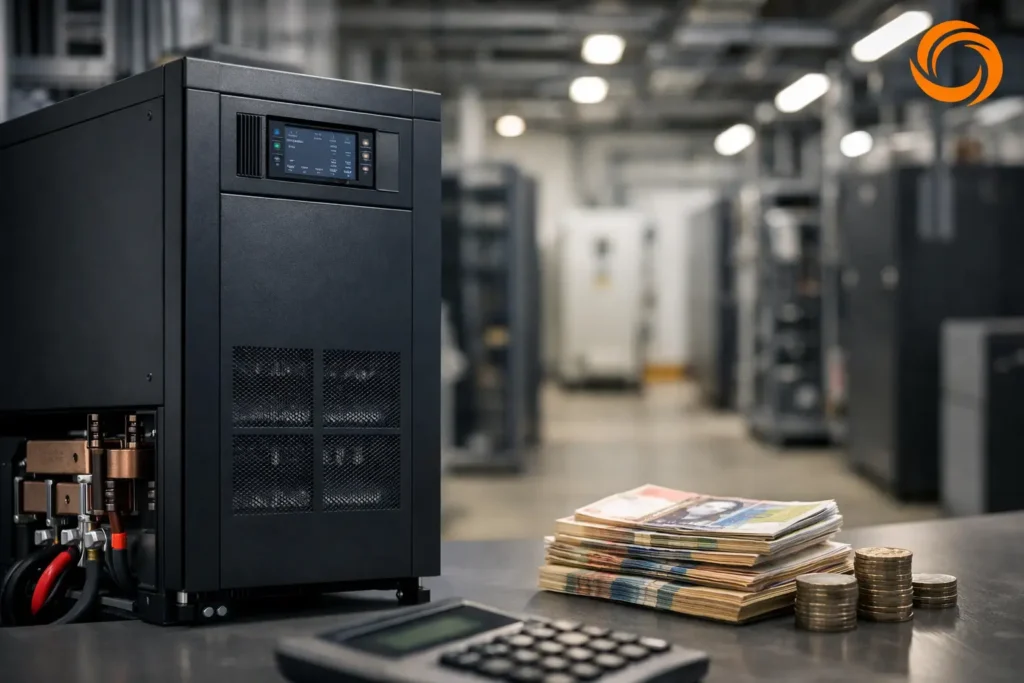
For industrial users in Serbia, the approximate investment in a three-phase online UPS typically starts at several thousand euros, while systems for larger industrial facilities, data centers, hospitals, telecommunications sites, or critical infrastructure can reach tens or even hundreds of thousands of euros. The difference is not determined by UPS capacity alone. Battery technology, required autonomy, redundancy, the condition of the existing electrical installation, and the scope of engineering, installation, and maintenance all have a significant impact on the final investment.
How Much Does an Industrial UPS Cost Based on Capacity?
Industrial UPS systems are typically sized in kVA or kW, but rated capacity alone is not sufficient for comparing quotations. Modern systems often have a power factor of 1.0, meaning that a 100 kVA UPS can deliver up to 100 kW of active power. With older or certain more economical platforms, this ratio may be less favorable.
As an initial market reference, the following price ranges can be expected for three-phase online UPS systems, excluding certain site-specific works and additional equipment:
- A 10 to 20 kVA UPS typically costs approximately €4,000 to €12,000.
- Systems ranging from 20 to 60 kVA are generally priced between €10,000 and €30,000.
- A 60 to 200 kVA UPS may require an investment of €25,000 to €100,000 or more.
- Modular, redundant, or containerized systems above 200 kVA are engineered and priced individually, as the final cost depends significantly on system architecture, battery capacity, and site-specific requirements.
These figures should be treated as a general indication rather than a substitute for a technical specification. A quotation for a 40 kVA UPS with five minutes of autonomy can differ significantly from a quotation for the same UPS with 60 minutes of autonomy. In the latter case, the battery system itself may cost more than the UPS unit.
Batteries Have the Greatest Impact on the Total Investment
A UPS without properly sized batteries does not solve the problem of power continuity. Batteries determine how long the load can continue operating during a grid outage and how reliably the system will perform after several years of operation.
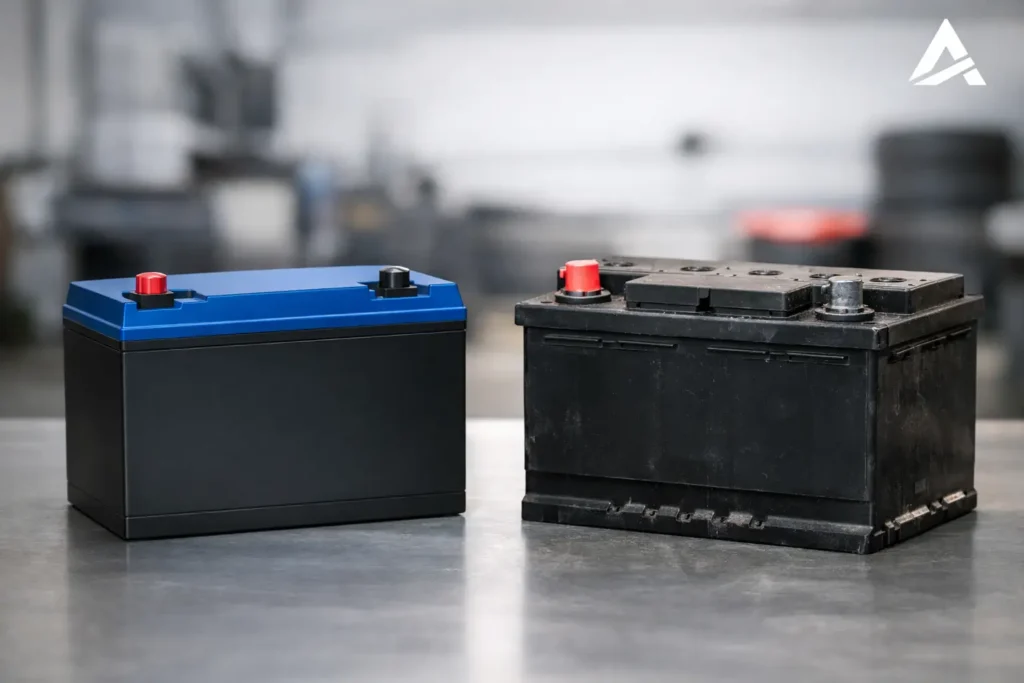
Conventional VRLA batteries remain a common choice when minimizing the initial investment is a priority. Their expected service life is generally shorter, they are more sensitive to elevated temperatures, and they require careful management of battery room conditions. For many industrial applications, they remain a justified solution, particularly when the UPS is intended to bridge the period until a diesel generator starts.
Lithium-ion batteries have a higher initial cost but offer a longer service life, a smaller footprint, lower cooling requirements, and greater tolerance for cyclic operation. In facilities with limited space, high downtime costs, or longer autonomy requirements, their overall economics may be more favorable. The analysis should not consider only the initial cost of the battery cabinet, but also the replacement plan, service interventions, cooling energy consumption, and the cost of disposing of end-of-life batteries.
Autonomy should not be determined arbitrarily. If a facility has a generator that reliably starts within 20 to 40 seconds, the UPS generally does not need to support the entire facility for an hour. It needs to provide sufficient time for the generator to start, voltage to stabilize, and the load to be transferred safely. Conversely, a data center without an alternative backup source or a process that cannot tolerate interruption may require significantly longer autonomy.
What Should Be Included in the Quotation?
The lowest purchase price does not necessarily mean the lowest project cost. For an industrial UPS, the quotation should clearly separate the equipment, batteries, transportation, installation, electrical works, commissioning, and user training. Without this breakdown, it is difficult to compare two apparently similar specifications.
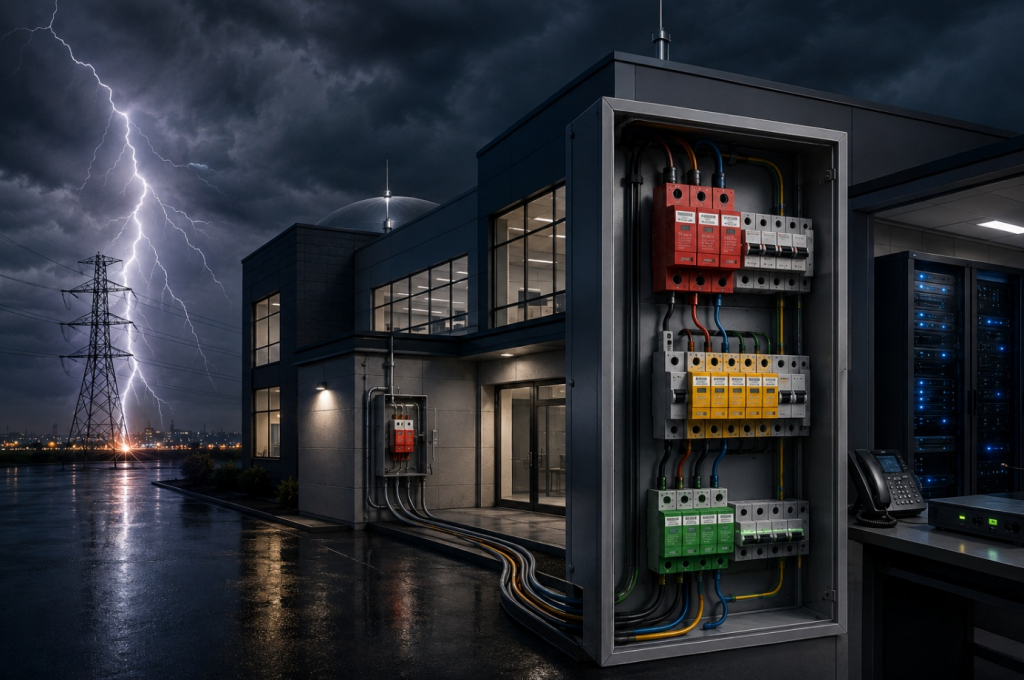
Particular attention should be paid to input and output distribution, protection devices, cables, maintenance bypass arrangements, and any necessary modifications to existing switchboards. The UPS must be properly integrated with the existing grid connection, generator, transformer, and earthing system. If power quality, short-circuit current, or protection selectivity are overlooked, correcting these issues later may cost more than proper engineering at the beginning of the project.
A professional specification should also define the operating environment. Temperature, dust, humidity, and ventilation directly affect the service life of both electronics and batteries. A UPS installed in an unsuitable room may meet its design parameters on the first day but fail to achieve its expected service life. This is why HVAC for the UPS and battery room is often part of the same overall energy infrastructure decision.
Redundancy Is Not a Necessary Expense for Every User
N+1 redundancy means that the system has one additional module or unit beyond the minimum required to support the intended load. If one module fails, the remaining capacity continues to supply critical loads. Parallel UPS systems can further increase availability and facilitate maintenance without interrupting operations.
This architecture increases the initial investment, but it is not automatically justified for every facility. For a smaller industrial facility with a reliable generator and a process that can tolerate a brief interruption, a single high-quality UPS with a bypass may be a more rational solution. For banking systems, telecommunications hubs, data centers, automated manufacturing, or cold-chain operations, the cost of downtime can significantly exceed the investment required for redundancy.
The real question is not whether N+1 is more expensive, but what the financial and operational consequences would be if critical loads were left without power. This calculation should form part of the feasibility study, together with an analysis of existing loads and future capacity expansion plans.
TCO Reveals the True Cost of a UPS System
Total Cost of Ownership (TCO) includes far more than the initial purchase price. An industrial UPS operates continuously and has its own energy losses. A difference of just a few percentage points in efficiency can become significant over ten years of operation for a high-capacity system.
TCO includes electricity consumption, routine servicing, fan and capacitor replacement, battery replacement, cooling costs, extended warranties, and spare parts availability. It also includes the consequences of potential failure: lost production, scrap, communication outages, equipment risks, and the cost of emergency intervention.
Two quotations can therefore only be compared when the conditions are equivalent: the same capacity in kW, the same autonomy at a defined load, the same battery technology, the same level of redundancy, equivalent warranty periods, and clearly defined service conditions. A UPS with a lower purchase price may ultimately be more expensive if it has higher energy losses, shorter battery life, or limited service support.
How to Properly Define Requirements Before Requesting a Quotation
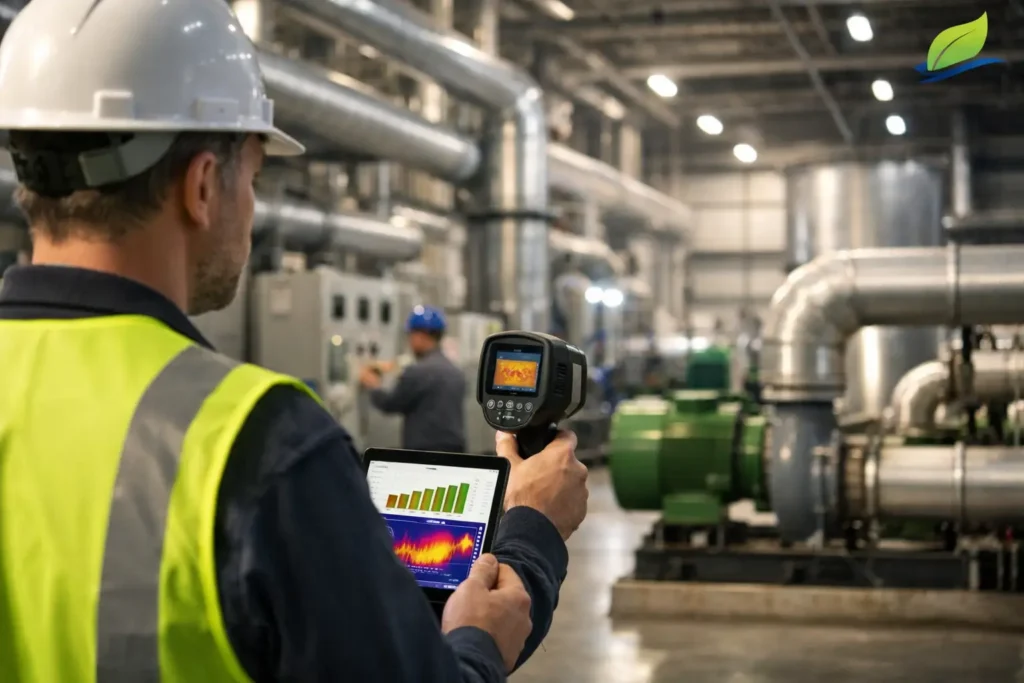
The starting point should be the measurement of actual load rather than simply adding together the rated capacities of all equipment in the facility. Maximum demand, peak currents, power factor, and the loads that genuinely need to remain operational must be identified. In many facilities, supporting the entire operation with a UPS is neither necessary nor economically justified. Priority may instead be given to automation, PLC systems, servers, communications, fire protection systems, critical pumps, and selected process equipment.
The next step is to define the grid outage scenario. Is a generator available? How long does it take to start? Is the grid unstable? How often do outages occur each year? Are there short-term voltage drops that affect sensitive electronics? The answers determine the required autonomy and system topology.
Future growth should also be considered. A UPS sized at the limit of the current load can quickly become a bottleneck when a new production line is introduced, a server room is expanded, or additional automation is installed. Modular systems allow capacity to be increased gradually, but their economic justification depends on the expected pace of future expansion.
Energize approaches these projects through load analysis, technical engineering, and integration of UPS systems with generators, battery systems, HVAC, and the rest of the facility’s energy infrastructure. The objective is not simply to deliver a unit with a specified capacity, but to design a system that remains reliable under real operating conditions.
When asking how much an industrial UPS costs, also request an autonomy calculation, TCO projection, maintenance plan, and clearly defined responsibility for the complete system. This approach transforms a UPS from an individual equipment purchase into measurable protection for business continuity.