The simultaneous startup of compressors, furnaces, pumps, or fast chargers can increase a facility’s power demand far above its normal consumption level within just a few minutes. This is precisely when the question of how to reduce peak demand with battery storage stops being theoretical and becomes an operational decision that affects electricity costs, production availability, and the capacity of the existing grid connection infrastructure.
A Battery Energy Storage System (BESS) can supply part of the facility’s demand during short periods of maximum load. This application is known as peak shaving, or peak demand reduction. However, simply installing a battery does not guarantee results. An economically viable system can only be achieved when the load profile, tariff structure, production process, available grid connection capacity, and future facility growth are properly analyzed.
What Is Peak Demand and Why Does It Increase Costs?
Peak demand is the highest amount of power a facility draws from the grid during a defined measurement interval. In industrial facilities, this increase is often not caused by high monthly energy consumption, but by the short-term overlap of several high-power loads. As a result, two facilities with similar consumption in kWh can have very different electricity costs and grid connection capacity requirements.
For commercial and industrial users, demand charges, contracted capacity, and excess demand costs depend on the customer category, metering point, and contractual conditions with the electricity supplier and system operator. It is therefore not enough to assume that every reduction in peak demand will have the same financial value. It is necessary to determine the cost of each additional kW, when peaks occur, and whether they affect facility operation or planned capacity expansion.
A BESS is installed behind the meter and continuously monitors power exchange with the grid. When consumption exceeds a predefined threshold, the battery discharges and supplies the additional power required. When consumption is lower, the system recharges according to a defined strategy – from the grid, the solar power plant, or a combination of both. The objective is not for the battery to supply the facility’s entire load, but to precisely eliminate costly and potentially problematic demand peaks.
How to Reduce Peak Demand With Battery Storage in Practice
The basic principle is straightforward: a target limit is defined for the maximum power the facility is allowed to draw from the grid. If a production facility normally draws 650 kW but occasionally reaches peaks of 900 kW, a BESS can limit grid demand to, for example, 700 kW. In this case, the battery must temporarily supply up to 200 kW, with sufficient available energy to cover the duration of the peak.
These two parameters should not be confused. Battery inverter power is expressed in kW and determines how much power the system can deliver at a given moment. Battery capacity is expressed in kWh or MWh and determines how long the system can maintain the required output. A 200 kW peak lasting 15 minutes requires significantly less energy than a peak of the same power lasting two hours, but in both cases the inverter must provide the required output power.
The BESS controller should not wait until the demand limit has already been exceeded before responding. A well-designed Energy Management System (EMS) uses high-resolution measurements, historical patterns, and, where appropriate, signals from the production process. If the system knows that a cooling cycle or production line startup occurs at approximately the same time each day, it can prepare the required State of Charge (SoC) before the expected peak.
Response speed is particularly important for loads with rapid changes in demand. Variable frequency drives, presses, welding equipment, crushers, refrigeration systems, and EV charging systems do not behave in the same way. System design should therefore not rely solely on average 15-minute values, but should also consider load profiles over shorter intervals and the operating logic of critical equipment.
Data That Determines BESS Size
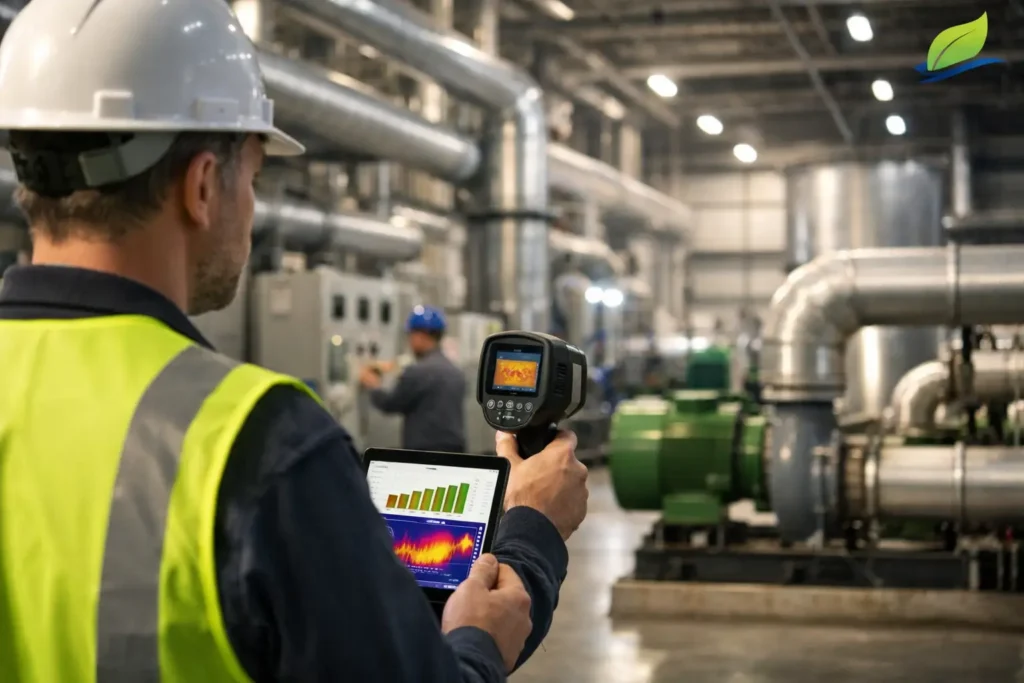
One of the most common mistakes is sizing the system based on total electricity consumption or a single electricity bill. The bill is a useful starting point, but it does not provide sufficient technical detail. A comprehensive study requires at least one year of historical data and, for facilities with variable operating profiles, shorter-interval measurements at the main incoming supply and key load branches.
The analysis should identify peak demand patterns by day, shift, and season. It should also determine how frequently peaks occur, how long they last, and whether they result from normal production processes or exceptional events. A battery designed for several short peaks per day may prove inadequate if the same peak occurs repeatedly before the system has enough time to recharge.
Particular attention should be paid to the following factors:
- maximum demand, contracted capacity, and the billing method applied at the specific metering point;
- duration and frequency of demand above the desired limit;
- available space, fire protection requirements, ventilation, and environmental conditions;
- planned production increases, new machinery, fleet electrification, or expansion of the solar power plant.
These factors determine not only the nominal battery size but also the control strategy. For some facilities, the best results come from maintaining a strict grid import limit. For others, a dynamic limit that follows the production schedule, solar generation, and the priority of critical loads provides greater value.
Battery Storage, Solar, and Load Management Work Better Together
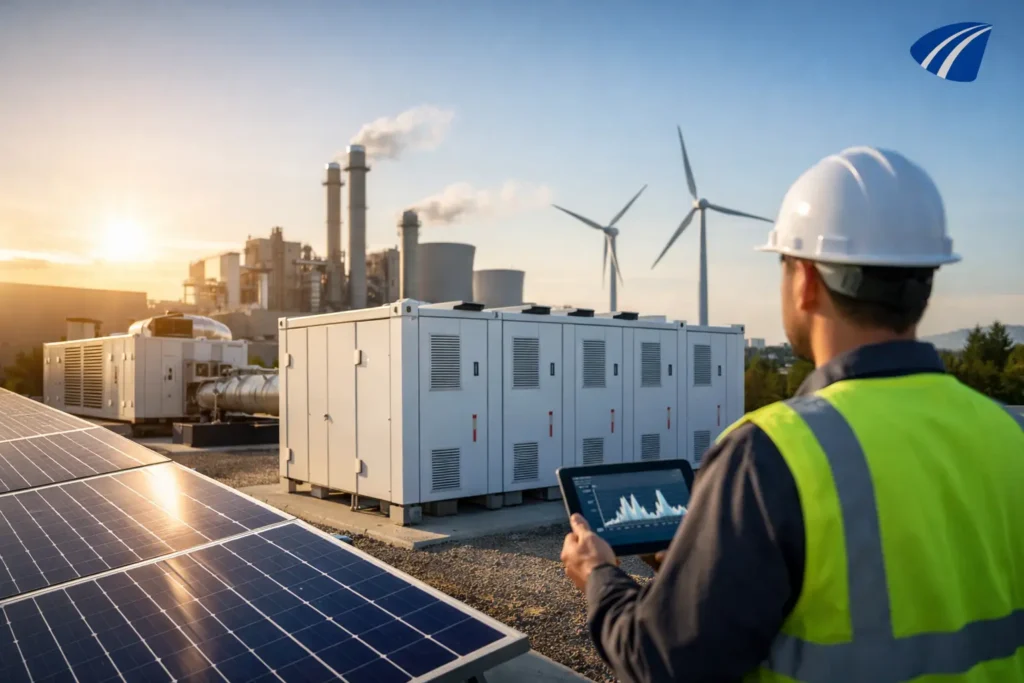
A solar power plant can reduce daytime electricity purchases, but it cannot address every peak demand event on its own. Photovoltaic generation depends on solar irradiation and does not always coincide with the exact moment when industrial loads create the highest demand peak. A BESS adds flexibility: surplus solar energy can be stored for later use, while the battery can support facility loads when solar generation decreases.
However, not every kWh delivered from a battery automatically represents a saving. If the battery is charged with expensive electricity from the grid and discharged without a clear tariff or operational benefit, conversion losses and battery degradation can weaken the business case. Optimization should therefore not be limited to a single function. The system can combine peak shaving, increased solar self-consumption, load shifting, and backup power for priority loads.
When operational continuity is critical, a BESS can be integrated with a UPS and diesel generator. Each system serves a different purpose. A UPS provides uninterrupted power to sensitive loads, a generator supplies energy during longer outages, while a BESS can reduce demand peaks, support transitions between power sources, and reduce the need to operate the generator under inefficient conditions. A unified control strategy prevents separate systems from operating against each other.
Financial Assessment Must Cover the Entire Lifecycle
A BESS investment should not be evaluated solely based on the cost of battery modules. The assessment must include power conversion systems, power distribution, protection equipment, civil works, HVAC, the Battery Management System (BMS), fire protection, integration with existing infrastructure, monitoring, and maintenance. For industrial users, the cost of downtime during installation and the quality of system commissioning are equally important.
On the benefits side, the assessment should include avoided excess demand charges, lower demand-related electricity costs where applicable, deferred investment in grid connection upgrades, greater utilization of solar generation, and reduced risk of process interruptions. If grid connection limitations prevent a facility from commissioning a new production line, the value of a BESS may be significantly greater than the direct savings visible on the electricity bill.
Battery degradation must also be taken into account. Over time, a battery loses part of its usable capacity, with the rate of degradation depending on temperature, Depth of Discharge (DoD), number of cycles, and operating conditions. Oversizing unnecessarily increases capital expenditure, while an undersized system operates more aggressively, reaches its reserve limits more frequently, and may lose economic value faster. A properly engineered project defines the permitted operating window, expected degradation, and guaranteed performance over the agreed period.
From Measurement to Implementation Without Assumptions
The first step is not purchasing equipment, but conducting an energy feasibility study. The study connects actual consumption data with the facility’s technical constraints and the investor’s financial objectives. This is followed by solution concept development, operational simulation based on actual data, equipment selection, engineering, obtaining the necessary approvals and connection requirements, and integration with the existing power distribution system.
At complex sites, responsibility should remain consolidated. A BESS affects low-voltage or medium-voltage distribution, protection systems, automation, solar generation, HVAC, and backup power operation. Purchasing individual components separately may initially appear less expensive, but it often creates unclear responsibility when control logic, protection systems, or overall performance fail to meet expectations. Energize approaches these projects through a complete engineering model – from measurement and techno-economic analysis to commissioning and maintenance.
For facility owners, the most important factor is to base the decision on the facility’s actual load profile rather than on a generic battery size. Precise measurements across several representative production cycles are often the fastest way to determine the BESS capacity that is actually required, how many demand peaks it can reliably cover, and where the investment can create measurable business value.