Ventilation is one of the most important, yet often underestimated, components of an HVAC system. When heating and cooling are discussed, the focus is usually placed on temperature. However, a space can be at the appropriate temperature and still not feel comfortable to occupy. The reason most often lies in the air itself: excess humidity, stuffiness, odors, poor circulation, or insufficient fresh air.
Modern buildings are better insulated and more energy-efficient than before. This reduces energy losses, but it also reduces natural air exchange. On average, people spend around 90% of their time indoors, while concentrations of certain pollutants inside can be two to five times higher than outdoors. For this reason, ventilation is not an add-on to an HVAC system — it is one of its fundamental components.
Good air is not only a matter of comfort
Air quality directly affects how a space feels to occupy. In an apartment or house, poor ventilation manifests as humidity, condensation, odors, and a sense of stuffiness. In an office, it is often recognized through fatigue, reduced concentration, and the constant need to open windows. In hotels, restaurants, and retail spaces, it shapes the customer experience. In industry, laboratories, and healthcare facilities, it can also play a functional or safety-critical role.
This is why HVAC should not be viewed merely as a system that regulates temperature. Its true value lies in the fact that it simultaneously manages heating, cooling, ventilation, humidity, and the overall quality of indoor conditions.
If ventilation is not well designed, a space quickly loses its quality. The temperature may be acceptable, but the air becomes heavy. If humidity is too high, there is a risk of condensation and mold. If the air is too dry, occupancy becomes unpleasant. If there is not enough fresh air, users experience a decline in comfort and concentration.
Energy efficiency does not mean less air at any cost
A common mistake in HVAC optimization is to treat savings purely as a reduction in system operation. This may lower consumption in the short term, but if the space becomes stuffy, humid, or unstable, the result is not a good one.
True optimization means that the system operates more intelligently. An empty space does not require the same regime as one full of people. A meeting room, an office, a restaurant, a classroom, or a retail unit do not have identical needs throughout the day. If the system can follow the actual occupancy and load of the space, consumption decreases without any loss of comfort.
Proper thermostat settings alone can reduce annual heating and cooling costs by up to 10%. In larger buildings, additional value comes from sensors, zone control, heat recovery, and automated ventilation regulation. In spaces with a variable number of occupants, managing ventilation according to real demand can significantly reduce unnecessary consumption.
Heat recovery and intelligent control
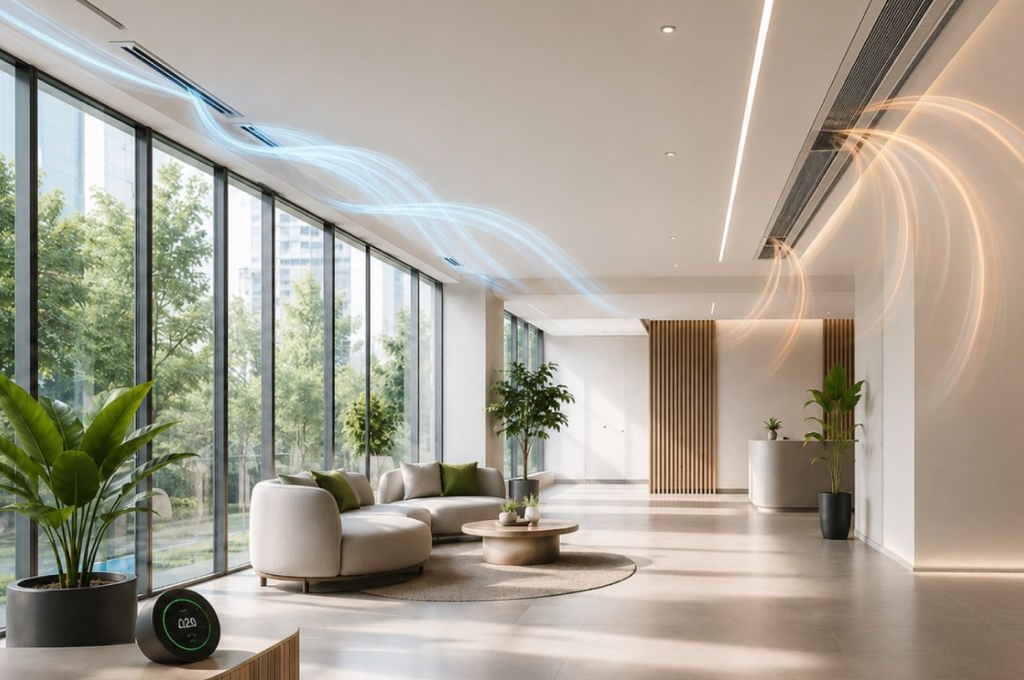
Heat recovery is one of the ways to improve air quality without unnecessary energy loss. The principle is simple: exhaust air leaving the building transfers part of its heat to the fresh air entering it. In this way, the space receives fresh air while the demand for additional heating or cooling is reduced.
This is especially valuable in well-insulated buildings, offices, schools, hotels, and commercial spaces where continuous air exchange is required. In residential buildings, heat recovery can help address humidity, condensation, and stuffiness, particularly after window replacement or energy retrofitting.
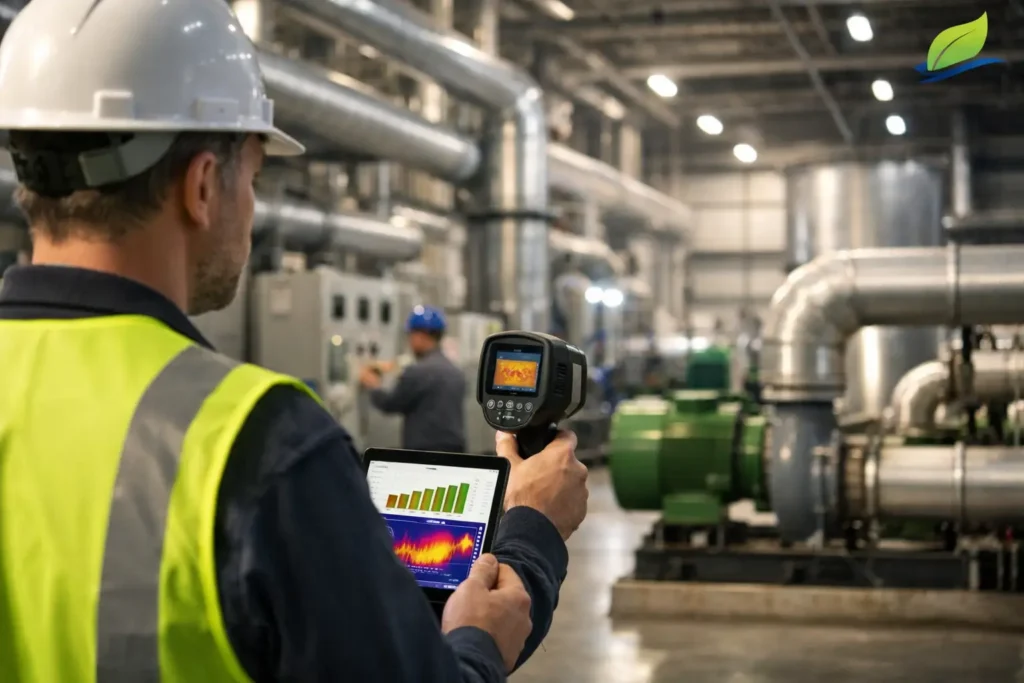
Intelligent control raises efficiency further. A system that measures temperature, air quality, humidity, or occupancy can dose HVAC operation more precisely. Instead of all zones running at the same intensity, energy is directed where it is actually needed.
The most common problems in practice
The most frequent issue is ventilation that is not aligned with the actual use of the space. In smaller buildings, this appears as stuffiness and humidity. In offices, it shows up as poor air in meeting rooms. In restaurants, it manifests as odors and unbalanced kitchen ventilation. In industrial settings, as dust, vapor, smoke, or excess heat.
The second problem is poor maintenance. Clogged filters, faulty sensors, weak airflow, and unbalanced systems all increase consumption and reduce the quality of the space. An HVAC system that is not maintained may technically still operate, but it does not deliver the conditions it was designed for.
The third problem is excessive oversimplification. Good air cannot be achieved simply by opening windows — particularly in spaces with high occupancy, external noise, outdoor pollution, or specific operational requirements. What is needed is a planned solution that brings together ventilation, filtration, control, and energy efficiency.
When HVAC works as it should
A well-designed HVAC system is not noticed through constant adjustment, but through the steady feel of the space itself. The air is not heavy, the temperature does not fluctuate sharply, there is no unpleasant humidity, noise levels are low, and consumption remains under control.
Ventilation, air quality, and energy optimization should not be treated as three separate topics. Together, they determine how healthy, pleasant, and rational a space is to use. When a system is designed and tuned to the real needs of the building, HVAC ceases to be merely an installation and becomes one of the key elements of the quality of the space itself.