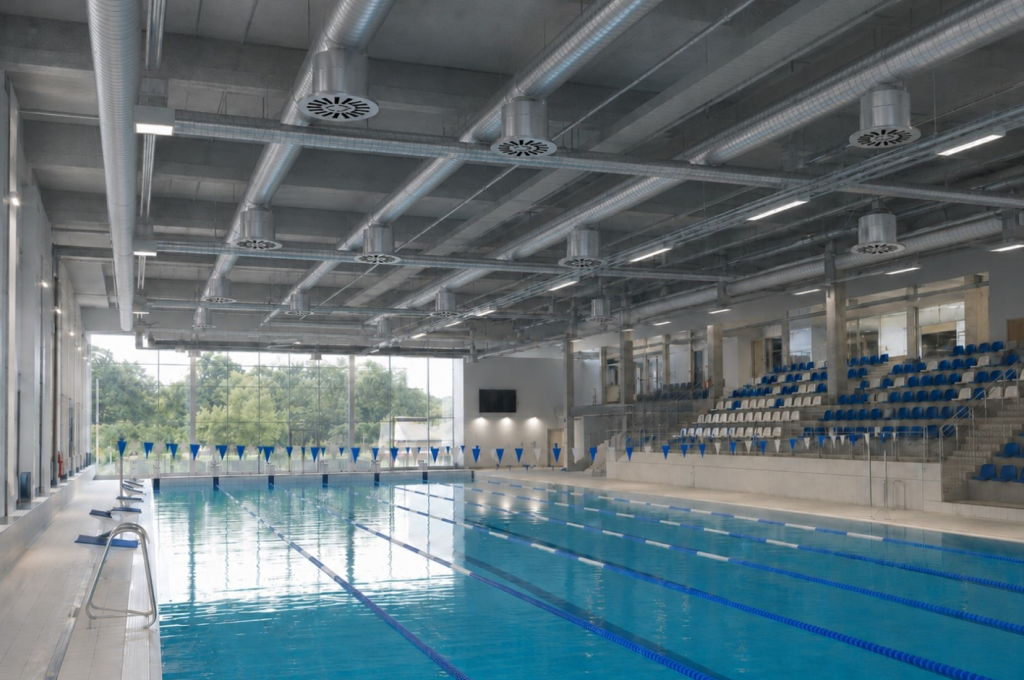
In pools, spa, and wellness centers, HVAC has a very specific role. It is not enough to maintain a comfortable air temperature. The key challenges are humidity, evaporation, indoor air quality, building protection, and energy cost. If the system is not properly planned, the space may look pleasant at first, while in practice condensation, heavy air, chlorine odor, material damage, and high energy consumption can appear.
Pool areas are demanding because air temperature, water temperature, relative humidity, and ventilation must be controlled at the same time. Every kilogram of water that evaporates at around 26.7°C removes approximately 2,438 kJ of heat from the system. This means evaporation is not only a humidity problem, but one of the largest energy losses in this type of facility.
Humidity is the central issue in pool areas
Unlike an office, hotel, or residential space, a pool constantly produces humidity. Water evaporates throughout the day, and evaporation increases when the water is warmer, when there are more users, and when air movement above the water surface is poorly controlled.
The recommended relative humidity level in pool spaces is usually around 50% to 60%. If humidity is higher, the space becomes heavy to occupy, and the risk of condensation, corrosion, mold, and structural damage increases. If humidity is too low, users may feel unpleasant dryness, while evaporation from the pool increases further.
That is why HVAC in pools should not be reduced to heating and cooling. Dehumidification is one of the main functions of the system. Without it, even a well-heated space can quickly become uncomfortable and harmful to the building.
Air and water temperature need to be aligned
In pools, the relationship between water temperature and air temperature is very important. In practice, it is often recommended for the air temperature to be approximately 1°C to 2°C higher than the water temperature. This helps reduce excessive evaporation and improves comfort for users.
In standard hotel pools, water temperature is often around 28°C to 30°C, while in spa and whirlpool areas it can reach around 36°C to 40°C. Warmer water means more evaporation, a higher dehumidification load, and higher energy consumption.
That is why spa and wellness spaces cannot follow the same HVAC approach as a standard recreational pool. A space with warmer water, saunas, steam rooms, and relaxation areas requires more precise humidity control, better ventilation, and more careful energy management.
Indoor air quality affects the user experience
In indoor pools, users often notice the air first. If there is a strong chlorine smell, if the space feels stuffy, or if the air irritates the eyes and respiratory system, the problem is often not only in the water, but also in the ventilation.
Chloramines can form in pool spaces when chlorine reacts with impurities in the water. If ventilation is not properly designed, they remain above the water surface and in the surrounding space. This can reduce the quality of stay for swimmers, coaches, staff, and visitors.
HVAC therefore needs to deliver fresh air in the right way and remove contaminated air efficiently. A good system should not only mix air in the room. It needs to control where air enters, how it moves across the water surface, and where it is exhausted.
Protecting the building is as important as comfort
Pool buildings are especially sensitive to condensation. When humid air meets colder surfaces, moisture condenses on glass, metal elements, ceilings, or structural components. Over time, this can lead to corrosion, façade damage, deterioration of finishing materials, and mold growth.
A typical pool space at about 28°C and 55% relative humidity has a dew point of around 18°C. This means surfaces colder than that can become condensation points. For that reason, HVAC for pools needs to be considered together with insulation, windows, materials, and the building envelope.
In a well-designed space, air is distributed in a way that protects critical surfaces, especially glass façades, exterior walls, and colder structural elements.
Energy optimization has major potential
Pools use a lot of energy because water, air, and humidity need to be maintained continuously. However, the savings potential is also significant. Covering the pool when it is not in use can reduce heating costs by 50% to 70%, because evaporation is greatly reduced. At the same time, it can reduce the need for makeup water by 30% to 50% and chemical use by 35% to 60%.
In indoor pools, additional value comes from heat recovery, energy recovery from the dehumidification process, and smart operating modes. The same mode is not needed when the pool is full of users, when it is closed to visitors, or when the space is maintained overnight.
A good HVAC system should distinguish between those modes. When energy is used according to actual need, the space remains stable and operating costs are lower.
The most common mistakes in pool and wellness spaces
The most common mistakes happen when HVAC is treated as a standard heating and cooling system. In pools, that is not enough. If humidity, air quality, and condensation are not addressed, problems will appear even if the temperature feels comfortable.
Another mistake is using the same approach for different zones. A pool, whirlpool, sauna, relaxation area, changing room, and technical room do not have the same needs. A third mistake is ignoring usage patterns. A space full of users has a very different load from a space that is empty overnight.
HVAC for pools, spa, and wellness centers needs to connect user comfort, building protection, and energy rationality. When humidity, ventilation, water temperature, air temperature, and operating mode are properly aligned, the space is more comfortable, the building is better protected, and long-term costs become more predictable.