A driver pulls up to a station, takes out the cable, walks over to the vehicle – and the plug simply will not go in. Nothing is broken, not a single light is blinking red. The station works. The vehicle is fine. And yet there is no charging.
The scenario sounds trivial, but it repeats itself everywhere the wrong connector meets the wrong market. Because a connector is not what it appears to be at first glance. Hidden behind its shape are three things at once: the type of current it carries, the power it can withstand, and the protocol through which the vehicle and the charger communicate. Change any one of them, and the “same” plug is no longer the same.
Type 2: Europe’s Quiet Winner
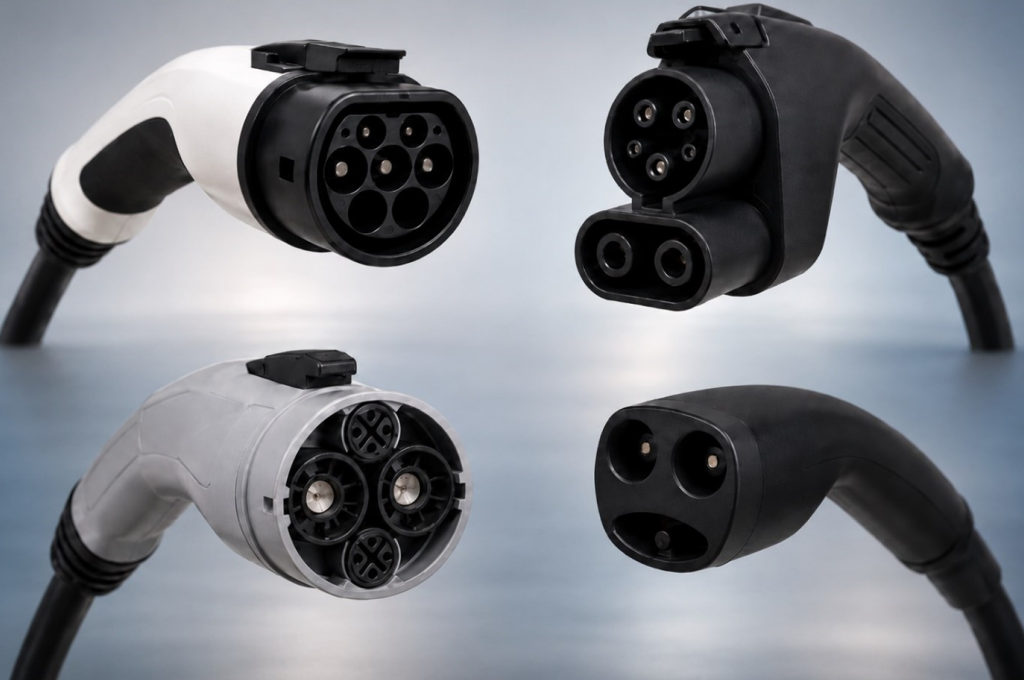
For alternating-current charging, Europe made its choice long ago. Type 2 (the IEC 62196-2 standard) became the default connector – so much so that it is hardly mentioned anymore, the way no one talks about an ordinary wall socket.
It supports single-phase and three-phase supply, and on practical installations it covers power levels up to 22 kW. But here lies the trap we have already described: because rectification takes place in the vehicle, Type 2 merely delivers alternating current to the onboard charger, and the speed remains locked by its limit. The connector promises – the vehicle delivers.
CCS: One Shape, Two Jobs
With fast direct-current charging, the story gets more interesting. Europe embraced CCS (the Combined Charging System) in its Combo 2 variant – a solution that seems obvious only once you see it: below the familiar Type 2, two powerful direct-current contacts have been added.
The result? A single inlet on the vehicle accepts both slow AC and fast DC charging. One opening, two worlds. It is precisely this dual role that made CCS the dominant fast-charging standard in Europe.
CHAdeMO: A Standard in Retreat
Not everyone wins. CHAdeMO, an older DC connector of Japanese origin, charged vehicles such as earlier Nissan models for years. Today it is quietly retreating in Europe and North America – new vehicles are largely abandoning it – while in Japan it still holds its ground.
The lesson for sales is clear: CHAdeMO is not a default option, but an item that depends on the specific market and fleet.
NACS: When the Limit Is Geographic, Not Technical
The biggest divide lies neither in current nor in power – but on the map. In North America, the Tesla connector, opened up for wider use and standardized as NACS (SAE J3400), has been adopted by a large number of manufacturers. It is compact, and a single shape covers both AC and DC charging – a serious challenger to CCS on that continent.
So the world today speaks in different “languages”: Europe in Type 2 and CCS Combo 2, North America increasingly in NACS, and markets such as China in their own GB/T. For a product tied to a single market – irrelevant. For international sales – decisive. The same device simply is not universal.
The Real Question Is Not “Which Plug”
Choosing a connector is not a matter of taste, but of compatibility. Before a site is equipped, three questions resolve almost everything: which market it is installed in, which fleet comes to charge, and whether the scenario is AC or DC. Adapters and combined inlets can bridge some of the differences, but they are a help, not a foundation – the basis remains the right standard for the right use.
Conclusion
A connector packs three decisions into a single shape: the type of current, the available power, and the communication between vehicle and charger. That is why “which connector” is never a purely mechanical question – it conceals where the charger is used, who uses it, and at what speed.
In a market still consolidating around a handful of standards, the best answer is not the one that tries to cover everything, but the one that precisely matches the specific market and fleet. That distinction is what separates a solution that works from an expensive plug that – will not go in.