A petrol driver barely glances at the gauge when it drops to a quarter of a tank. That same person, behind the wheel of an electric vehicle, feels uneasy at 40 percent of the battery – even though the remaining range far exceeds anything they plan to drive that day. The numbers say one thing, the feeling says another.
That is range anxiety: the fear that the vehicle will not have enough energy to reach its destination, leaving the driver stranded somewhere in between. The fear is real. But its cause is almost always misdiagnosed – which is precisely why it resists so stubbornly the very solution everyone reaches for first.
The Gap Between the Real and the Perceived
Looked at as cold arithmetic, there is usually no problem. The vast majority of daily trips are far shorter than the range of a modern electric vehicle; a typical day fits within range with plenty to spare. The math, in other words, works.
The trouble is that fear is not math. Range anxiety is not fed by the average day, but by the rare, uncertain moment: an unfamiliar route, a low battery, and the question “what if this is the time I can’t find somewhere to charge.” The perceived risk is far greater than the real one – and no statistic about average mileage removes it on its own.
Why a Bigger Battery Is Not the Answer
The first, intuitive reaction is: let’s fit a bigger battery. It sounds logical, but it quickly hits a wall. A bigger battery means more mass, a higher price, and longer charging – and range does not grow linearly with capacity. At some point you are adding kilograms and euros for an ever-smaller gain in kilometers.
More importantly, a bigger battery treats the symptom, not the cause. It moves the limit, but it never touches what actually triggers the fear – the uncertainty that charging will be available when it is needed. The driver is not afraid of the small number on the screen; they are afraid that behind that number there is no network to rely on.
The Real Cure: The Network, Not the Battery
Range anxiety does not retreat before greater capacity, but before trust. And trust is built by infrastructure, through several things at once.
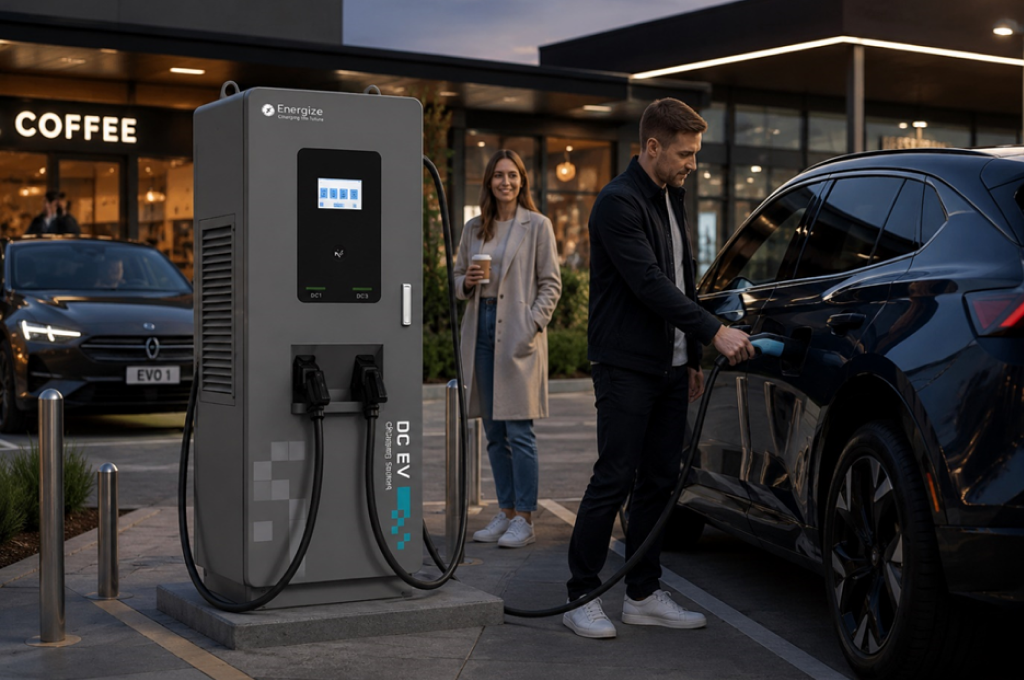
Density comes first: enough chargers that a station is never far turns “what if I can’t find one” into a question that simply never arises. Reliability is second, and perhaps most important – a network is only as good as its broken charger. A single station that fails at the moment of need does more damage to trust than ten working ones build. Speed is third: on corridors, where long distances are covered, DC charging shortens the stop to the length of a coffee rather than a lunch. And finally, predictability – real-time information about where a charger is free and working – removes the last piece of uncertainty.
A Shift in the Mental Model
The deepest change, however, is not in the number of stations, but in the habit. A petrol driver thinks in the logic of “refueling”: fuel is topped up occasionally, at a special place, when it runs low. An electric vehicle allows a different rhythm – “topping up” wherever the vehicle is already parked: at home, at work, in the destination car park.
When a vehicle charges while its owner sleeps or works, every morning begins with a full battery. And a driver who sets off full each day rarely even thinks about range. There, almost imperceptibly, range anxiety disappears – not because the battery is bigger, but because the need for a “big charge” no longer exists.
Conclusion
Range anxiety is an infrastructure problem disguised as a battery problem. The real answer is not more kilowatt-hours in the vehicle, but a denser, faster and – above all – reliable network, together with charging that happens where the vehicle already spends its time.
Back to the beginning: a petrol driver is calm at a quarter of a tank because they know the next station is nearby and working. The electric driver needs exactly the same certainty. The day they get it, the battery gauge becomes just a number – as it was always meant to be.