
A production line does not stop because the electricity bill is high. It stops when power quality deteriorates, peak demand exceeds the contracted limit, or a grid outage interrupts a process that cannot simply be restarted.
That is why the question of whether a company needs energy storage is not merely about purchasing a battery. It is a decision about controlling costs, operational risk, and business continuity.
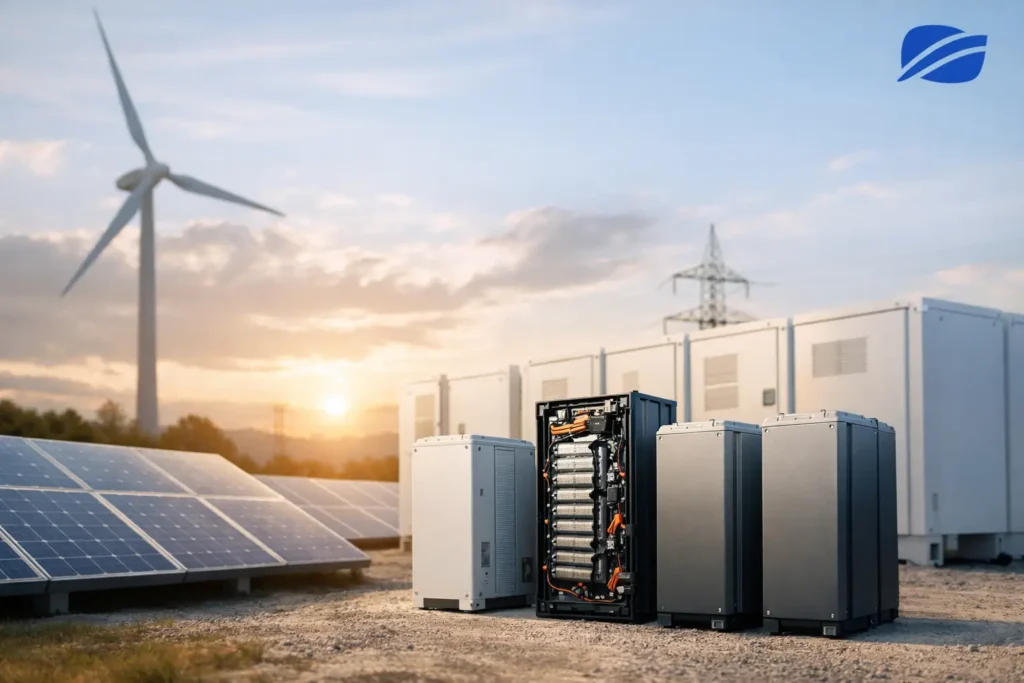
For a company with significant electricity consumption, a Battery Energy Storage System can connect a solar power plant, the grid, a generator, a UPS, and critical loads into one manageable energy system.
However, storage is not automatically cost-effective at every location. Its true value emerges when the system is sized according to the actual consumption profile, electricity tariffs, production requirements, and the company’s future development plans.
When Energy Storage Delivers Measurable Value to a Business
The most common reason for installing an energy storage system is to reduce peak demand.
Many industrial and commercial consumers experience short periods of extremely high electricity consumption, caused by the simultaneous startup of machinery, compressors, refrigeration systems, pumps, charging stations, or large HVAC systems.
These peaks can significantly affect electricity costs and the required contracted capacity.
In this scenario, the BESS charges when demand is lower or when the solar power plant produces surplus energy, then discharges during peak periods.
This principle, known as peak shaving, does more than reduce the electricity bill. It allows the company to manage the power drawn from the grid more consistently without limiting critical processes.
Energy storage has an especially clear business case when a company already operates a solar power plant.
Without a battery, solar generation often does not coincide with the periods of highest consumption. Solar production reaches its maximum around midday, while shift patterns, refrigeration, logistics operations, or evening production may create demand at other times.
A battery system stores part of the generated electricity and delivers it when it has the greatest operational or economic value.
Another strong argument is operational continuity.
A UPS covers very short interruptions and protects sensitive equipment, while a diesel generator can support the facility during longer outages.
A BESS occupies an important position between these two solutions. It responds quickly, can support critical loads during the transition period, and can reduce the need to start the generator during every short-term grid disturbance.
In certain projects, it can also reduce the required generator capacity, but only after a detailed analysis of starting currents and load priorities.
Does the Business Need Storage or Simply a Larger Solar Power Plant?
A larger solar power plant is not a substitute for energy storage.
Solar addresses the production of electricity, while storage addresses the timing of its use.
If a company consumes most of its electricity during sunny hours, additional solar capacity may be the more rational first step.
If surplus solar production occurs when demand is low, while expensive consumption peaks appear before or after the solar maximum, a battery may deliver greater value than additional panels.
The decision depends on four key sets of data:
- interval-based consumption profiles, not only monthly electricity bills;
- the cost structure, contracted capacity, and potential demand peaks;
- production data from the existing or planned solar power plant;
- backup power requirements and the consequences of operational interruptions.
An incorrect investment sequence often results from treating storage as a universal addition to solar power.
A battery that is too small will not cover the critical peak or the required period of autonomy.
An oversized system unnecessarily increases capital expenditure and extends the payback period.
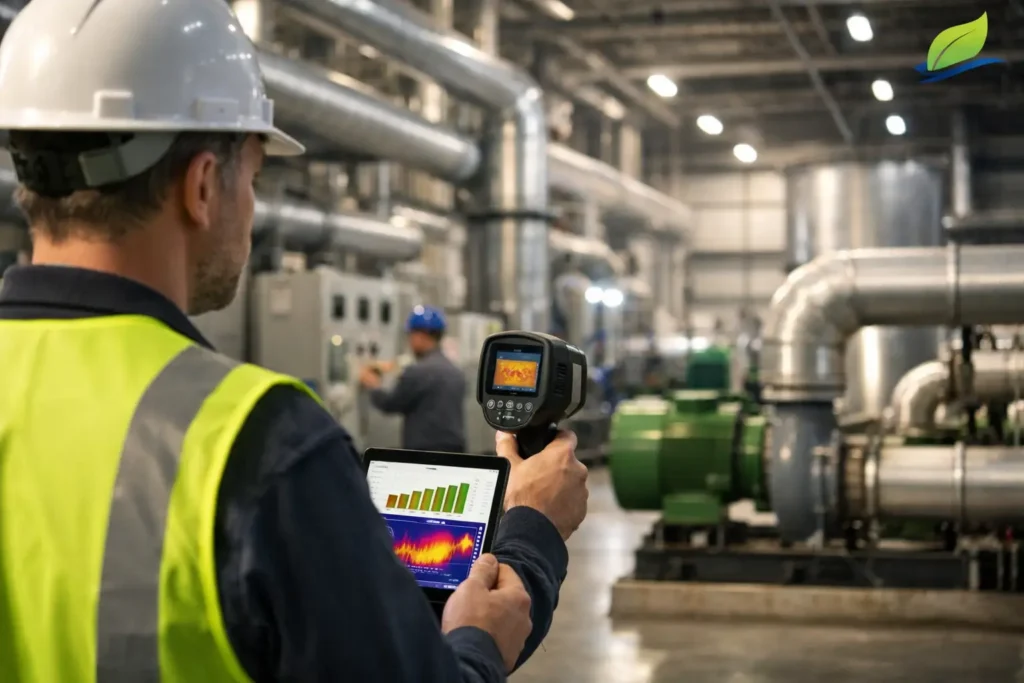
A sound engineering approach begins with measurements, operational simulations, and scenarios for different business conditions.
Power and Capacity Are Not the Same
Two specifications determine the outcome of an energy storage project: power, expressed in kilowatts, and capacity, expressed in kilowatt-hours.
Power indicates how quickly the system can absorb or deliver energy.
Capacity indicates how long it can continue doing so.
A company that wants to reduce a short but significant demand peak may require high power and relatively limited capacity.
A cold storage facility that must keep critical equipment running during a longer outage requires a different power-to-capacity ratio.
A data center, manufacturing plant, and logistics facility cannot be designed according to the same template, even when their annual electricity consumption is similar.
For this reason, a BESS should not be selected solely according to the battery’s nominal capacity.
The design must also include:
- inverters or power conversion systems;
- the Energy Management System;
- electrical protection;
- the fire-safety concept;
- ventilation or container cooling;
- the grid connection;
- coordination with the existing UPS or generator.
Four Clear Signs That Energy Storage Should Be Assessed Immediately
Energy storage warrants a detailed feasibility study when a company has at least one of the following operating patterns:
- significant demand peaks that increase electricity costs;
- power outages with expensive operational consequences;
- solar generation that is not used at the most valuable time;
- planned growth in electrical demand.
The final factor is particularly important.
A new production facility, electrification of heating, industrial refrigeration, EV charging infrastructure, or expansion of data systems may require greater grid connection capacity.
In certain cases, a BESS can help manage the increase in demand without an immediate and costly upgrade of the grid connection.
However, it should not be presented as a universal substitute for grid infrastructure.
If the new load is continuously high, increasing the connection capacity may still be unavoidable.
The Financial Assessment Must Cover the Entire Service Life
The lowest initial battery system price does not necessarily represent the best investment.
A sound business decision should include the total cost of ownership:
- engineering and design;
- electrical infrastructure;
- on-site works;
- the Energy Management System;
- maintenance;
- expected battery degradation;
- warranty conditions;
- future expansion options.
Operating cycles require particular attention.
A battery that completes several cycles every day will have a different aging profile from a system that is activated only as an emergency reserve.
Temperature, depth of discharge, the available charging window, and the control strategy directly affect performance throughout the system’s operating life.
A professional project should therefore not be based solely on the nominal energy available on the first day. It should consider the guaranteed operating parameters over the agreed service period.
The return on investment most often comes from a combination of several value streams rather than a single benefit.
These may include:
- reduced peak demand;
- higher self-consumption of solar energy;
- avoided losses caused by operational interruptions;
- lower generator fuel consumption;
- deferred investment in grid connection infrastructure.
The more of these benefits that are present at a single location, the stronger the business case for energy storage becomes.
From a Battery to a Managed Energy System
A BESS delivers its full value only when it is controlled according to the company’s operational priorities.
The Energy Management System must know:
- when to charge the battery from the solar power plant;
- when to limit power drawn from the grid;
- which loads to protect during an outage;
- when to preserve stored energy for a later critical period.
This is where equipment sales and energy engineering differ.
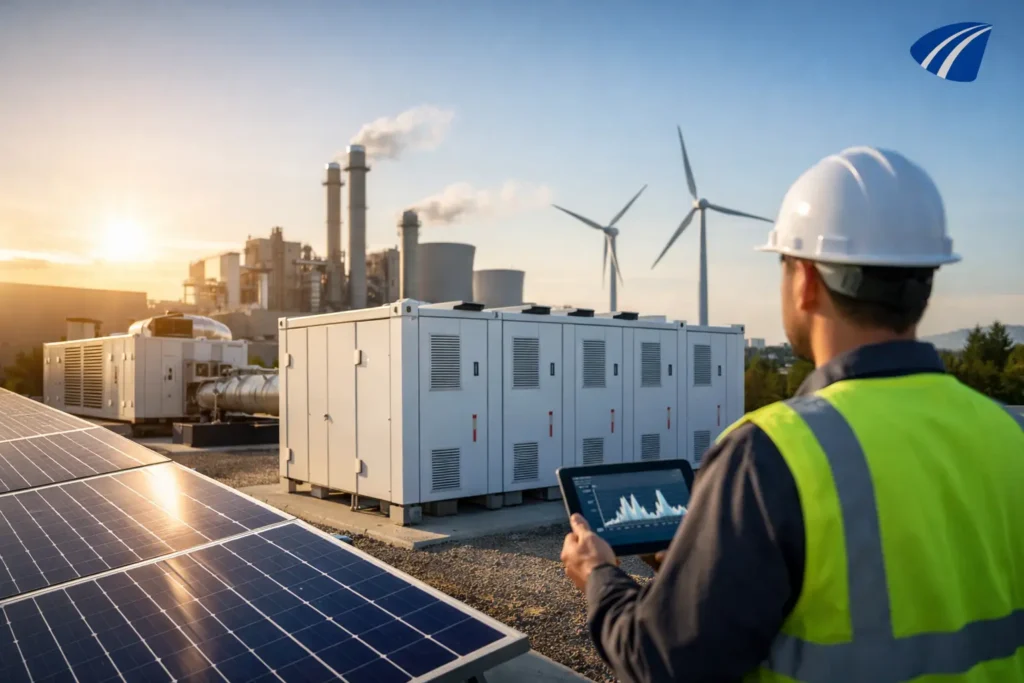
The project requires the coordinated integration of the solar power plant, storage system, grid connection, UPS, generator, HVAC infrastructure, and protection systems.
A single incorrectly defined switching or control sequence can reduce the system’s benefits or compromise power supply reliability.
For industrial companies, it is therefore essential to work with a partner who assumes responsibility for the complete concept—from the feasibility study and system design to commissioning and maintenance.
Energize approaches storage projects as part of a wider energy infrastructure.
The objective is not to install the greatest possible number of battery modules, but to design a system that matches the actual operation, cost structure, and growth plans of the facility.
Measure the Problem Before Selecting the Technology
A company should not invest in energy storage simply because battery technology is currently receiving attention.
It should invest when accurately measured data demonstrates that energy storage can reduce costs, increase production availability, or support safer business growth.
A properly prepared feasibility study turns the decision from an assumption into an investment plan with clear technical and financial parameters.
If your facility experiences high demand peaks, operates critical processes, or produces solar energy that cannot be used when it is most valuable, the next step is not selecting a battery from a catalog.
The next step is to analyze consumption and design a system that turns energy into a measurable business advantage.