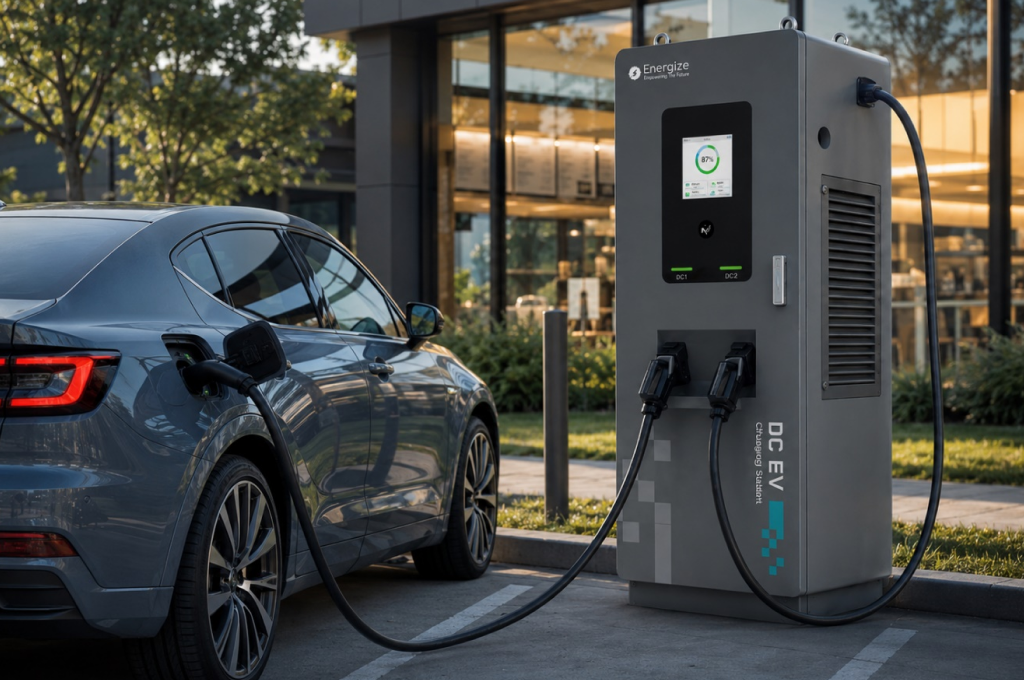
Anyone who has charged an electric car has noticed it: at the start the percentages fly, and near the end they crawl. The first eighty percent arrives quickly, while the last twenty seems to hesitate. The first instinct is that something is wrong, that the charger has weakened or something has broken. Nothing is broken. It’s the battery that has decided to slow down, and it does so on purpose.
The Charger Doesn’t Set the Speed — The Battery Does
Contrary to expectation, the charger doesn’t “push” as much energy into the battery as it likes. It offers, and the battery takes only as much as it can and is allowed to accept at that moment. That exchange is governed by the battery management system (BMS) in the vehicle, at every instant it tells the charger how much power to send. This is why even a high-power charger doesn’t run at full power the whole time: it follows what the battery permits.
The Charging Curve
Charging a lithium battery doesn’t proceed evenly, but along a curve. In the first phase the battery accepts full current power is high and the percentages climb quickly. This is the part where most of the capacity is filled. As the battery nears the top, the cell voltage approaches its upper limit, so the system gradually reduces the current. Power falls, and with it the speed at which the percentages rise.
The closest image is filling a glass of water. While it’s empty, you pour fast; as it nears the brim, you slow down so it doesn’t overflow. The battery does the same, except that “overflowing” here isn’t spilled water.
Why It Has to Slow Down
The reason is chemistry. When a cell is nearly full, continuing to force high current into it would push the voltage past a safe limit. That triggers what’s called lithium plating instead of settling in neatly, the ions deposit as a metallic layer, which permanently damages the cell, generates heat, and in the worst case becomes a safety risk. To prevent this, the BMS deliberately reduces the flow at high states of charge. The slower ending isn’t a flaw, it’s the battery protecting itself.
Why Manufacturers Quote “10–80%”
This is exactly why manufacturers almost always state charging speed for a range of 10 to 80 percent, not to 100. Above eighty percent the speed drops sharply, so the last twenty percent can take as long as the first sixty. On a fast charger, topping up to 100% rarely pays off: it spends a disproportionate amount of time for a little extra range.
A simple practice follows from this. At a fast-charging station it makes sense to leave at around 80% and carry on; topping up to a full 100% is best done at home on an AC charger, overnight, when time doesn’t matter. At a public station it’s also a matter of courtesy, occupying the charger for the last, slowest percentages means blocking it for those who are waiting.
Why You Barely Notice It on a Home Charger
On an AC charger at home this drop is hardly felt, and that makes sense. There the power is low to begin with — eleven or twenty-two kilowatts, far below what the battery can accept even when fairly full. The limit there isn’t the battery but the charger, so the curve stays almost flat. The slowdown at the top is visible only on a fast charger, where the charger can deliver more than the battery will allow.
The slower ending, then, isn’t a fault or a defect in the equipment, but a battery managing its own health. Once you know this, you plan a trip differently and it becomes clear why “fast” and “all the way” aren’t the same goal when charging.