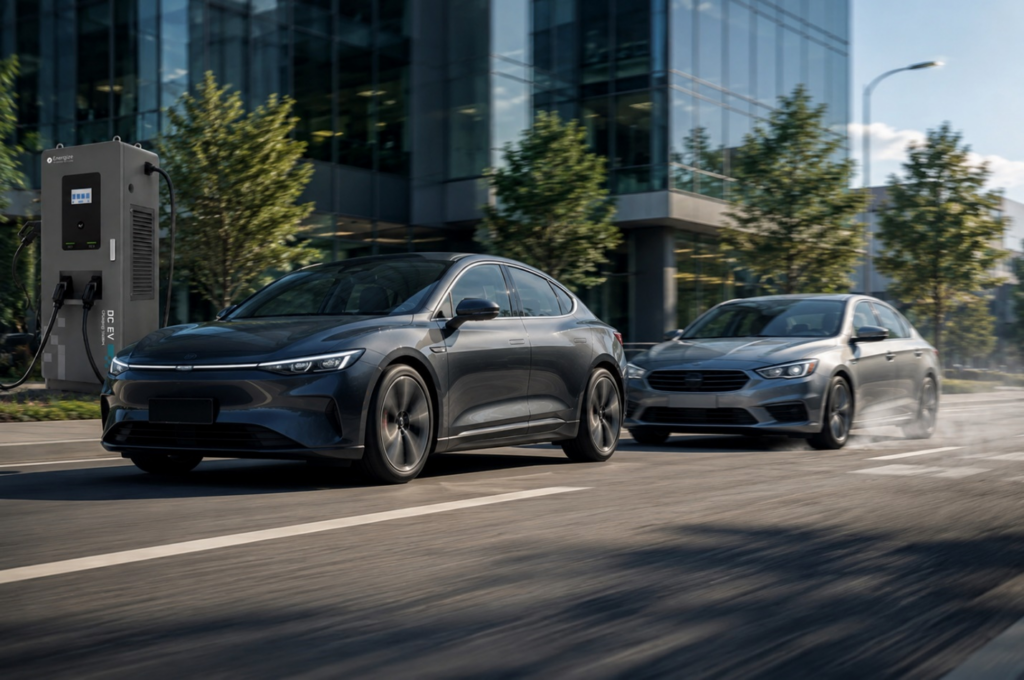
Anyone who has driven both feels the difference in the first few seconds. An electric car doesn’t “wind up” — it sets off immediately, smoothly and without interruption, in one continuous surge. A petrol car, even a fast one, accelerates in waves: the engine revs, the gearbox shifts, and then it starts over again. The difference isn’t simply that one is stronger, it’s in how the force reaches the wheels.
What You Feel Is Torque, Not Power
It’s worth separating two things that are often confused. Power tells you how quickly the engine does work and largely determines top speed. But what pins you to the seat as you pull away is torque, the force with which the motor turns the wheels. Acceleration depends above all on the torque at the wheels, and here the electric motor and the combustion engine behave completely differently.
An Electric Motor Delivers Full Torque From Zero
An electric motor develops its maximum torque practically from a standstill. The moment you press the pedal, the full force is there no waiting, no winding up, no delay. There’s no idle while a turbo “catches,” no moment in which the clutch and gearbox get ready; the link between the pedal and acceleration is almost instantaneous. That’s why an electric car “jumps” off the line: it doesn’t have to prepare anything, the force is available from the first millimeter of pedal travel. That feel is why even a modest city EV can seem quicker than its figures suggest, especially pulling away from a traffic light.
A Petrol Engine Has to Wind Up First
The internal combustion engine works the opposite way. At low revs it produces little torque; to reach its full power, it has to wind up into a narrow rev band where it’s “in its element.” Because of this, a petrol car first builds revs and only then pushes and the sensation is that acceleration arrives with a small run-up rather than at once. Diesel and petrol engines differ in how wide that band is, but neither comes close to the range over which an electric motor stays usable.
Why a Petrol Car Has a Gearbox and an Electric Car Doesn’t
This is also the reason for the gearbox. Since a combustion engine works well only within a narrow rev range, multiple gear ratios are needed to keep returning the engine to that range hence the shifting of gears. An electric motor delivers useful torque across a very wide range, from zero to very high revs, so a single fixed ratio is enough, with no gearbox and no shifting.
The consequence is felt directly. An electric car accelerates in one pull, without the interruptions in force that a gearbox produces at every shift. A petrol car accelerates in jumps: surge, gear change, then another surge. It’s precisely that continuity that makes even a moderately powerful electric car feel eager, especially in city driving.
Why the Advantage Fades at High Speed
That powerful sensation is strongest from a standstill and at medium speeds. As speed rises, the electric motor enters a regime in which power stays roughly the same but torque drops, so the forceful push into your back eases off. That’s why an electric car is most convincing from the start and in town, while at very high speeds the gap to a powerful petrol car narrows.
In the end, the difference in acceleration isn’t just a number in a table, but the shape in which the force arrives instant, flat and unbroken in the electric car, gradual and interrupted in the petrol one. That’s why two cars with similar zero-to-sixty figures on paper can drive entirely differently: one delivers everything at once, the other only once it has wound up and shifted into the right gear. The number is the same; the experience is not.