The highest concentration of heat pumps in Europe is not found in the mild Mediterranean countries, but in Scandinavia. In Norway, roughly six out of ten households have a heat pump, more than anywhere else in the world, with Finland and Sweden close behind. The technology still rumored to “fail in the cold” is thus most widespread in the coldest markets on the continent.
The explanation lies not in climate but in design. Modern units developed for cold climates deliver heat at outdoor temperatures of -25°C, and the Scandinavian experience shows that viability depends less on air temperature than on how well the system fits the specific building. For the owner of a commercial building, the question is therefore not whether heat pumps work, but whether they suit that particular property.
The answer is not always yes. A heat pump is an excellent solution for one type of building, a conditional one for another, and the wrong one for a third. The difference is not visible in a brochure; it emerges from a handful of criteria checked before the decision.
A heat pump does not generate heat, it moves it
A boiler burns fuel and turns one kilowatt-hour of energy into at most one kilowatt-hour of heat, in practice less. A heat pump works on a different principle: instead of converting electricity into heat, it uses electricity to move heat that already exists in the outdoor air into the building. For every kilowatt-hour of electricity invested, it delivers three to four kilowatt-hours of heat. That ratio is called COP (coefficient of performance), and it is why a heat pump heats far more cheaply than direct electric heating and, as a rule, than a boiler.
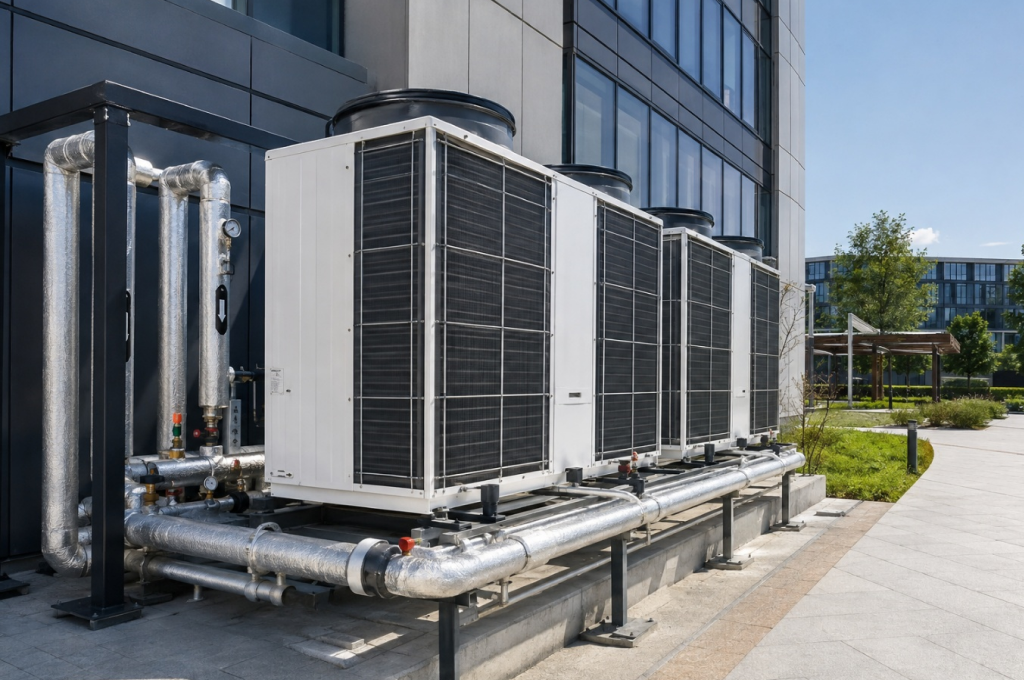
There is heat even in air that people experience as bitterly cold, so modern machines extract usable energy well below freezing, hence the Norwegian numbers. The device is also reversible: in summer, the same circuit runs in the opposite direction and cools the space. For commercial buildings, which must provide cooling anyway, this means one plant takes over the role of both the boiler and the chiller.
What matters is seasonal efficiency, not the catalog figure
The catalog COP is typically stated at an outdoor temperature of +7°C and a low water temperature, the conditions of a mild October day, not a January morning. As the outdoor temperature drops and the required water temperature rises, performance declines. A machine that runs very economically in the shoulder seasons can, tied to old radiators on a freezing day, slide close to the threshold of viability.
A serious decision is therefore based not on a single catalog point but on SCOP, the seasonal efficiency that evaluates operation across the entire heating season for a specific climate and temperature regime. Two temperatures decide the outcome: the outdoor one, which cannot be influenced, and the water temperature in the system, which is a matter of design. That is why the same heat pump produces two entirely different electricity bills in two different buildings.
Its natural territory is buildings that need both heating and cooling
A heat pump performs best when four conditions align. The first is a well-insulated building, newly built or thoroughly renovated, because low losses mean low required temperatures. The second is low-temperature distribution: underfloor heating, fan coil units, or surface systems, which run on much cooler water than old radiators. The third is a need for both seasons, since offices, hotels, and retail spaces cool in summer anyway, so a reversible heat pump comes not as an extra system but as one system replacing two. The fourth is available electrical connection capacity, since the energy for heating shifts to the electrical supply.
In buildings that meet these conditions, the heat pump is not a compromise but the most rational option: one plant for both seasons, one maintenance contract, and no combustion, chimney, or fuel storage on the premises. This is why new office buildings and hotels increasingly specify it as the primary source rather than an auxiliary one.
Old radiators and poor insulation change the math
The most common candidate for disappointment is an older building with radiators designed for high water temperatures. A heat pump can heat that water, but with an efficiency that drops precisely when heating is needed most. Poor insulation doubles the problem: high losses demand even hotter water, so the system consumes a great deal of electricity for modest comfort. In such a building, simply swapping the boiler for a heat pump does not save money; it merely moves the cost from one bill to another.
The same applies to buildings with high-temperature process needs, where production requires steam or water at temperatures standard heat pumps cannot reach economically. The order of moves is therefore clear: first the envelope and the distribution, insulation, windows, a shift to low-temperature emitters where feasible, and only then the heat source. A heat pump rewards a well-prepared building and punishes improvisation.
A hybrid with the existing boiler is often the most rational transition
Between “all heat pump” and “keep the boiler” there is a middle path that in practice proves the most cost-effective for existing buildings. In a hybrid system, the heat pump carries most of the season, while the existing boiler steps in only on the coldest days, when demand peaks and the heat pump’s efficiency is at its lowest. The pump is then sized not for an extreme that lasts a few days a year, but for the conditions in which it operates for thousands of hours.
For the owner, this means a smaller investment, lower required connection capacity, and built-in redundancy, because if one source stops, the other takes over. The controls select the source according to outdoor temperature and energy prices, so the building is always heated by the cheaper of the two. For a large share of the existing commercial stock, a hybrid is the fastest way to cut consumption without risk and without interrupting operations.
The decision belongs to calculation, not ideology
A heat pump is a tool, not a matter of conviction. The Scandinavian record confirms that the technology works reliably in serious frost, but it does not remove the need for calculation: heat losses, the temperature regime of the distribution system, operating hours, energy prices, and available capacity produce an answer no brochure can replace. The same technology pays back its investment in a few years in one building and remains an expensive gesture in another.
The choice of a heat source should therefore be seen as a decision about long-term operating costs and asset value, not a question of technological fashion. A building that heats and cools efficiently, with low and predictable bills, is easier to lease, easier to sell, and better prepared for the energy regulations that tighten across Europe year after year. Where the calculation for a specific building confirms its place, a heat pump is the shortest route to such a property; where it does not, the more honest answer is a hybrid or a different solution. The difference between those two outcomes is made not by the technology but by the seriousness of the preparation.