
When a company considers investing in its own electricity generation, the most expensive mistake is not the size of the investment but the wrong assumption at the very beginning. That is why a solar power plant feasibility study is not an administrative step, but the technical and financial foundation of the entire decision. It determines whether the project makes sense, under which conditions it delivers the expected return, and which technical solution truly aligns with the facility’s consumption profile.
For industry, logistics centers, commercial buildings, and energy-intensive systems, the decision to invest in solar cannot be reduced to the number of panels and a rough estimate of savings. It requires a clear understanding of actual consumption, peak loads, available space, grid connection constraints, structural integrity, orientation, shading, and regulatory conditions. Without this, investors often end up with systems that are installed but not optimized.
What a Solar Feasibility Study Includes
A high-quality solar feasibility study integrates technical analysis, financial evaluation, and risk assessment. Its purpose is not to validate a predefined decision, but to provide a reliable basis for determining whether to proceed, at what system capacity, and under which implementation model.
The first layer is consumption analysis. This goes beyond total annual electricity bills to include monthly, daily, and hourly consumption profiles. This is critical because identical annual consumption can lead to very different financial outcomes. A facility that consumes most of its energy during the day when solar production is highest has significantly better potential than one with dominant nighttime consumption.
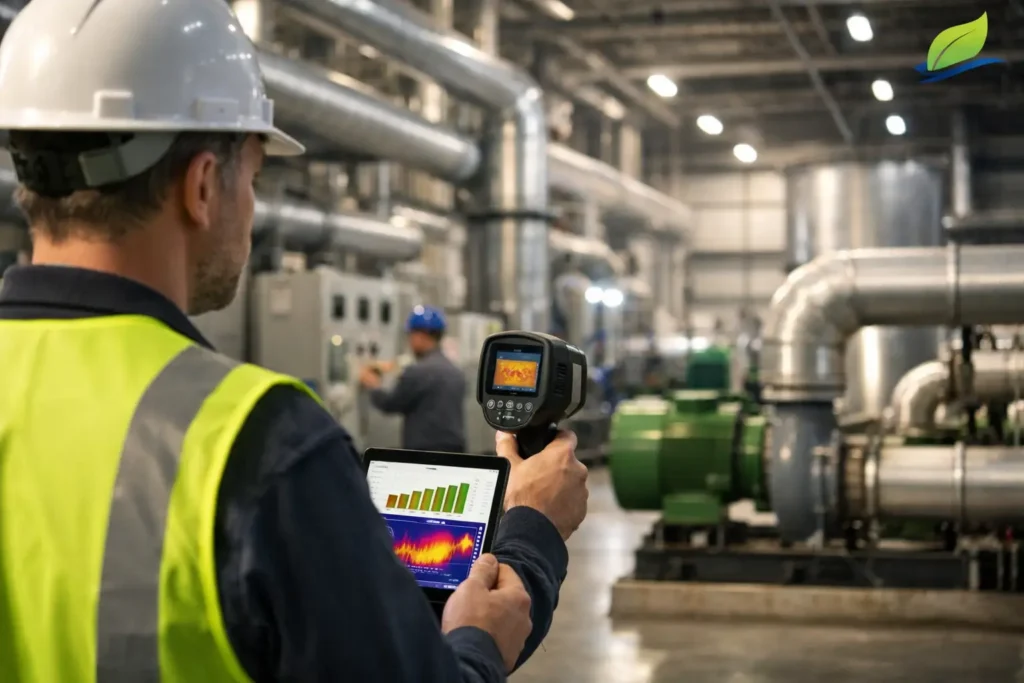
The second layer is site analysis. This includes evaluating available roof or ground areas, tilt and orientation, shading impact, structural condition, and installation feasibility. In industrial facilities, roof structural capacity is often a decisive factor. If reinforcement or rehabilitation is required, the financial model changes accordingly.
The third layer focuses on electrical conditions. This includes assessing how the system will integrate with existing infrastructure, identifying any grid connection limitations, evaluating internal network capacity, and determining whether additional upgrades are required for protection, metering, or energy management. For serious energy users, this is where the difference between equipment sales and engineering expertise becomes evident.
Why a Feasibility Study Matters More Than a Quote
A quote can be delivered quickly. A feasibility study should not be superficial. When an investor asks only for a price per installed kilowatt, they receive a rough estimate but not a foundation for decision-making. Equipment cost alone does not indicate whether the system will operate optimally, how much it will produce, how much energy will be consumed on-site, or when the investment will realistically pay back.
This is why a solar feasibility study must answer the key questions that finance teams, management, and technical departments ask before approving an investment. What is the expected annual production? What percentage of generated energy will be self-consumed? How much will electricity costs be reduced? What are the key technical risks? Is adding battery storage justified? And perhaps most importantly should the system be implemented in full capacity immediately or in phases?
This is where the difference lies between projects that look good in presentations and those that deliver predictable results in operation. A serious investor does not simply purchase a solar plant, they invest in energy stability, lower cost per kilowatt-hour, and greater control over long-term operating expenses.
How Project Profitability Is Assessed
The financial component of the study goes far beyond estimating annual savings. It evaluates the relationship between investment and expected benefits over the entire system lifecycle. This includes CAPEX, maintenance costs, equipment degradation, electricity price projections, potential connection costs, insurance, and the replacement of key components during operation.
While payback period is commonly used, it is not the only relevant metric. For companies making capital investment decisions, net present value (NPV), internal rate of return (IRR), and total cost of ownership (TCO) are equally important. A project with a slightly longer payback period may still be the better choice if it delivers higher reliability, lower operational risk, and better integration with existing infrastructure.
There is no universal answer. For manufacturing facilities with stable daytime consumption, solar often has a clear economic advantage. For facilities with highly variable loads or limited available space, the financial model may require more precise optimization or integration with a BESS (Battery Energy Storage System). That is why profitability must always be assessed based on the specific consumer profile not through generic assumptions.
Technical Risks and Feasibility Studies
Most issues in the market do not arise from unreliable solar technology, but from improperly sized systems or poor integration with existing infrastructure. A feasibility study must therefore identify risks before the project enters the execution phase.
One category of risk is structural and mechanical. Can the roof support the additional load? What is the condition of waterproofing? Are structural modifications required? Another category is electrical ranging from grid connection quality and protection systems to compliance with technical standards and distribution network requirements.
The third category is operational risk. If a company relies on uninterrupted power supply, a standalone solar system may not be sufficient. In such cases, the study should evaluate whether the project makes more sense when combined with battery storage, UPS systems, generator backup, or advanced load management. The investor is then assessing not just energy production—but the entire energy architecture of the facility.
When Is the Right Time for a Feasibility Study
The optimal moment is before requesting final offers and before any internal investment approval. If the study is conducted too early without sufficient consumption and site data—it produces generic conclusions. If conducted too late, the company may already have formed expectations based on simplified assumptions that later require correction.
For companies planning production expansion, facility upgrades, or changes in energy usage patterns, the study is especially important. A solar system should be aligned with the future state of the facility not just current consumption. If energy demand is expected to change significantly within the next two to three years, system sizing must reflect that evolution.
The same principle applies to households, although with simpler parameters. A home with a heat pump, EV charger, or planned extension has a different potential than one with stable and low consumption. A good analysis saves money both before installation and throughout the system’s lifecycle.
What Investors Should Expect from a Project Partner
If a solar partner offers only equipment and a rough production estimate, the investor still carries a significant portion of the risk. In contrast, a partner who delivers feasibility studies, system design, integration, and turnkey implementation assumes far greater responsibility for the result.
This is particularly important for complex systems where solar is not a standalone investment. In industry, data centers, telecommunications, and facilities with high uptime requirements, it is necessary to align generation, storage, backup power, protection systems, and monitoring. This requires engineering depth not just a commercial offer.
That is why a serious feasibility study must be clear, verifiable, and based on real input data. Its purpose is not to present an idealized project, but to establish a solid foundation for it. This is the approach taken by companies such as Energize, which evaluate investments through system performance, long-term reliability, and total cost of ownership not just initial price.
How Much a Good Study Impacts the Final Outcome
Far more than investors often expect. A properly executed feasibility study can prevent system oversizing, avoid unnecessary construction costs, improve self-consumption rates, and accelerate internal decision-making. At the same time, it may reveal that a project in its current form is not optimal, which is equally valuable, as it prevents a poor investment.
The greatest value lies not in the document itself, but in the quality of the decision it enables. When you understand how much the system can produce, how it integrates with the facility, where the limitations lie, and what the realistic financial impact is, negotiations, budgeting, and execution become significantly more predictable.
If you are considering investing in your own energy production, do not start by asking for the price of a solar system. Start by determining whether the project is technically and economically justified for your facility because that is where the difference is made between an expense and a strategic investment.