In cold storage facilities and temperature-sensitive spaces, HVAC is not a comfort issue. It is about preserving goods, stabilizing processes, and maintaining a reliable supply chain. In these buildings, temperature directly affects product quality, shelf life, safety, and financial risk. If conditions are not kept stable, the consequences can include product loss, claims, delivery disruption, or loss of customer trust.
Cold storage facilities are energy-intensive buildings. Refrigeration systems in these spaces often account for more than 70% of total electricity consumption, while refrigerated warehouses can use approximately 430 to 650 kWh per square meter per year. That is why HVAC and refrigeration systems should not be selected only by cooling capacity, but by stability, efficiency, and how the facility actually operates.
Temperature must remain stable, not only low
One of the most common mistakes is treating a cold room as a space that simply needs to be cooled. In practice, it is more important for the temperature to remain stable, especially for goods stored for longer periods or moved through several points in the supply chain.
Chilled spaces usually operate above 0°C, while frozen spaces operate below 0°C. For frozen food, typical storage ranges are often around −18°C to −35°C. For medical and pharmaceutical products, requirements can be even stricter. Vaccines, for example, are often stored between 2°C and 8°C, while some frozen and ultra-cold chains require much lower temperatures.
This shows that cold storage is not one single category. A space for fruit, meat, pharmaceutical goods, frozen products, or temperature-sensitive logistics cannot operate under the same conditions.
Doors, docks, and goods movement change conditions
In cold storage, many problems do not appear while the space is closed and stable, but during operation. Every door opening brings in warm and humid air. Every incoming product load changes the thermal load. Every movement through docks, anterooms, and picking zones affects temperature stability.
If the system is not designed for the real operating rhythm of the facility, temperature can fluctuate frequently. This increases refrigeration load, energy consumption, and the risk of condensation, ice formation, or product-quality decline.
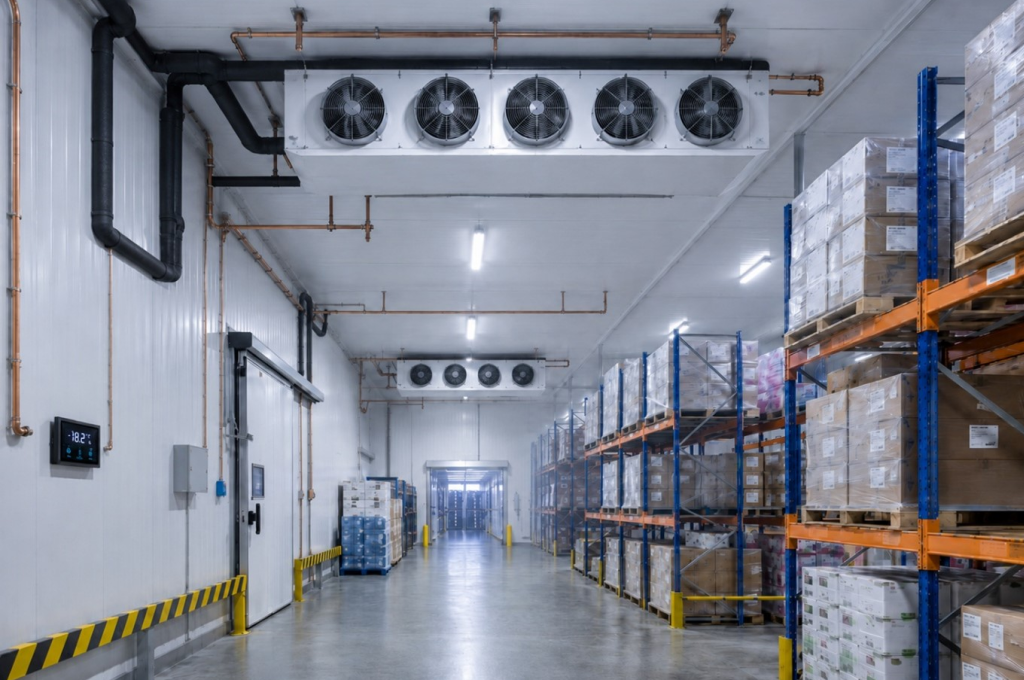
That is why anterooms, air curtains, fast doors, strong insulation, infiltration control, and clear zoning are especially important in cold storage. A powerful refrigeration system alone is not enough. The goal is to prevent unnecessary losses and allow the space to recover quickly after door openings or goods intake.
The goods define the HVAC logic
In temperature-sensitive spaces, the product is the starting point. Some goods only need protection from high temperatures. Others require a strictly defined temperature range. Some are sensitive to humidity, condensation, particles, or changes during transport and storage.
For food, shelf life, texture, microbiological safety, and quality stability are important. For pharmaceutical products, proof of conditions, continuous measurement, and excursion control matter. For electronics or special materials, humidity and condensation can be just as problematic as temperature.
That is why cold storage is not designed only by room volume. It is designed according to product type, storage duration, inbound and outbound flow, allowed deviations, and monitoring requirements.
Energy efficiency depends on details
In cold storage, small details have a large effect. Poor door sealing, weak insulation, unbalanced airflow, frequent dock openings, or inadequate defrosting can significantly increase energy use. Because refrigeration equipment operates for long hours under constant load, every inefficiency quickly becomes a cost.
In larger cold stores, a well-maintained system can achieve much better specific consumption per cubic meter of space. In practice, large and well-managed facilities can reach significantly lower consumption values than smaller or poorly optimized cold rooms. This means building size is not the only factor; work organization, control, and maintenance often make a greater difference than equipment alone.
Efficiency is achieved through a combination of strong insulation, proper sizing, optimized defrosting, fan control, temperature monitoring, and a service plan. The system should not operate harder than needed, but it must react quickly enough when conditions change.
Monitoring is part of product safety
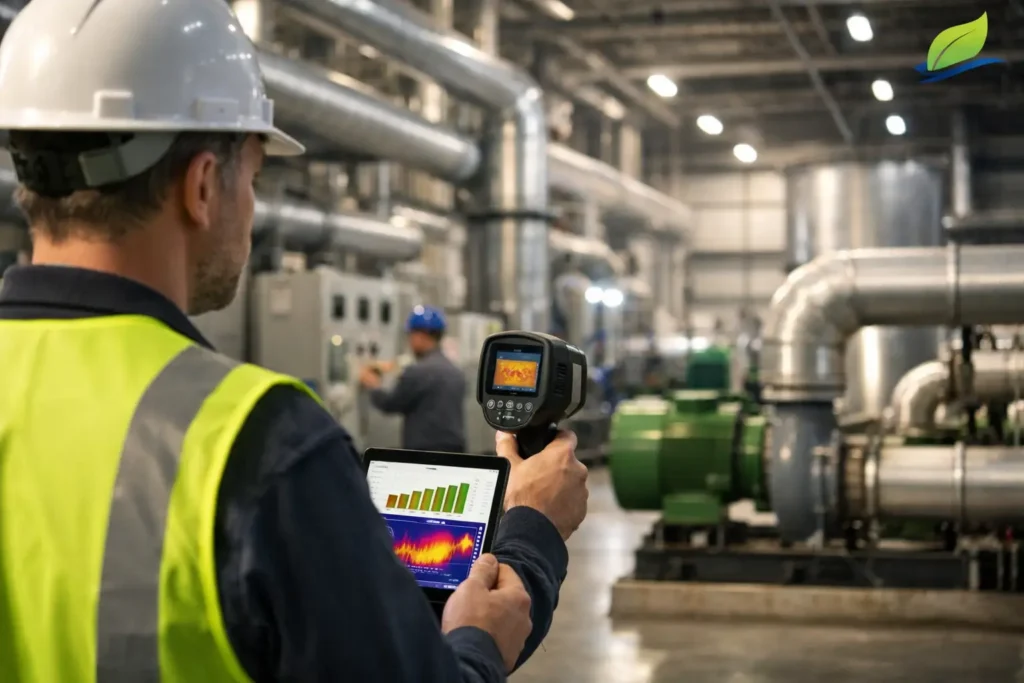
In cold storage and temperature-sensitive spaces, monitoring is not an extra feature. It is a core part of control. Temperature needs to be measured, recorded, and tracked, especially when goods are sensitive or regulated. One short deviation may be less important for some products, but critical for pharmaceuticals, vaccines, or fresh food.
A good system should provide alarms, trend tracking, and equipment-performance visibility. If temperature slowly moves outside the required range, the system should react before damage occurs. The same applies to doors left open, fan failure, defrosting problems, or reduced refrigeration capacity.
Without monitoring, a problem is often discovered only after the goods are already at risk. With monitoring, cold storage becomes a more predictable and secure part of the supply chain.
Common mistakes in cold storage
The most common mistakes occur when the system is selected only by required temperature, without understanding the goods and logistics. Another frequent mistake is neglecting doors, docks, and air infiltration. A third is poor maintenance, especially of filters, fans, evaporators, defrosting systems, and sensors.
Problems also appear when all parts of the facility are treated in the same way. Goods receiving, the main chilled area, freezer space, anterooms, and picking zones have different requirements. If they are managed under one operating mode, the system often consumes more energy while conditions remain less stable.
HVAC for cold storage and temperature-sensitive spaces should be seen as part of the quality system. When temperature, humidity, insulation, doors, monitoring, and service are properly aligned, the facility preserves goods better, uses less energy, and reduces the risk of expensive losses. In these spaces, good HVAC does not mean only cold air, but controlled conditions that protect product value.