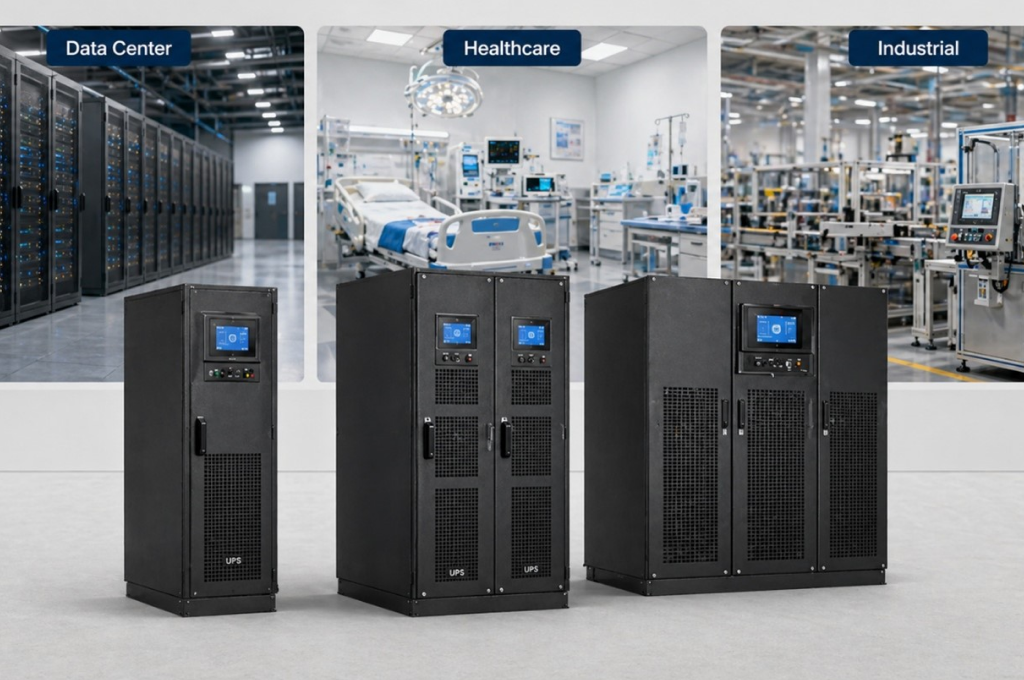
Every power outage has a price. For some businesses, that price is measured in lost data, for others in spoiled goods, halted production lines, or damaged client relationships. The difference between a company that treats a power outage as a minor inconvenience and one that suffers serious consequences often comes down to a single factor: whether a system exists to bridge that interruption. That is exactly why a UPS is not just a technical solution, but a tool for protecting revenue, business continuity, and client trust.
A UPS Uninterruptible Power Supply is exactly that system. But its role in modern infrastructure goes well beyond simply bridging a power cut. For many companies, a UPS is the difference between a short interruption and a serious business problem that brings extra costs, delays, and operational disruption.
What a UPS System Actually Does
A UPS sits between the utility grid and the equipment it protects. When power is stable, the UPS continuously charges its internal batteries while passing current through to connected loads. The moment an outage occurs, voltage drops, or serious grid disturbances appear, the system instantly switches to battery power with no interruption to the connected equipment.
Beyond outage protection, a UPS also filters and conditions the power supply removing harmonics, voltage spikes, sags, and frequency instabilities. For sensitive electronics, servers, medical equipment, and automated production lines, this conditioning function is just as important as outage protection itself. In practice, this means lower risk of equipment failure, more stable operation, and fewer unplanned interruptions that directly affect productivity.
Three Core UPS Topologies
Not all UPS systems work the same way. There are three fundamental topologies that differ in how the system interacts with the grid, in transfer time to battery, and in the quality of power they deliver to connected loads. Choosing the right topology often determines whether the client gets an optimal solution or a system that is either too weak for the actual risk or more expensive than necessary.
Online double conversion
The most robust UPS topology. Grid power passes continuously through the battery and inverter, meaning connected equipment never receives raw mains power directly. Transfer time is zero milliseconds because there is nothing to transfer the system is already supplying power from the inverter. Online UPS also provides complete voltage and frequency conditioning. It is recommended for data centers, hospitals, telecommunications infrastructure, and any system that cannot tolerate even a millisecond of interruption. Its greatest business value lies in minimizing the risk of downtime where even a single interruption can mean lost money, lost data, or contractual exposure toward clients.
Line-interactive
A balance between cost and performance. The UPS passes mains power through directly but automatically compensates for voltage variations without switching to battery. Only when an outage occurs does the battery activate with a transfer time of a few milliseconds. Suitable for smaller server rooms, office networks, and equipment that can tolerate a brief transition. This topology can be a good choice for companies that want essential protection with a controlled budget, while still safeguarding key digital processes.
Offline (standby)
The simplest topology. The UPS remains idle while the grid is stable and only switches to battery upon outage. Transfer time is between 10 and 30 milliseconds. Application is limited to less critical equipment, home offices, and systems that do not require power conditioning. For businesses with even the smallest risk of data loss, process interruption, or operational downtime, this topology is usually not sufficient as a long-term solution.
Capacity and Autonomy
Two parameters define UPS sizing: power in kVA or kW, which must cover the total load of connected equipment, and autonomy how long the UPS can supply that load during an outage.
Autonomy depends on battery capacity and load size. In most industrial and IT applications, the target autonomy ranges from 5 to 30 minutes enough time to start a diesel generator or safely shut down systems. Properly defined autonomy prevents a company from underinvesting and remaining unprotected, or overinvesting and unnecessarily increasing CAPEX.
One of the most common sizing errors is underestimating peak loads and future growth. Modular UPS systems address this directly: capacity is increased by adding modules rather than replacing the entire system, which means a lower initial investment and infrastructure that scales with actual demand. This is especially important for companies that are growing, opening new lines, expanding IT infrastructure, or trying to preserve flexibility without another major investment in two or three years.
When UPS Is Not Optional
There are sectors and situations where a UPS is not an option but an obligation — regulatory, technical, or commercial. Healthcare facilities must maintain redundant power supply under European standards EN 50171 and IEC 62040. Data centers offering services with guaranteed uptime cannot afford a single second of unplanned unavailability. Automated production facilities lose significant revenue with every unplanned stoppage.
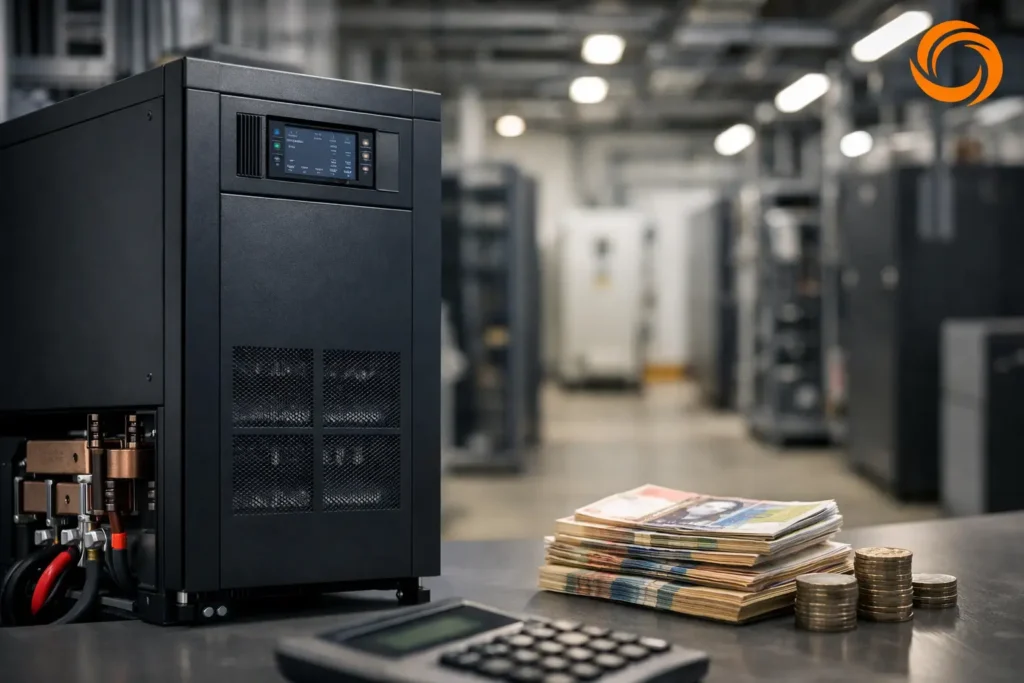
In food processing and logistics, a brief power outage can compromise an entire inventory or break the integrity of a cold chain. The cost of a single such incident typically exceeds the annual cost of the UPS system that would have prevented it many times over. In other words, the risk is not just technical. Without a UPS, a company can lose goods, data, production hours, customer trust, and money that is often measured in amounts far greater than the investment in the protection system itself.
More importantly, companies without a UPS often do not calculate the true cost of an interruption until the incident has already happened. That is when the cost of idle staff, system restarts, lost transactions, delayed deliveries, or reduced service quality becomes painfully clear.
UPS as Part of a Broader Energy Infrastructure
Modern UPS systems are not isolated boxes waiting for the lights to go out. They integrate with energy management platforms, monitor battery health in real time, generate alerts and reports, and in more advanced configurations actively participate in load management. This gives the client more than protection alone: better system visibility, easier maintenance planning, and greater control over critical infrastructure.
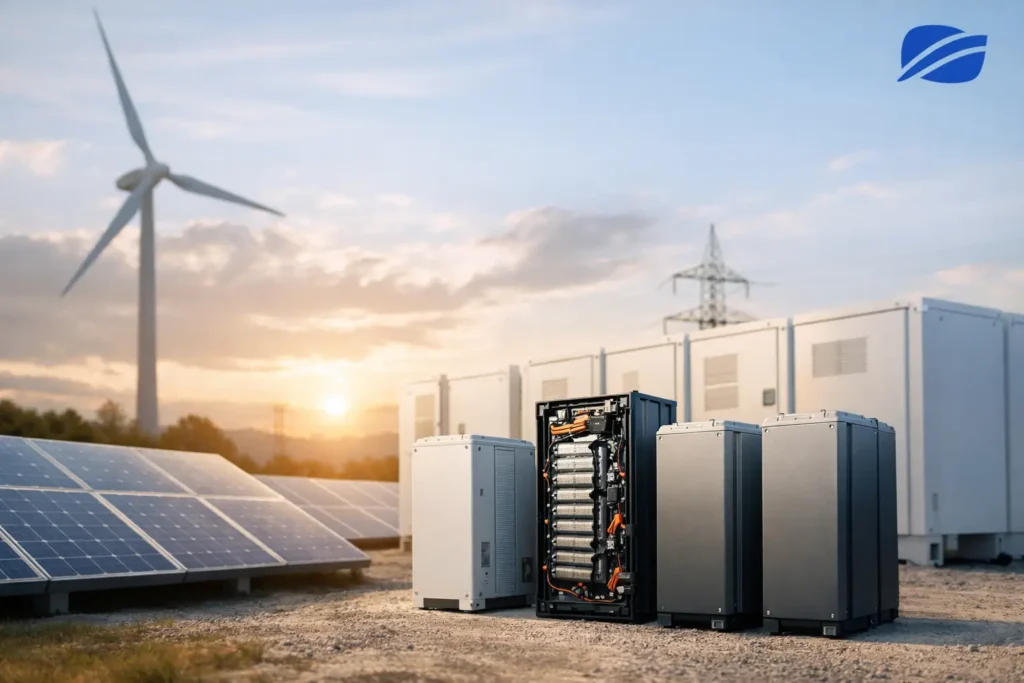
When a UPS is combined with a solar power plant and a battery energy storage system (BESS), it becomes part of a hybrid energy system that not only protects equipment but also optimizes electricity costs, reduces peak demand, and increases the site’s degree of energy independence. These configurations are covered in detail in subsequent articles in this series. This is especially relevant for companies that are no longer thinking only about backup, but also about energy efficiency, system resilience, and long-term reduction of operating costs.
A correctly sized, properly installed, and regularly maintained UPS is not an expense. It is risk management with a measurable financial return. That is why the right time to decide on a UPS system is before the first serious incident, not after it. Companies that introduce the right level of protection in time are not simply buying equipment they are buying stability, predictability, and the assurance that their business can continue operating even when the grid fails.