It is not only important how many kilowatt-hours a battery can store, but also how reliably it can deliver that energy when a production facility, server room, or solar power plant requires it. The question of lithium vs. lead-acid batteries is therefore not simply about technology for technology’s sake. It is a decision that directly affects business continuity, system availability, maintenance costs, and the total cost of ownership over the years ahead.
For smaller systems, the initial purchase price often appears to be the main criterion. In industrial facilities, telecommunications, logistics, data centers, and buildings with critical loads, this approach can become expensive. A battery system must be aligned with the consumption profile, load demand, required autonomy, charging regime, ambient temperature, and planned future capacity expansion. Only then does the comparison provide real business value.
Lithium vs. Lead-Acid Batteries: A Difference That Changes the Entire Project
Lead-acid batteries have been the standard solution for UPS systems, telecommunications, industrial backup power, and vehicles for decades. The technology is well established, widely available, and generally more affordable in terms of initial investment. In stationary applications, the most common options are VRLA batteries – AGM or GEL – as well as conventional flooded industrial cells where sufficient installation space and maintenance procedures are available.
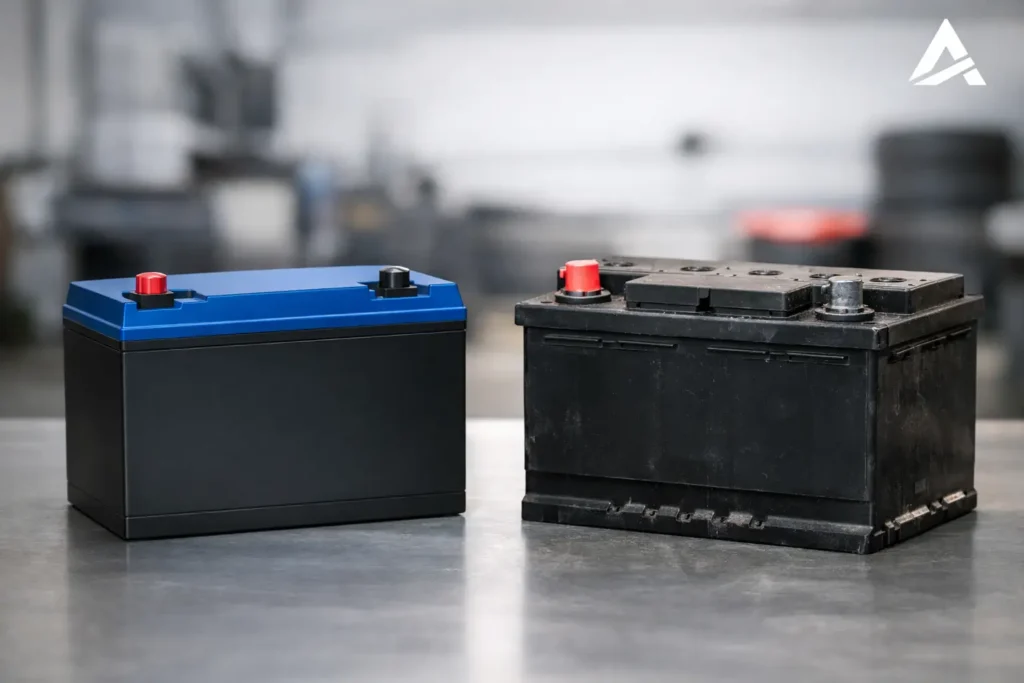
Lithium batteries for stationary energy storage are most commonly based on lithium iron phosphate chemistry, known as LFP or LiFePO4. These are not the same as the batteries used in smartphones and should not be evaluated through simplified comparisons. When properly engineered with an appropriate Battery Management System (BMS), adequate protection mechanisms, and suitable thermal operating conditions, LFP systems offer a high cycle life, greater energy utilization, and significantly lower space requirements.
The key difference is not only in the battery chemistry. Lead-acid batteries perform best when they are not deeply or frequently discharged. Lithium batteries can tolerate deeper discharge levels while maintaining a more stable voltage and experiencing less loss of usable capacity. As a result, two batteries with the same nominal energy rating in kWh may not deliver the same amount of usable energy in real-world operation.
Usable Capacity Matters More Than Nominal Capacity
If a lead-acid battery is designed to operate with a limited depth of discharge in order to preserve its service life, part of its nominal capacity remains practically unavailable. With LFP solutions, the permissible operating range is typically much wider, allowing a larger portion of the installed capacity to be used in everyday operation. This can reduce the number of required battery modules, installation space, and supporting infrastructure costs.
Battery system design therefore begins with more than simply determining how many kWh are required. It is equally important to define the required power output in kW, peak load duration, allowable depth of discharge, expected operating temperature, degradation reserve, and target backup autonomy. A system that appears correctly sized on paper but ignores these parameters may fail precisely when it is needed most.
Purchase Price vs. Total Cost of Ownership
Lead-acid batteries generally require a lower upfront investment. This is a genuine advantage for straightforward applications such as rarely activated UPS systems, short backup durations, limited budgets, and installations where available space is not critical. For certain backup applications, especially where only a small number of discharge cycles is expected, a properly selected lead-acid battery can be a rational choice.
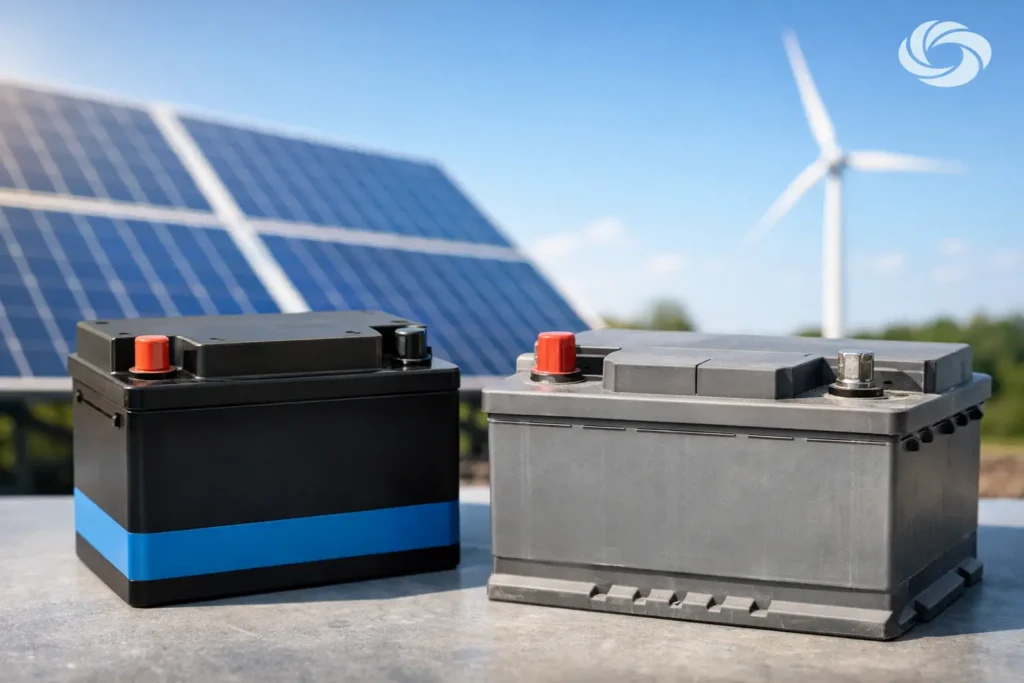
However, the initial purchase price does not represent the total economics of a project. In systems that charge and discharge every day—such as solar energy storage systems, peak shaving applications, or facilities with frequent grid interruptions—lithium technology often delivers a lower cost per usable kWh over its lifetime. This is primarily due to its longer cycle life, higher energy efficiency, and fewer replacement requirements.
Lead-acid batteries are more sensitive to deep discharge, insufficient charging, and elevated temperatures. In practice, this may result in earlier replacement, particularly if the system is operated differently from its original design assumptions. Lithium systems require a higher initial investment but typically retain their usable capacity much longer under intensive operating conditions.
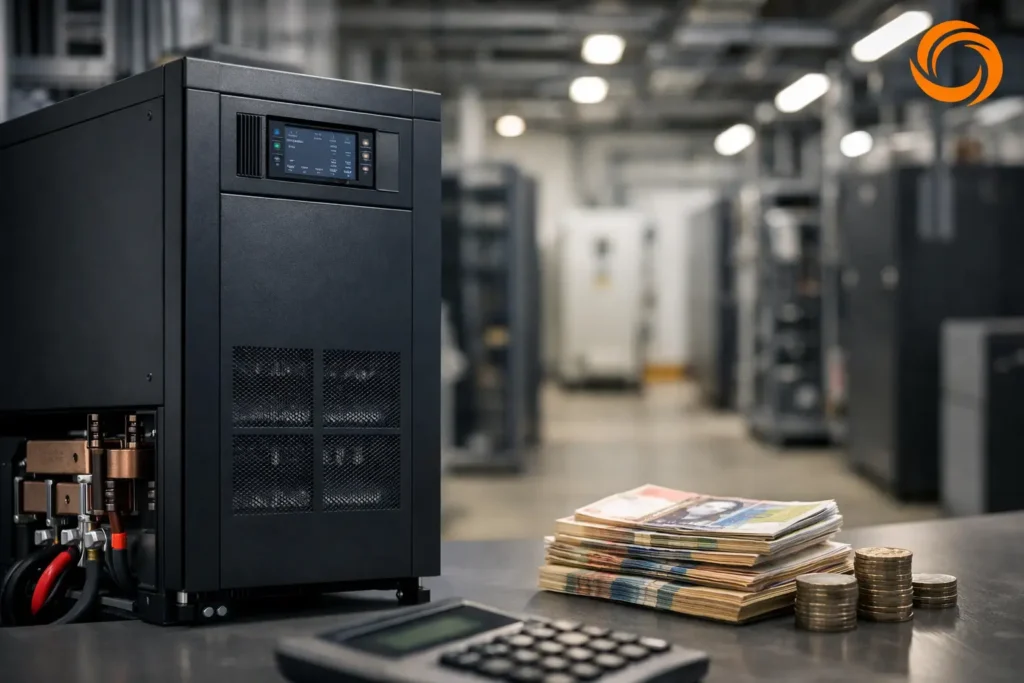
A Total Cost of Ownership (TCO) analysis should include not only battery purchase costs, but also replacement costs throughout the projected service life, charging and discharging losses, cooling requirements, installation space, installation work, monitoring, preventive maintenance, and the financial consequences of potential downtime. In a manufacturing facility where one hour of downtime can stop production, the cost of unavailable energy cannot be reduced to the price of a single battery module.
Efficiency, Power Output, and Load Performance
Lithium batteries provide high charging and discharging efficiency, which is particularly valuable when energy is generated by a solar power plant and used every day. Lower energy losses mean that a greater share of the generated solar energy remains available for self-consumption, evening operation, or reducing peak demand from the grid.
With lead-acid batteries, energy losses are higher, and the available capacity also depends on the discharge rate. At high discharge currents, the actual capacity may be lower than the rated value. This is especially important in UPS applications and systems with high-power loads, where the battery must deliver substantial power over a short period. LFP systems generally handle these operating conditions more consistently, although they must still be properly matched with the inverter, UPS, and designed load requirements.
Faster charging is another advantage of lithium technology. Following a power outage or a period of increased energy consumption, the system can restore its available energy reserve more quickly. However, charging speed should never be the objective on its own. It is essential to verify the available grid connection capacity, charger or inverter power, the solar generation profile, and any charging limitations specified by the battery manufacturer.
Space, Temperature, and Maintenance
In facilities where every square meter of technical space is valuable, energy density provides a practical advantage. Lithium systems generally require less space and weigh less than comparable lead-acid systems while delivering the same usable capacity. This simplifies installation in existing electrical rooms, containerized systems, and modular Battery Energy Storage System (BESS) configurations.
Depending on the battery type, lead-acid systems may require more installation space, ventilation, and stricter environmental monitoring. Flooded batteries require proper management of gases generated during charging. VRLA batteries are easier to install but remain sensitive to elevated operating temperatures. Any prolonged deviation from the recommended temperature range accelerates battery aging.
Lithium systems also require careful thermal design. The Battery Management System continuously monitors voltage, temperature, current, and cell condition, but the BMS is not a substitute for a properly engineered installation environment. Larger systems require appropriate cooling, fire protection, detection systems, system segmentation, ventilation where required, and clearly defined operating and maintenance procedures.
Safety Is a Matter of Engineering, Not Battery Chemistry
It is incorrect to claim that one battery technology is automatically safe while another is inherently dangerous. Every battery stores a significant amount of energy and must be engineered according to its intended application. Lead-acid batteries present risks associated with electrolyte, gas generation, and short circuits. Lithium systems require high-quality cells, a reliable Battery Management System, certified equipment, proper installation, and integrated protection systems.
Among lithium chemistries, LFP offers greater thermal stability than several alternative lithium technologies, which is one of the reasons for its widespread use in stationary energy storage. Nevertheless, the safety of the entire system depends on its architecture, component quality, communication between the battery and power conversion equipment, protection devices, and the expertise of the installation contractor. A battery should never be treated as a standalone purchase, it is an integral part of the electrical power system.
When Do Lead-Acid Batteries Still Make Sense?
Lead-acid batteries are not an outdated technology that should be automatically dismissed. They remain a practical solution for applications where the operating mode is primarily backup, discharge cycles are infrequent, required autonomy is short, and capital budgets are limited. Thanks to their widespread availability and established service practices, they remain a suitable choice for certain UPS installations, alarm systems, smaller telecommunications facilities, and auxiliary backup power systems.
Their limitations become more apparent when daily cycling is required. If the battery is expected to store surplus solar energy, supply evening loads, reduce peak demand, or frequently support the facility during grid instability, cycle life and efficiency become decisive factors. In these scenarios, lithium technology is generally the more economical choice over the system’s operating lifetime, despite its higher upfront investment.
How to Choose the Right Battery for Your Facility
The right decision begins with measurement, not catalog pricing. It is necessary to analyze the facility’s 15-minute load profile, peak demand, critical loads, frequency and duration of power outages, available grid connection capacity, solar generation profile, and future expansion plans. In a manufacturing plant, for example, the optimal solution may differ between production equipment, cold storage, administrative offices, and fire protection systems.
The battery’s primary function should then be clearly defined. Is the priority backup power, maximizing self-consumption of solar energy, peak demand reduction, power quality stabilization, or a combination of multiple objectives? A single battery system can support several business requirements, but only if the inverter, control logic, and battery capacity are designed accordingly.
Energize approaches battery technology selection through a comprehensive feasibility study and an evaluation of the project’s total economic performance, rather than through an isolated comparison of battery prices per kWh. Integrating solar generation, battery storage, UPS systems, cooling infrastructure, and energy management ensures that every component has a clearly defined function and a measurable impact on energy consumption, operational continuity, and business risk.
The battery with the lowest purchase price is not necessarily the most cost-effective solution for your business. The right choice is the one that delivers the required power and autonomy under the intended operating conditions, protects the availability of critical processes, and justifies the investment through measurable results throughout the entire lifecycle of the system.