A New Item on the Exporter’s Balance Sheet
Every company exporting to the European Union is including new costs in its calculations. CBAM, EU ETS, environmental fees, and Guarantees of Origin are no longer future obligations but line items reported every quarter.
Green hydrogen in Serbian industry is usually analyzed through the price per kilogram. A more practical analysis also accounts for the cost of staying on gray hydrogen. For a typical plant exporting to the EU, the difference reaches several million euros per year.
CBAM: The Border That Costs
The Carbon Border Adjustment Mechanism is the EU regulation requiring Serbian exporters of steel, iron, aluminum, fertilizer, cement, hydrogen, and electricity to report the CO2 emitted during production. Based on those emissions, a levy is calculated at the same price European plants pay under the EU ETS system.
The CO2 certificate price in the EU currently ranges between EUR 70 and 90 per ton. For a Serbian fertilizer plant emitting around 200,000 tons of CO2 per year due to gray hydrogen in ammonia, the annual CBAM bill amounts to between EUR 15 and 18 million. For a steel mill, the figure is higher.
When gray hydrogen is replaced with green, the calculation changes. Ammonia produced from green hydrogen does not enter the CBAM obligation on the hydrogen side. The Guarantee of Origin is the document submitted with the report and directly affects the final amount.
Environmental Fees in Serbia
Serbia has introduced several environmental fees in recent years: emission fees, air-use fees, pollution charges, and specific fees for sulfur dioxide, nitrogen oxides, and particulate matter. The amounts are currently modest compared to the EU but are growing, particularly in the context of the accession process.
A facility using green hydrogen reduces its obligation under most of these headings. CO2 fees no longer apply because no CO2 is emitted. SO2 fees do not apply because the feedstock contains no sulfur. NOx appears only in traces and is controlled by standard end-of-line systems.
Premium Prices for Green Goods
European buyers increasingly require evidence that goods are produced through low-carbon processes. Volkswagen, BMW, and Mercedes have public Scope 3 targets that commit them to tracking the emissions of their suppliers. Electronics manufacturers and major fashion brands operate similarly.
Serbian exporters holding a Guarantee of Origin retain market access and earn a premium of 5 to 15 percent above the price of conventional goods. On EUR 100 million in annual exports, this premium represents between EUR 5 and 15 million unavailable to competitors without certification.
Access to Cheaper Capital
The EU finances green projects through several mechanisms, including the European Hydrogen Bank, the Innovation Fund, and the Connecting Europe Facility. EBRD and EIB offer dedicated credit terms for projects with a low-carbon profile. Domestic banks are gradually incorporating these instruments into their own offerings.
Capital for green hydrogen projects costs 1 to 3 percentage points less than capital for fossil-based projects. On a EUR 50 million project, that difference averages around half a million euros in annual interest savings.
A Concrete Example: A Fertilizer Plant
A fertilizer plant produces 100,000 tons of ammonia annually and uses gray hydrogen from natural gas. Annual CO2 emissions amount to around 180,000 tons. Assuming the transition project is economically feasible with available grants, the annual effect is as follows:
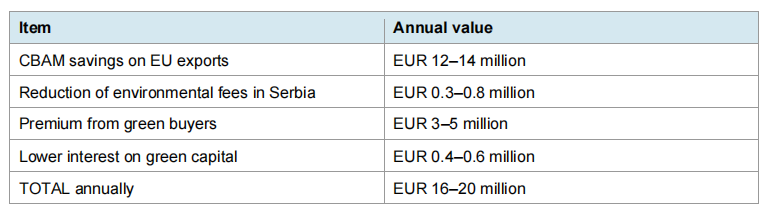
The amount stays in the company every year, while the transition investment itself is one-off.
Conclusion: What a Serbian Exporter Can Do Now
Companies in Serbia’s steel, fertilizer, chemical, and petrochemical sectors have a limited window to prepare the transition before CBAM calculations begin to materially affect profit. The starting point is not equipment investment but an exposure assessment: how much CO2 enters the product, what share of the product goes to the EU, and what the projected CBAM cost looks like over the first five years.
After that assessment, three workstreams advance in parallel. The first is an internal technical analysis, focused on the plants generating the largest emissions inside the company. The second is a dialogue with key EU customers about their willingness to cover part of the premium price through long-term contracts, which secures stable revenue to repay the new equipment. The third is the application to European funds, submitted before the investment rather than after, which in favorable cases covers around a third of capital costs.
Companies completing this preparation by 2028 enter the mature CBAM period with a product carrying a lower total cost and a certificate that competitors do not have. Companies that do not gradually lose share in the European market, regardless of underlying product quality.
Given the scale of the financial effect, this topic belongs on the agenda of the CFO and the commercial director, not only the environmental department.