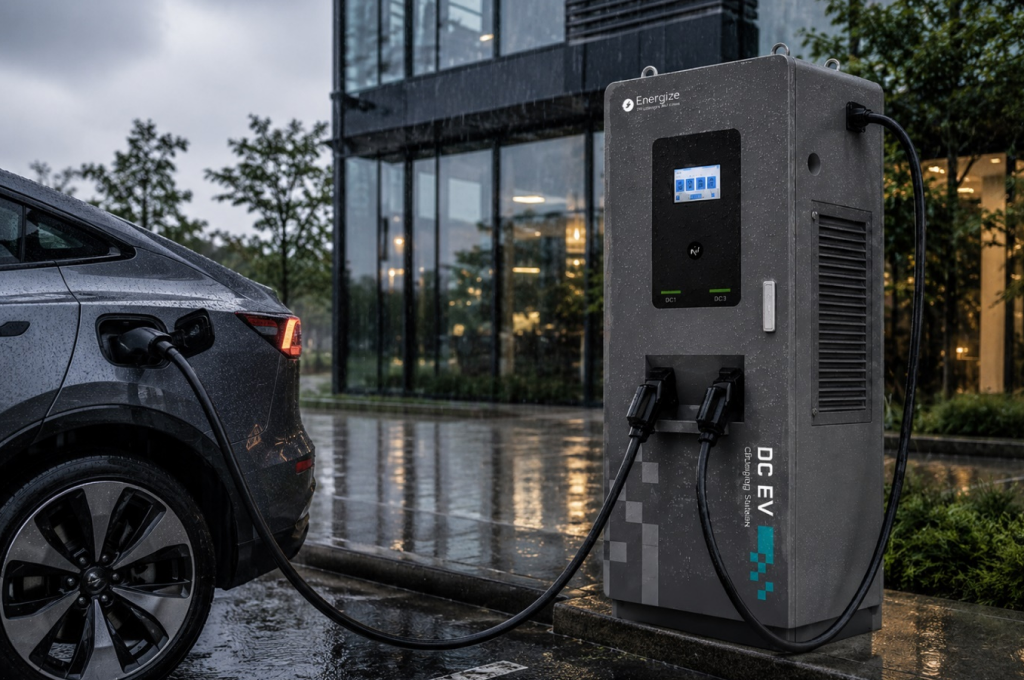
The fear is understandable. From an early age we’re taught that electricity and water don’t mix, and now you’re meant to pick up a thick, high-voltage cable and plug it into a car in the middle of a downpour. But that fear assumes charging behaves like a household appliance with bare live wires. It doesn’t. The whole system is designed from the outset on the assumption that it will get wet, and the metal you can touch is never live.
Where the Danger Would Actually Be
It’s worth understanding where the danger from electricity comes from in the first place. The problem isn’t that water touches something live, but that a person becomes the path through which current flows to ground. The safety of charging therefore doesn’t come down to keeping water away, but to ensuring that path through a person can never form rain or no rain.
The Plug Is “Dead” Until It’s Locked and Verified
The most important protection is also the least visible. The pins in the connector aren’t live while you hold the cable in your hand. Voltage is applied only once the connector is mechanically locked into the vehicle and the car and charger exchange a digital confirmation that the connection is sound and sealed. Only then does the charger close its contactors and let current flow. In other words, while you bring the plug up with wet hands, nothing is flowing through it, and by the time current starts, the contacts are already sealed inside the coupling. The communication that arranges all of this runs at a low, harmless voltage; the high voltage stays locked behind every check until they pass.
Everything Is Sealed Against Water
The connectors, the port on the vehicle and the charger’s enclosure all carry a specified degree of protection against the ingress of water and dust (the IP rating). They aren’t merely “moisture-resistant”, they’re designed and tested to operate while rain pours over them, sprayed with a jet of water during testing. Water resistance isn’t an afterthought, but part of the device’s specification itself.
The System Is Always Listening
In DC chargers, the system continuously measures whether current is leaking anywhere toward ground what’s called insulation monitoring. If any leakage path appears, including one that water might create, the charger stops charging within a fraction of a second, before the situation can become dangerous. This isn’t a one-off check at the start, but constant monitoring throughout the whole session.
The Same Protection as a Wet Bathroom
There’s also a protection many already know from home. A residual current device constantly compares how much current goes out with how much returns; the moment even a small difference appears — a sign that current is “escaping” somewhere, it cuts the supply within milliseconds. On top of that, grounding ensures that any fault current travels a safe path into the earth rather than through a person. It’s the same principle that protects sockets in a bathroom.
And one last reassuring detail: the connector can’t be yanked out while it’s under load. The lock holds it, and the supply stops before it unlocks.
It’s worth noting that none of these protections depends on the others. The dead plug, the sealing, the insulation monitoring, the residual current protection and the grounding all work independently, so even if one were to fail, the next still prevents harm. Safety here isn’t a single measure you trust, but several overlapping layers.
In the end, charging in the rain isn’t a risk the system tolerates, but a condition it was built for. The only thing worth watching isn’t the weather, but the state of the equipment: a damaged cable, a broken connector or a dubious adapter are the real danger, not the raindrops. A charger in good order can be used in a downpour just as calmly as in the dry.