Why Standalone Systems No Longer Work
In Serbian industry, the solar panel story usually begins and ends in the same place: rooftop panels that reduce the electricity bill. The UPS conversation starts with “what happens when the power goes out” and ends with purchasing a single device tucked into the corner of a server room. And battery energy storage systems (BESS)? Most managers in the region haven’t even considered them yet.
The problem is that each of these systems, when operating in isolation, delivers only a fraction of its potential value. A solar park without storage loses energy precisely when it’s cheapest. A UPS without intelligent power supply depends on the same unstable grid it’s trying to protect you from. And a BESS without strategy is an expensive battery waiting in idle.
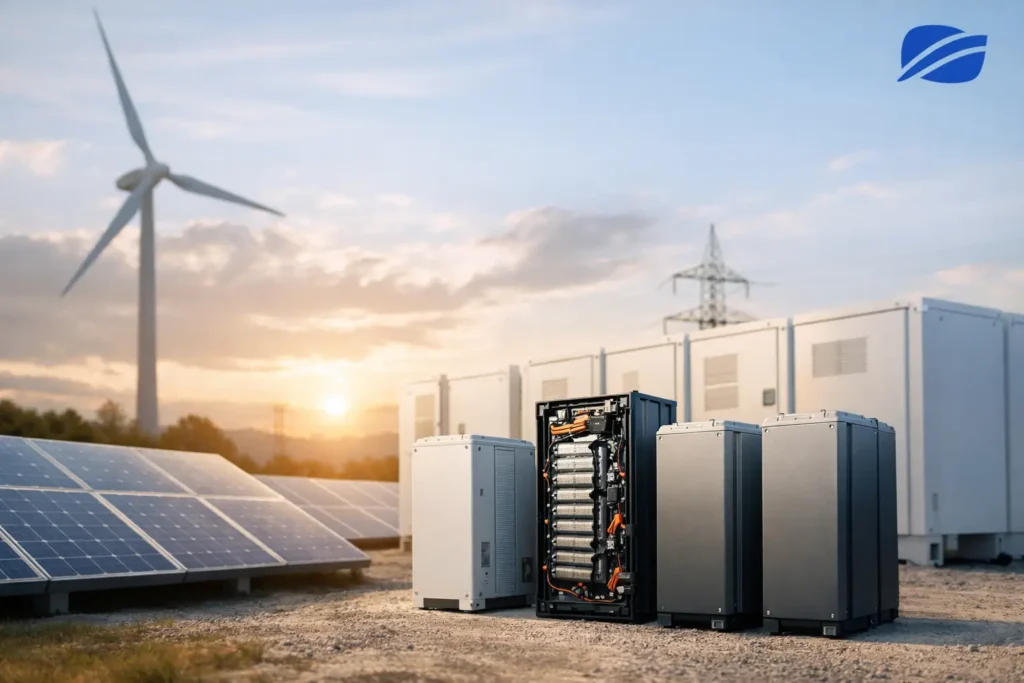
The future of industrial energy isn’t about buying individual devices. It’s about designing an integrated energy system where solar, UPS, and BESS work as a single organism.
How Does an Integrated System Work?
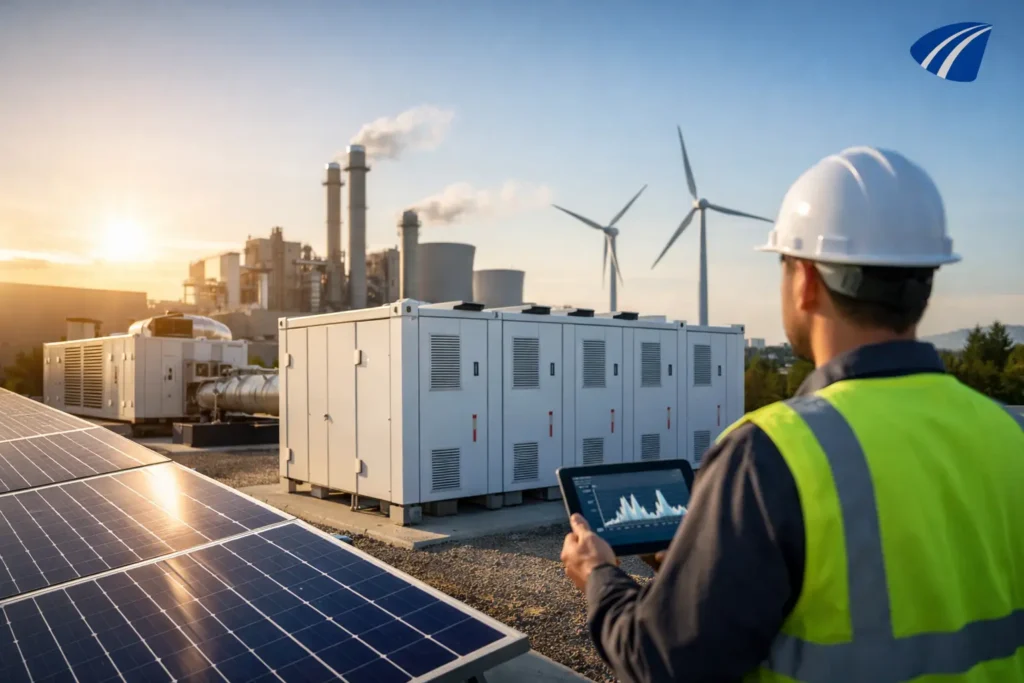
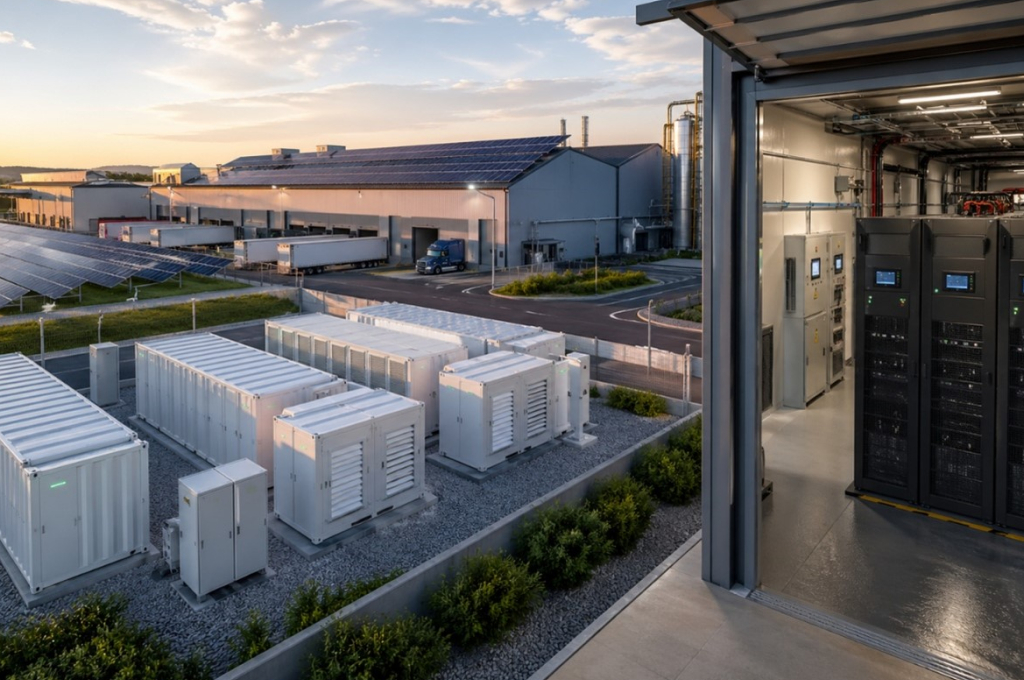
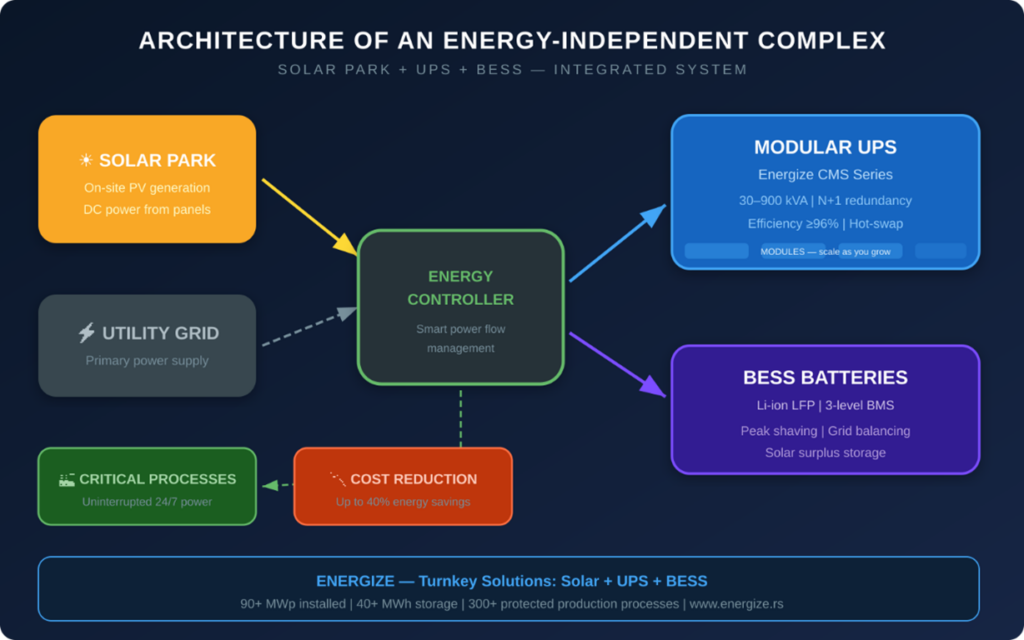
Imagine an industrial facility: a food processing plant, a metalworking operation, or a pharmaceutical complex. Solar panels on the roof and surrounding land generate electricity during the day. That power flows to a smart energy controller making decisions in real time.
When solar production exceeds the facility’s current consumption, the surplus is directed to BESS batteries. When the grid becomes unstable or electricity prices spike on the exchange, the factory switches to its own battery reserves. And when a complete power outage occurs – which is not uncommon in Serbia – the modular UPS takes over critical loads with zero transfer time, while BESS powers the rest of the facility.
The result? A factory that never stops, pays less for electricity, and can even earn revenue by selling balancing services back to the grid.
Three Pillars of Return on Investment
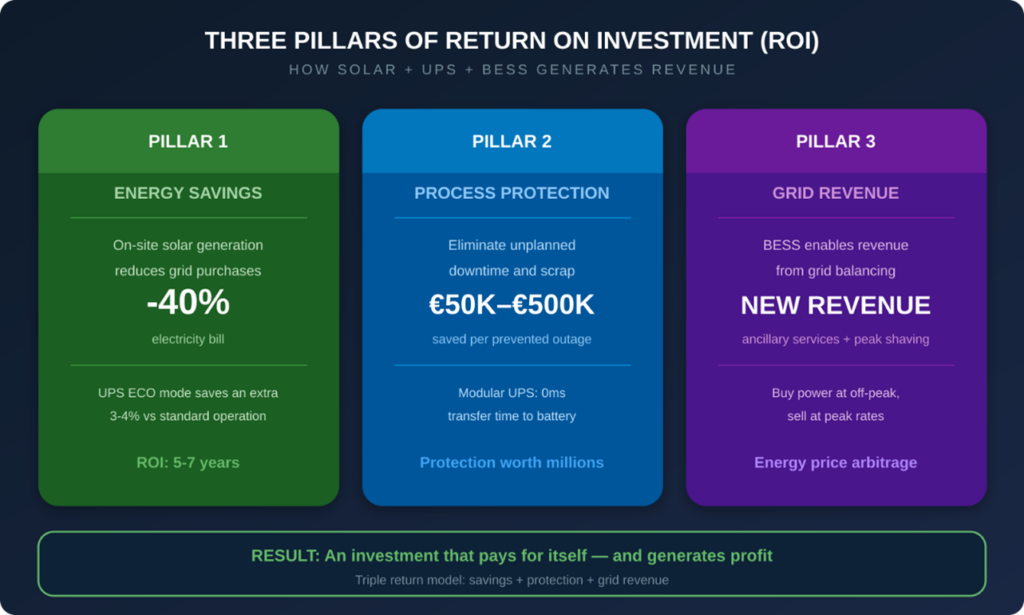
When a manager evaluates an investment in such a system, the key question is always the same: how quickly does it pay back? The answer lies in three parallel value streams.
The first pillar is direct savings on the electricity bill. On-site solar production, combined with smart storage, can reduce grid electricity purchases by up to 40%. This is particularly relevant for facilities operating one or two shifts, as surplus daytime solar energy is used in the evening instead of being wasted.
The second pillar is downtime protection. In the food industry, one hour without power can destroy a production batch worth tens of thousands of euros. In metalworking, sudden machine stoppages can damage tools and work-in-progress. A modular UPS with online double conversion topology eliminates this risk with zero interruption during the switch to battery power.
The third pillar, which many still don’t recognize, is grid revenue. BESS systems can participate in the balancing market, providing services to the transmission system operator (TSO). Additionally, price arbitrage (buying electricity when it’s cheap and using batteries when it’s expensive) delivers additional savings that further shorten the payback period.
The Role of Modular UPS in a Hybrid System
In this architecture, the UPS isn’t just “insurance” against power outages. It’s the nerve center of critical process protection.
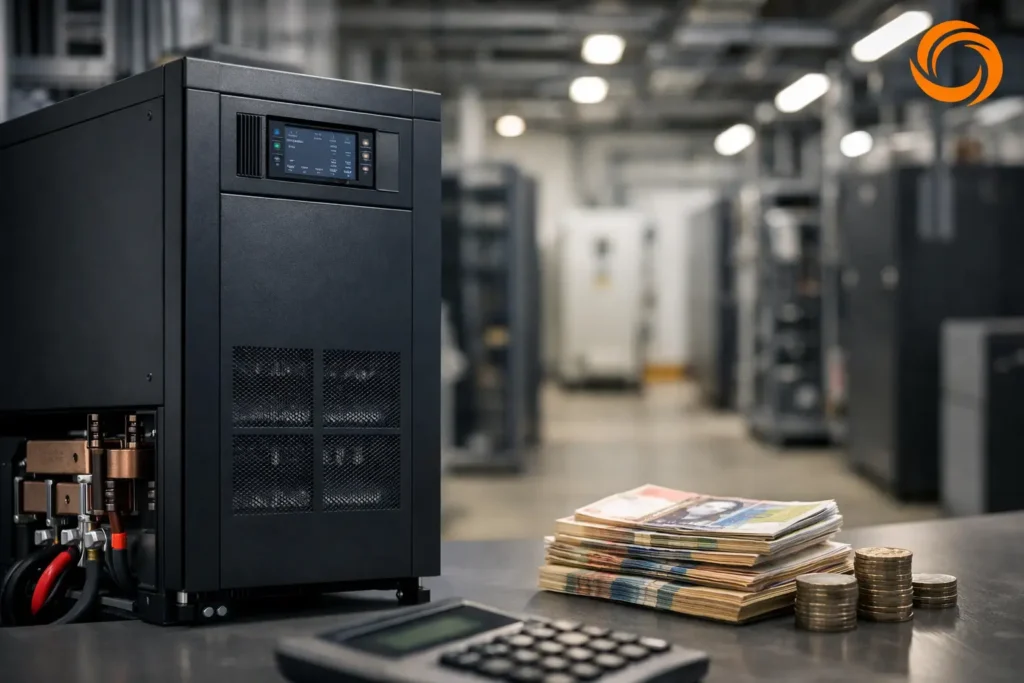
Modular UPS systems, such as the Energize CMS series covering the range from 30 to 900 kVA, offer a key advantage in hybrid environments scalability. A factory doesn’t need to purchase a UPS for full load capacity on day one. It can start with the required capacity and add modules as production grows. This is the “pay-as-you-grow” model that dramatically reduces initial CAPEX.
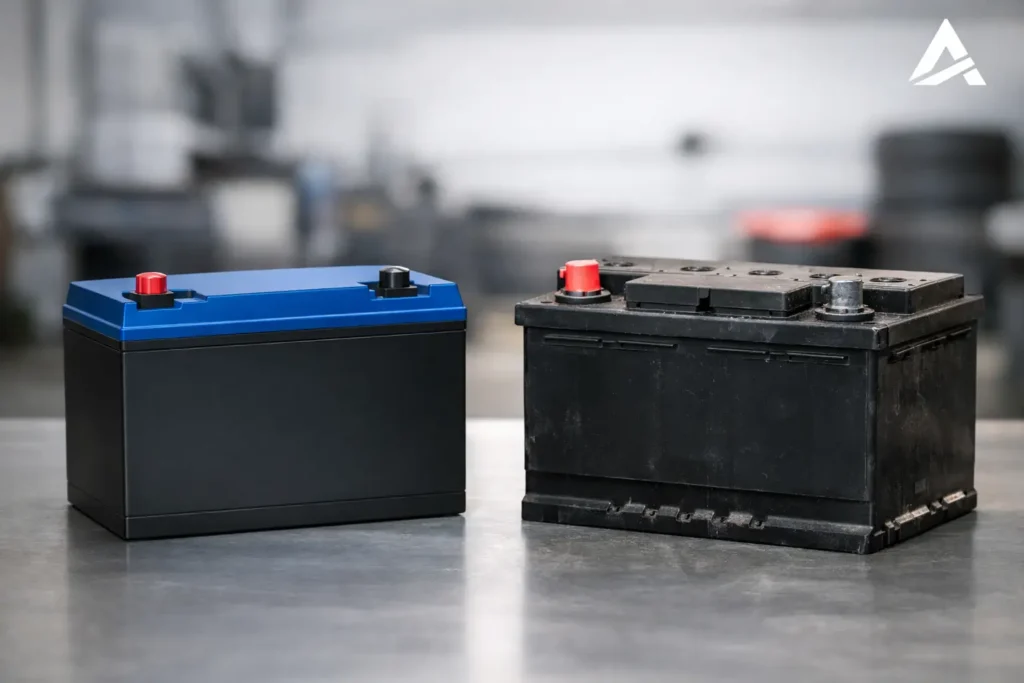
The second critical advantage is lithium-ion battery compatibility. Traditional lead-acid batteries require climate-controlled rooms, more frequent replacement, and occupy three to four times more space. Li-ion batteries with LFP chemistry, as used by Energize, last up to 10 years, feature three-level BMS protection (at module, cabinet, and system level), and operate across a wider temperature range.
The third advantage is hot-swap functionality. If a module requires service, a technician slides it out and replaces it without shutting down the system. In an industrial environment where downtime costs thousands of euros per hour, this isn’t a luxury it’s a necessity.
System Design: What to Consider
Integrating solar, UPS, and BESS is not a trivial task. There are several key questions engineers must resolve before the first panel is placed on the roof.
First is sizing. How much solar capacity should be installed? What BESS capacity is optimal? What UPS rating for critical loads? These aren’t independent decisions – they depend on each other and on the facility’s 24-hour consumption profile.
Second is electrical architecture. Does solar connect to the AC or DC side of the UPS? How is BESS integrated with the UPS battery block or as a separate system? Is there an automatic transfer switch (ATS) between grid, solar, and generator?
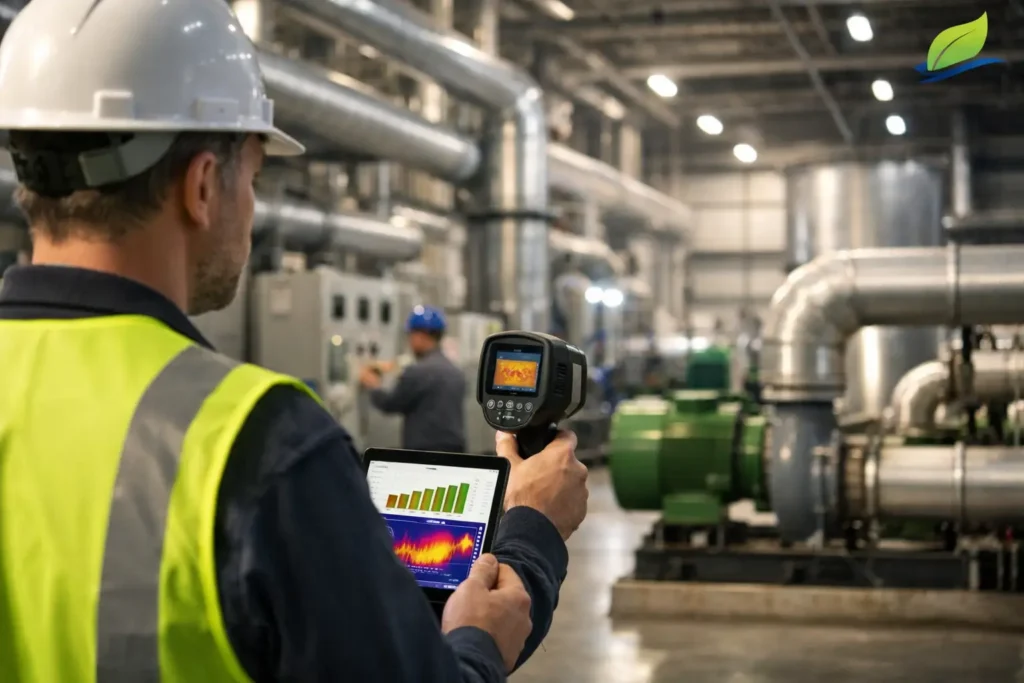
Third is software integration. Modern systems require intelligent management that optimizes energy flows based on electricity market prices, solar production forecasts, and battery states. Without this “brain,” the system works but not at its optimal level.
This is precisely why it’s important to work with an integrator offering a complete solution. Energize, with experience spanning over 90 MWp of installed solar plants and 40+ MWh of storage solutions, provides a turnkey approach where all elements (solar, UPS, BESS, software, and monitoring) are designed, installed, and commissioned as a unified system.
Application in Serbia: Where It Makes the Most Sense
Serbian industry has specific characteristics that make this model particularly attractive. Grid instability in rural industrial zones means UPS protection is necessary, not optional. Relatively high industrial electricity prices make solar economically justified. And growing energy efficiency requirements, driven by EU regulation through the CBAM mechanism, are forcing companies to think about decarbonization.
Particularly interesting locations include industrial complexes in Vojvodina and central Serbia, where there’s a combination of high solar potential, developed infrastructure, and large energy consumers.
Conclusion: An Investment That Pays for Itself
Solar park + UPS + BESS isn’t just a technical project – it’s a business strategy. A company that structures its power supply this way becomes more resilient to grid instability, more competitive in operating costs, and ready for the regulatory requirements ahead.
The question isn’t whether your factory needs this system. The question is how much every day without it is costing you.
—
*Learn more about Energize modular UPS solutions and integrated energy systems: [www.energize.rs](https://energize.rs/)*