When a production line stops due to a short voltage drop, the cost is not just the electricity bill. Lost working hours missed delivery deadlines, and reduced customer trust all follow. That is why the question of how battery energy storage works is no longer a technical curiosity, but a business topic for any company where operational continuity, cost control, and energy resilience are priorities.
Battery energy storage allows electricity to be stored when it is available and cheaper, and delivered when it is needed or more expensive. In practice, this means the system absorbs excess energy from the grid or a solar plant, stores it in batteries, and then supplies it back to consumers at the right moment. While the principle appears simple, it involves complex engineering, as performance and profitability depend not only on battery capacity, but on how the entire system is integrated.
How Battery Energy Storage Works in Practice
The basic principle involves converting electrical energy into a chemical form within battery cells and then converting it back into electricity when power is needed. When the system detects surplus generation or favorable charging conditions, the battery charges. When demand increases, energy prices rise, or the grid becomes unstable, the battery discharges and supplies energy to the load.
In industrial and commercial environments, this process is not random. It is controlled by a system layer that monitors generation, consumption, battery status, priority loads, and grid parameters. In other words, battery storage is not just a container of batteries, it is a coordinated energy system.
If the facility includes a solar power plant, the logic becomes even clearer. During the day, when solar production exceeds consumption, excess energy is stored in the batteries. Later, during evening hours or peak demand periods, the system uses stored energy instead of purchasing more expensive electricity from the grid. This increases self-consumption and reduces exposure to peak tariffs.
Key Components of a BESS System
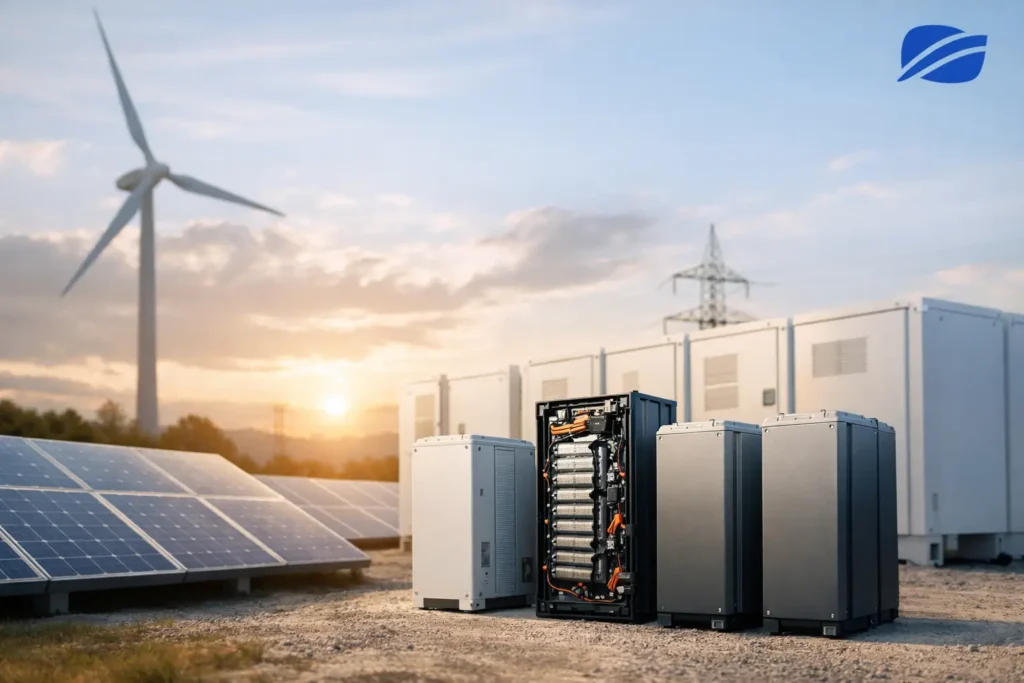
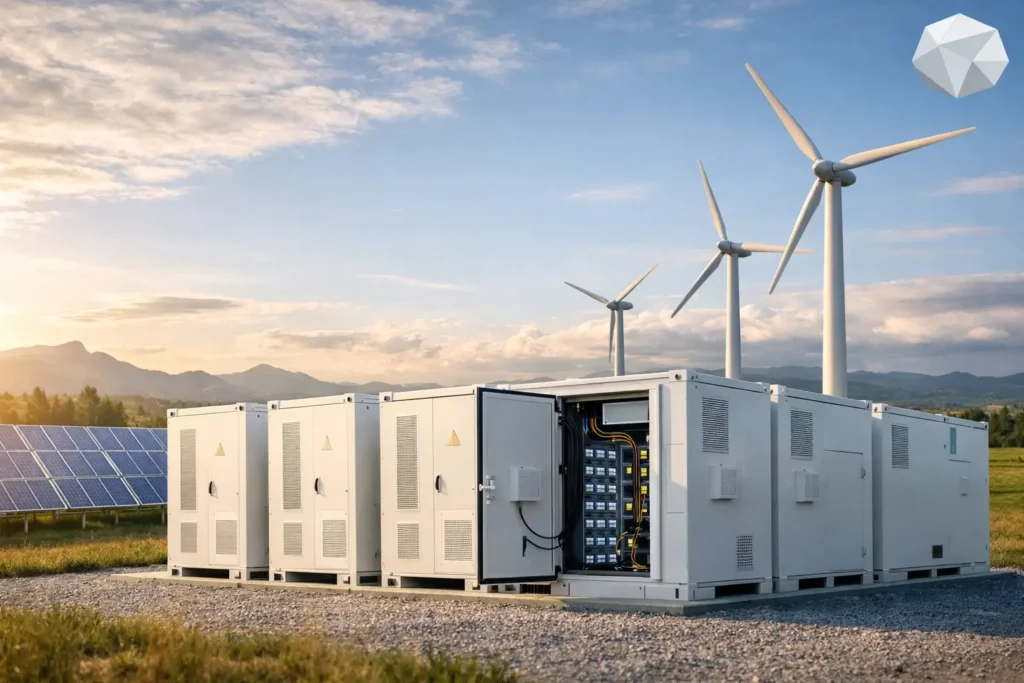
To understand how battery energy storage works, it is important to distinguish its core components. A BESS (Battery Energy Storage System) consists of battery modules, power conversion systems (PCS), a battery management system (BMS), an energy management system (EMS), protection systems, cooling (HVAC), and fire protection subsystems.
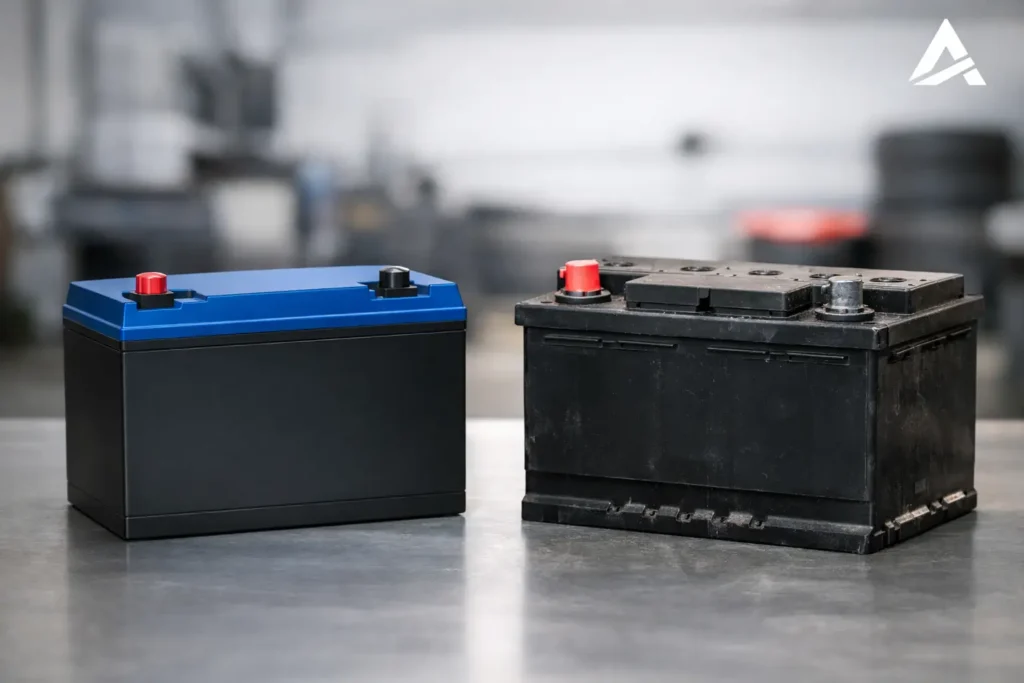
Battery modules store energy. Today, lithium-ion batteries, especially LFP (lithium iron phosphate) are most used due to their safety, long lifespan, and stability in demanding operating conditions. Power converters (PCS units) handle the conversion between DC and AC power, enabling the battery to interact efficiently with the grid, solar systems, and internal loads.
The BMS monitors voltage, temperature, current, and cell balancing. Its role is critical not administrative for ensuring safety and extending system life. The EMS controls the overall energy behavior: when to charge, when to discharge, how much energy to reserve for critical loads, and how to respond to changes in generation or grid conditions. In advanced systems, EMS is the key factor determining whether the investment delivers the expected value.
Cooling and protection systems are often underestimated, yet they directly affect reliability. Batteries are sensitive to extreme temperatures, and without proper protection, an industrial system cannot be considered a long-term safe solution.
What Happens During Charging and Discharging
During charging, electrical energy enters the battery cells and initiates chemical processes that store energy. During discharging, these processes reverse, releasing energy to power consumers. Not all stored energy is available without losses every system has an efficiency factor, with some energy lost to conversion, control, and thermal stabilization.
That is why it is not enough to consider nominal capacity. What matters more is usable energy, maximum output power, duration at a given load, and the operating regime. An investor aiming to reduce peak demand requires a different system design than one seeking backup power for critical processes.
This leads to the key distinction between energy and power. Capacity, expressed in kWh or MWh, defines how much energy the system can store. Power, expressed in kW or MW, defines how quickly that energy can be delivered or absorbed. A system may have high capacity but insufficient power for demanding operations or high power but limited autonomy. Proper sizing is therefore more important than equipment selection alone.
Where Battery Storage Delivers the Most Value
For most business users, the value of battery storage comes from four areas: peak demand reduction, increased utilization of solar energy, protection against outages, and energy cost optimization through tariff management.
In industries with high demand peaks, batteries can absorb part of the load during critical periods, reducing peak demand charges. In facilities with solar systems, they enable more on-site use of generated energy instead of exporting it under less favorable conditions. In environments where power interruptions lead to production losses, damaged goods, or IT failures, batteries become part of a broader energy security strategy.
However, not every application delivers the same financial return. If a facility has minimal peak demand, no critical loads, and already consumes most energy during solar production hours, the economic impact of storage may be lower than expected. That is why serious analysis starts with consumption profiles not equipment catalogs.
Integration with Solar Power Systems
The greatest potential for BESS in Serbia today lies in integration with solar systems. Solar generates energy when sunlight is available, but consumption rarely follows the same pattern. Battery storage bridges this gap by shifting excess daytime production to periods when energy is more valuable or needed.
For businesses, this means greater predictability. For households, greater independence and better utilization of self-generated energy. For larger-scale investors, it enables more precise control over production, consumption, and grid constraints.
However, integration must be designed as a unified system. If solar, storage, and energy management are treated separately, the result is often poor sizing, inefficient control logic, and reduced return on investment. This is why the market increasingly seeks partners who can deliver the full value chain from feasibility study to commissioning and maintenance. More about this approach can be found at Energize.
Safety of Modern Battery Systems
Safety depends on battery chemistry, component quality, system architecture, and installation quality. Modern BESS solutions are not improvised storage units; they include multi-layer monitoring of temperature, voltage, and current, anomaly detection, fire protection systems, ventilation, and clearly defined operating procedures.
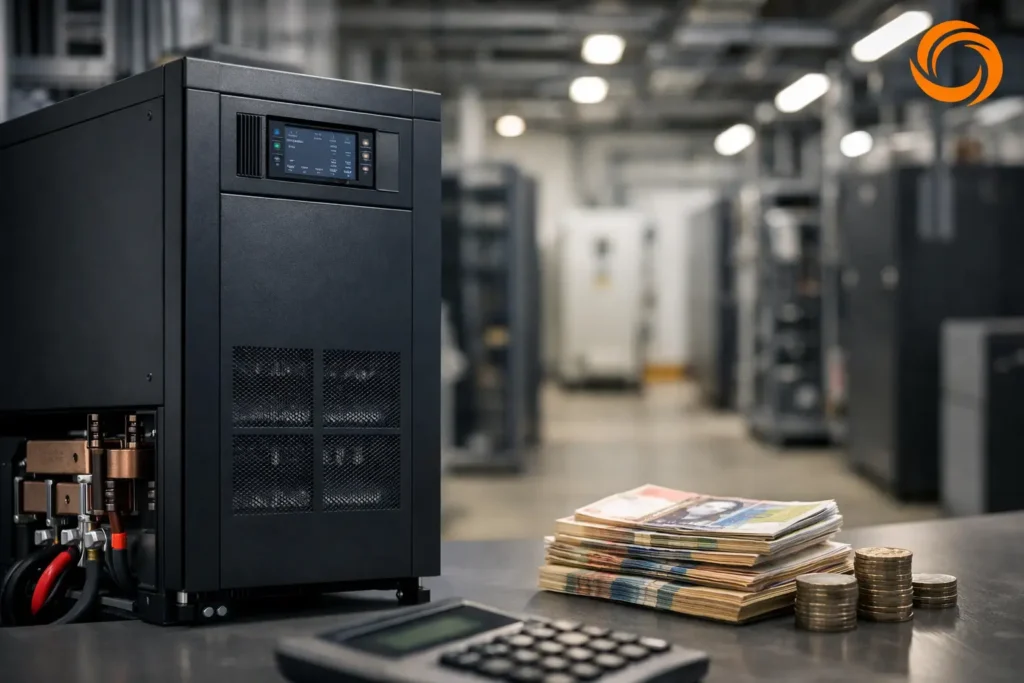
In practice, the greatest risks do not come from the technology itself, but from poor design, inadequate integration, and the use of unverified equipment. That is why the decision should not be based on the lowest cost per kWh. More important considerations include total cost of ownership, warranty coverage, service capability, and long-term performance over 5, 7, or 10+ years.
When the Investment Makes Sense
Battery energy storage can offer strong economic value, but only when aligned with a real consumption profile and a clear business objective. If the system addresses high peak costs, unstable power supply, or low solar utilization, the return on investment can be highly competitive. If installed without proper analysis, simply because storage is a trending solution, the results often fall short of expectations.
Key factors include cost of capital, cycle life, battery degradation, operating conditions, reserve capacity for critical loads, and future expansion plans. In some cases, it is better to start with a smaller, precisely sized system that can be expanded later. In others, a larger system is justified from the start especially where consumption is expected to grow or operational requirements are complex.
The true value of storage is not just in storing energy. It lies in giving companies greater control over energy as a cost, a risk, and a strategic resource. When properly designed, a battery system is not just backup, it becomes an active part of business infrastructure, protecting operations, stabilizing costs, and increasing energy independence.
If you are considering an investment, the most useful question is not whether you need a battery but which specific problem you want to solve. Once that answer is clear, technology begins to work in your favor.