A single miscalculation in battery system design can lead to two costly consequences at once: premature investment in oversized capacity or, even worse, insufficient autonomy when power is needed most. That is why sizing industrial batteries is not just a technical item within a project, but a decision that directly affects operational continuity, equipment lifespan, and the total cost of ownership.
In industrial applications, batteries are not selected from a catalog they are selected according to the operating profile. A battery system used for UPS backup in a manufacturing facility is not the same as one supporting a telecommunications site, performing peak shaving, operating alongside a solar power plant, or forming part of a larger BESS solution. Each application has a different load profile, depth of discharge, cycle frequency, and system availability requirement.
How to Size Industrial Batteries Without Guesswork
The first step is to define precisely what the battery system needs to do. In practice, this means understanding the active power demand of the loads in kW, the apparent power in kVA if the system is connected to a UPS, the required runtime without grid power, and whether the system will be used for short-term backup or frequent cycling. Without these four inputs, every calculation is only an estimate.
A basic engineering approach follows a simple principle: required energy equals load power multiplied by the required autonomy time. If a facility requires 100 kW for two hours, the basic energy demand is 200 kWh. However, this is not the final battery capacity. In a real project, the calculation must also account for allowable depth of discharge, system efficiency, ambient temperature, degradation over time, and a safety margin.
This is where many investors make a critical mistake. Nominal battery capacity and actually usable capacity are not the same. Lithium-ion systems, for example, can operate at a higher depth of discharge than conventional VRLA or OPzS batteries, but even they require design allowance for degradation and operation under unfavorable conditions. If the system is sized only according to ideal laboratory conditions, it will deliver less in real operation than the investor has paid for.
Key Parameters That Determine Battery Capacity
Autonomy is the most visible parameter, but it is not the only factor that matters. In industrial applications, battery sizing is based on the intersection of several requirements.
The first is the load profile. Knowing total consumption is not enough. It is important to understand whether the facility has a constant baseload, peak loads during motor startup, load variations between shifts, or critical consumers that must remain operational under all circumstances. If the system supplies a production line, SCADA system, server room, and safety systems, not all loads need to have the same priority. Proper load segmentation often reduces the required battery capacity without compromising operational safety.
The second parameter is autonomy time. In some cases, 10 to 15 minutes is enough for a UPS to bridge the gap until a generator starts. In other cases, two, four, or more hours of operation may be required due to grid instability, tariff optimization, or integration with renewable energy sources. The longer the required autonomy, the more important it becomes to select the right battery chemistry and thermal management strategy.
The third parameter is cycle life. A battery designed for standby use and a battery designed for daily charging and discharging are not the same product, even if their nominal capacity appears similar. If the system is expected to perform one cycle per day for energy arbitrage or increased self-consumption from solar power, the focus shifts from autonomy alone to cycling durability and lifetime cost per usable kWh.
The fourth parameter is ambient temperature. Battery capacity and lifespan are directly affected by thermal conditions. High temperatures accelerate degradation, while low temperatures reduce available capacity. In facilities without adequate climate control, the design calculation must be more conservative. This is especially important in industrial halls, telecom cabinets, and outdoor containerized energy storage solutions.
Power and Energy Are Not the Same
One of the most common sources of confusion is mixing up kW and kWh. Power indicates how much load the system can supply at a given moment, while energy indicates how long it can supply that load. An industrial battery may have enough stored energy but insufficient output power for demanding startup currents or short peak-load events. Conversely, it may have high power capability but insufficient energy for the required autonomy.
That is why battery sizing must always be performed in two dimensions: energy requirement and discharge power. If the facility has high peak loads, the inverter, Battery Management System (BMS), and battery architecture must all be aligned with that operating mode. Otherwise, the system may appear correctly sized on paper but fail to deliver the required performance in real operation.
A Simplified Battery Sizing Example
Assume the critical load is 80 kW and the required autonomy is 1.5 hours. The basic energy requirement is 120 kWh. If the system is based on lithium technology with an allowable depth of discharge of 90% and overall system efficiency of 95%, the required nominal capacity is not 120 kWh, but approximately 140 kWh. If an additional margin is included for degradation during operation, the design capacity may increase to 150 kWh or more.
With lead-acid batteries, the difference is even more pronounced, because allowable depth of discharge, performance under higher currents, and temperature sensitivity are generally less favorable. This does not mean lead-acid batteries are a poor choice in every application. For certain standby scenarios, they can still be a rational solution, especially when the investment budget and operating profile are clearly defined. However, for intensive cycling applications, lithium technology usually provides a better Total Cost of Ownership.
Technology Selection Changes the Entire Project
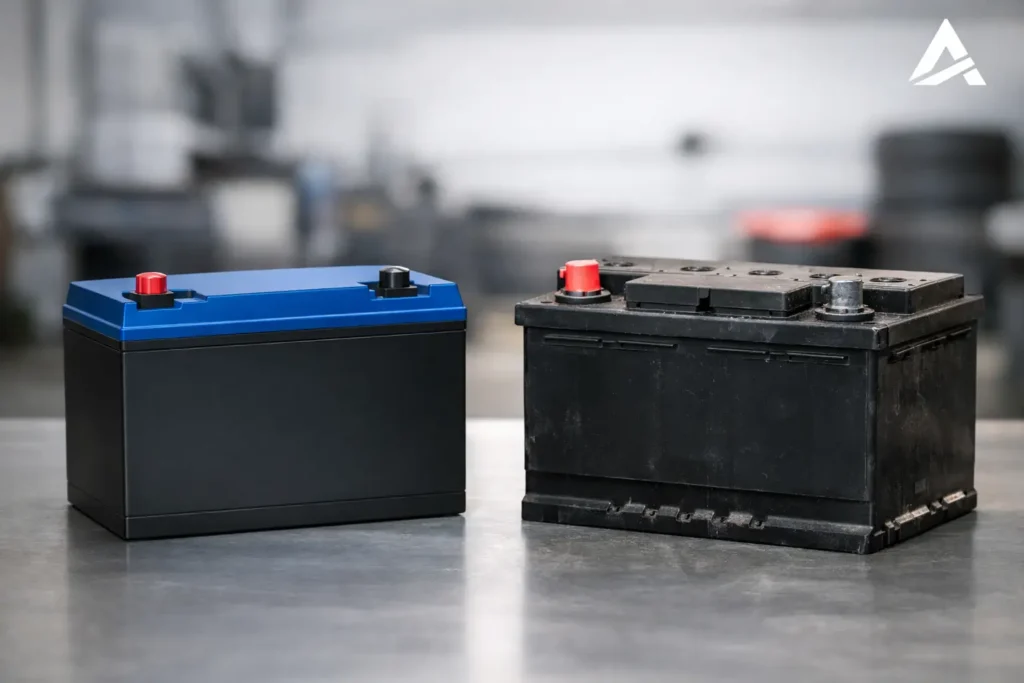
When discussing how to size industrial batteries, the calculation cannot be separated from the technology itself. VRLA, GEL, OPzS, OPzV, and different lithium-ion chemistries each have different energy density, service life, temperature behavior, maintenance requirements, and safety characteristics.
If an investor requires a system for a data center where reliability, short bridging time, and precise control are the highest priorities, the criteria will be different than for a factory using batteries alongside a solar power plant to reduce peak grid demand. In the first case, availability and UPS integration are critical. In the second, cycle life, efficiency, and return on investment become decisive.
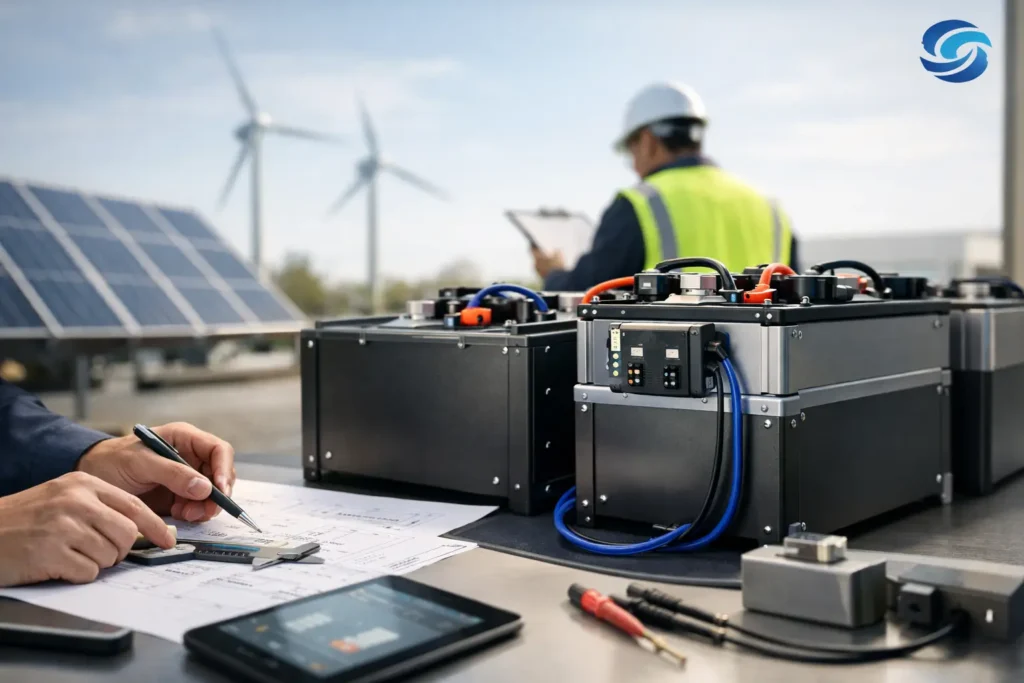
This is where a serious project extends beyond the battery itself. Battery modules, inverters, protection systems, cooling, EMS, fire protection, and load management must all be properly coordinated. The best result does not come from installing the largest battery, but from engineering the right system.
Mistakes That Increase Project Costs
The most expensive mistake is oversizing without a real operational need. It may appear safe, but it unnecessarily ties up capital, increases space requirements, and often complicates the rest of the infrastructure. In multi-site projects, this mistake is multiplied across every location.
Another common mistake is ignoring future load growth. If a facility is expanding, the battery system must either support planned development or be designed for modular expansion without major reconstruction. A fixed solution that is optimal only for current conditions can become a bottleneck within two or three years.
A third mistake is sizing the system based only on initial purchase price. A battery with a lower upfront cost may have a shorter lifespan, higher maintenance requirements, lower efficiency, and higher replacement costs over time. In industrial environments, this is poor economics. The correct decision is therefore not based solely on CAPEX, but on the total cost of ownership.
When a Detailed Load Profile Is Required
If the system is simple and used only for short-term backup of clearly defined loads, an approximate calculation may be sufficient for an initial investment estimate. However, as soon as solar power, variable loads, tariff management, generators, or multiple priority branches are involved, a detailed load profile becomes essential. The system must be analyzed by hours, days, and seasons.
This is especially important for manufacturing companies, logistics centers, and facilities with refrigeration systems, where consumption is never a flat line. In these cases, proper sizing does not only determine how large the battery should be—it also shows whether the most profitable investment should focus on autonomy, peak demand reduction, a hybrid generator solution, or integration with a solar power system.
An Engineering Approach Delivers a Better Investment
In practice, high-quality battery sizing begins with an analysis of consumption and business risk. Which process must never stop? How long can an interruption last? What is the cost of one hour of downtime? What is the expected growth in energy demand? Only when these answers are combined with electrical parameters does a meaningful project brief emerge.
That is why serious investors do not simply ask how large a battery they need. They ask what capacity delivers the best balance between reliability, durability, and return on investment. This is where the difference becomes clear between purchasing equipment and engineering an energy solution. Companies that approach this process with engineering precision, such as Energize, do not treat batteries as isolated components—they size the complete system according to the real operating profile of the facility.
If you are planning industrial energy storage, backup power, or battery integration with solar and UPS infrastructure, the most valuable next step is not selecting a model from a catalog, but conducting a precise load analysis. Only then does the battery system stop being a cost on paper and become a tool for more stable operations, lower risk, and smarter energy management.