When a solar power plant stops delivering the expected yield, the problem rarely starts with a major failure. More often, it begins quietly a single string starts underperforming, an inverter occasionally reports an error, production drops by a few percent, and the issue is only noticed when the monthly calculation shows a lower-than-expected result. That is why online solar power plant monitoring has become the standard for anyone who treats their investment seriously, whether it is a manufacturing facility, logistics center, farm, commercial building, or household.
Online monitoring is not a nice-to-have add-on. It is a tool for managing performance, risk, and total cost of ownership. If you have invested in a solar power plant to reduce energy costs and improve business predictability, you need to know how the system performs every day, across every part of the installation.
What Online Solar Power Plant Monitoring Includes
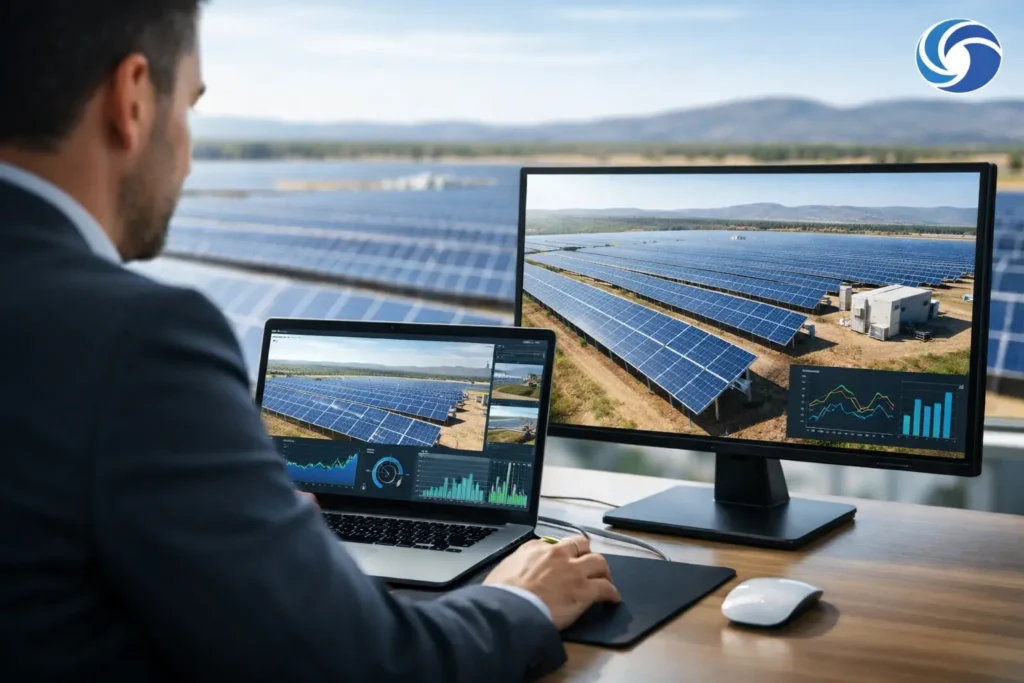
At its core, monitoring collects and displays data from key system components. This usually includes production by inverter, real-time power output, daily, monthly, and annual yield, alarm statuses, operating temperatures, string voltages and currents, as well as data on consumption and grid export when included in the system configuration.
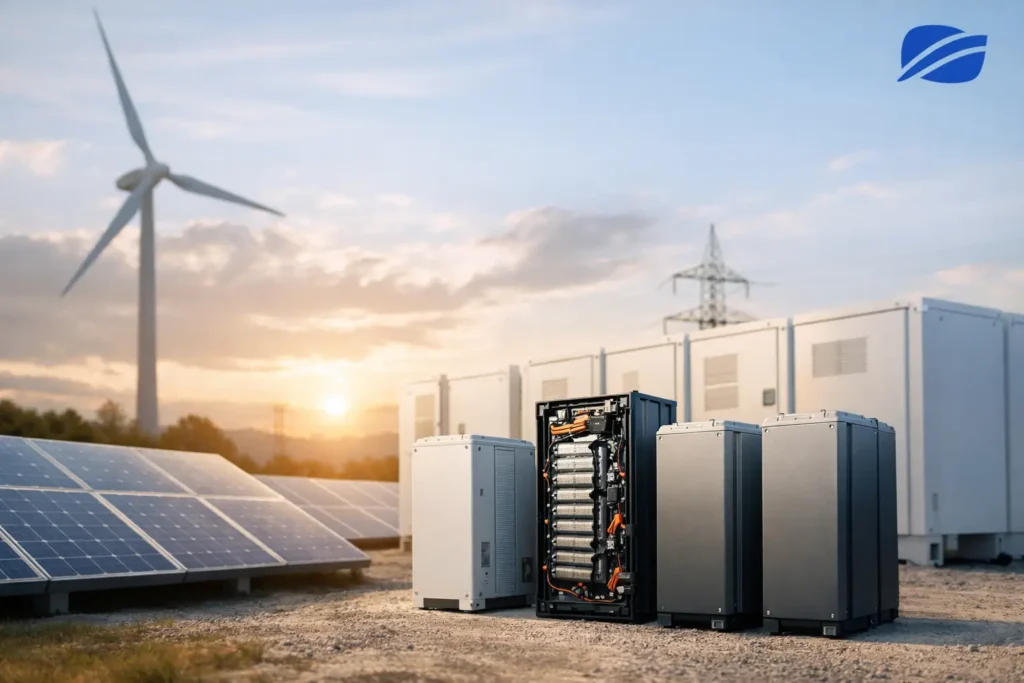
In more advanced systems, especially in industrial environments, monitoring does not stop at the solar power plant itself. It extends to the facility’s broader energy profile consumption by zones, BESS behavior, power quality, peak loads, and the relationship between generated, stored, and grid-supplied energy. This is where the difference becomes clear between simple data visualization and real energy management.
For smaller systems, a standard inverter manufacturer’s cloud platform may be sufficient. For larger facilities, it often is not. Factory management does not make decisions based on attractive graphs, but on accurate, comparable, and actionable data.
Why Online Monitoring Is Critical for Return on Investment
The most expensive fault is not necessarily the one that stops the entire system. Often, the more expensive fault is the one that lasts for weeks without being noticed. If part of the power plant operates below expected performance for 30 or 60 days, the losses accumulate quietly. On paper, the plant is operating. In practice, the investment is not delivering the planned result.
Monitoring makes it possible to identify deviations early. These may include panel soiling, newly created shading, reduced performance of one string, a faulty optimizer, communication issues, poor electrical contact, excessive temperature, or intermittent inverter shutdowns. Some of these problems can be resolved quickly and inexpensively if detected in time. If ignored, they can lead to longer downtime, higher service costs, and weaker financial results.
For businesses, it is also important to compare solar production with the facility’s consumption profile. It makes a major difference whether the plant produces electricity when the facility is operating at full capacity or when demand is low. Without this insight, it is difficult to optimize consumption, size storage correctly, or assess the feasibility of system expansion.
Which Data Should Be Monitored and What Is Often Overlooked
Many users look only at total daily production. That is useful, but not enough. If you want real control over the system, you need to monitor several levels of data.
The first level is real-time production and historical yield. This provides a basic picture of whether the system is operating and how it performs over time. The second level includes alarms and equipment statuses. If an inverter reports errors, unstable operation, or communication interruptions, this requires attention even if production appears normal.
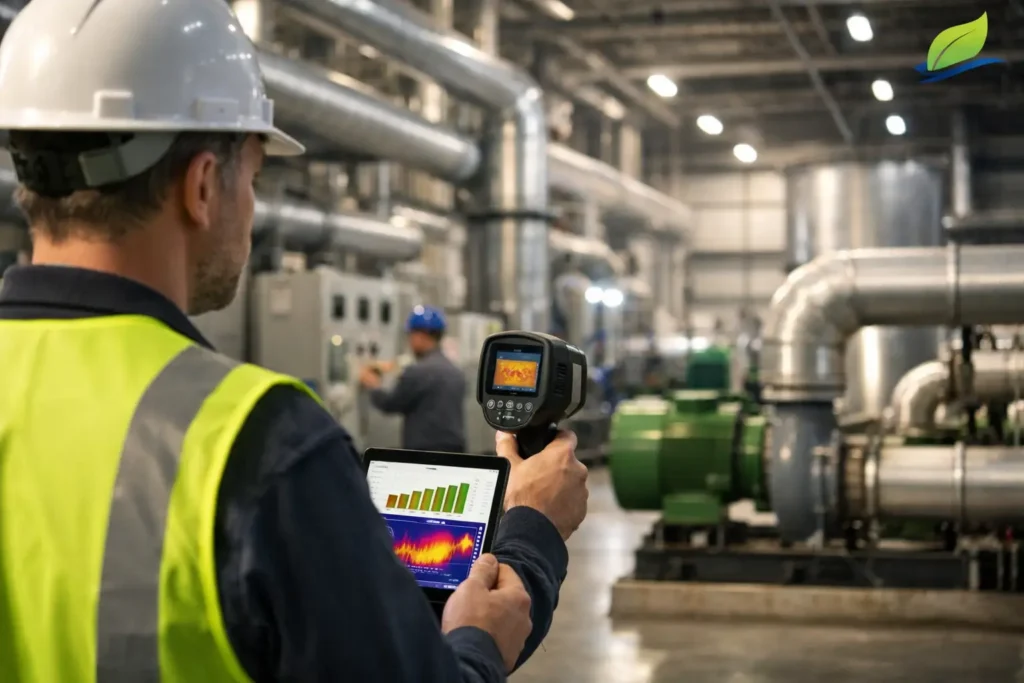
The third level, especially important for larger plants, is string-level data. This is where imbalances are most often detected, revealing local problems. The fourth level is the relationship between production and the facility’s consumption. Without this, you do not know how much energy is actually consumed on-site, how much is exported to the grid, and where additional optimization is possible.
Meteorological context is also often overlooked. A drop in production is not always a fault. Sometimes it is caused by module temperature, cloud cover, dust, or seasonal changes in solar irradiation angle. Quality monitoring therefore does not interpret data in isolation, but in relation to projected performance and real operating conditions.
Online Solar Monitoring for Businesses and Industry
For industrial users, online monitoring has a broader role than servicing alone. It becomes part of operational energy management. If a factory has expensive daytime consumption, multiple metering points, sensitive equipment, and a high cost of downtime, the solar power plant cannot be viewed separately from the rest of the energy system.
In such an environment, it is necessary to know not only how much the plant produces, but also how it affects peak demand, how much it reduces grid consumption, how it operates in combination with battery storage, and whether there are intervals when energy can be distributed more intelligently. This is particularly important in sectors such as manufacturing, processing, cold storage, logistics, telecommunications, and data centers, where power stability is just as important as the price per kilowatt-hour.
That is why serious monitoring implementation often includes integration with existing metering points, power analyzers, and building management or technical control systems. At that point, we are no longer talking only about monitoring a solar power plant, but about a unified energy platform for decision-making.
Where Data Interpretation Mistakes Occur
One of the most common mistakes is comparing days without context. If today’s production is lower than last Tuesday’s, that alone does not mean there is a problem. Irradiation, temperature, season, and operating conditions all need to be compared. Another mistake is relying solely on the manufacturer’s app without verifying settings accuracy, time synchronization, and communication quality.
A third mistake is ignoring alarms because the system is still running. Many faults begin as occasional and seemingly harmless anomalies. The fourth mistake is treating monitoring as a tool for the owner only, rather than for the service team as well. Monitoring delivers the greatest value when there is a clear process: who tracks the data, who responds to deviations, within what timeframe, and according to which priority.
What a Good Online Solar Monitoring System Looks Like
A good system must be reliable, easy to understand, and detailed enough for the level of investment. For smaller systems, simplicity is the priority the owner should quickly see whether the plant is performing as expected. For commercial and industrial systems, the priorities are data granularity, alarms, historical analytics, and integration with other energy subsystems.
Data availability is also important. If key information is slow to access or spread across several disconnected platforms, monitoring loses operational value. Cybersecurity is equally important, especially when the system is connected to a company’s internal network or when data is used for remote diagnostics and control.
In practice, the best results come from a solution designed according to the facility’s actual purpose. A family home, distribution center, and 24/7 manufacturing plant do not have the same needs. That is why platform selection, metering depth, and reporting structure should be defined during the design phase—not added later.
Is a Standard App Enough?
Sometimes, yes. For a smaller solar power plant with a simple configuration and no specific consumption analysis requirements, a standard app can provide a perfectly adequate overview. It is a good starting point and, for many users, a sufficient level of control.
However, as the investment grows, so does the cost of invisible losses. At that point, a standard app often becomes a bottleneck. It may lack sufficient detail, fail to connect production and consumption data, provide limited advanced alarms, or be unable to generate reports needed by management, finance, and maintenance teams.
For companies that treat energy strategically, monitoring must be part of a broader solution. This is where the value of a partner that understands design, installation, storage, power quality, and long-term system optimization becomes clear. Energize applies this approach through an engineering model that measures investment by performance, availability, and total cost of ownership.
What You Gain When Monitoring Is Set Up Properly
You gain more than an overview of production. You gain the foundation for faster fault response, more accurate yield assessment, better consumption control, and a clearer view of profitability. For businesses, this means fewer energy surprises and more reliable planning. For investors, it means greater performance predictability. For households, it means greater peace of mind that the system is doing what it was purchased to do.
Most importantly, good monitoring gives control back to the system owner. A solar power plant is not passive equipment that you simply turn on and occasionally check through an electricity bill. It is an energy-producing asset. And every asset that generates savings and affects business continuity must be measured precisely, interpreted professionally, and managed responsibly.
If you are planning a solar power plant or already have an installed system, the real question is not whether you need online monitoring. The real question is whether your monitoring is good enough to protect the performance of your investment day after day.