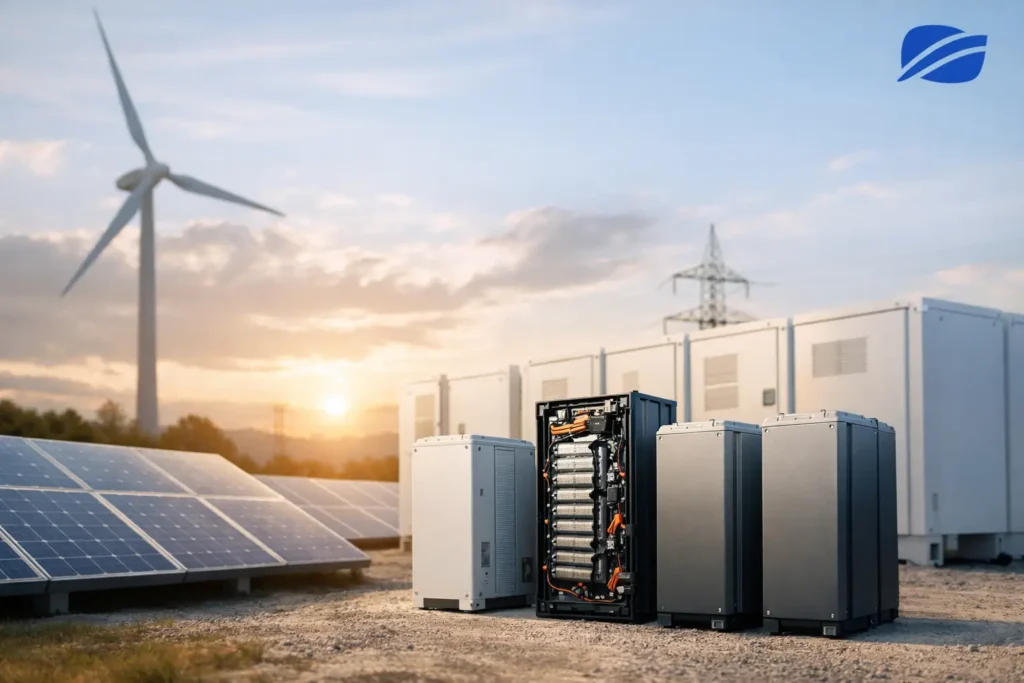
A grid power outage does not need to last long for a data center to suffer serious consequences. An incorrect transfer to generator power, a battery string that has not been tested under real operating load, or a cooling system without backup power may be enough to compromise operations. This data center backup case study demonstrates how to design energy infrastructure that protects services, data, and business continuity without relying on assumptions.
The case involves a representative regional data center supporting critical business applications, telecommunications equipment, and customers requiring uninterrupted availability. The objective was not simply to provide an alternative source of electrical power. The task was to eliminate single points of failure through the coordinated operation of UPS systems, industrial batteries, diesel generators, switchgear, automation, and cooling infrastructure.
The Initial Challenge: Equipment Was in Place, but Continuity Was Not Guaranteed
The facility was equipped with UPS systems and generator backup, but the assessment identified several risks. The UPS capacity had been based on historical consumption rather than actual peak demand and the projected growth of IT capacity. Battery autonomy had not been confirmed through a recent discharge test, while the generator operating regime did not include regular load-bank testing.
Another issue was that some auxiliary loads primarily precision cooling, monitoring systems, and selected network equipment—followed a different power supply logic from the main IT load. During a grid outage, the servers would remain operational, but the loss of cooling would eventually cause room temperatures to rise beyond acceptable operating limits. Such a configuration may formally include backup power, but it does not provide true system resilience.
For data center management, the question was not whether another piece of equipment should be purchased. The key question was: how many minutes of interruption, how much temperature increase, and how many individual infrastructure failures could the facility withstand before customer services were compromised?
Methodology: From Load Measurement to Failure Scenarios
The first step was a detailed assessment of the existing infrastructure. Measurements included active and apparent power, power factor, peak loads by circuit, inrush currents, load distribution across UPS lines, and the facility’s 24-hour demand profile. Particular attention was given to future consumption growth resulting from the addition of new racks, network equipment, and cooling systems.
Designing a data center around average consumption is a common mistake. A data center must be engineered for the most demanding foreseeable scenario: maximum IT load, high outdoor temperatures, full cooling operation, loss of utility power, and the requirement for the generator to assume the entire critical load without destabilizing the system.
Following the site assessment, the required failure scenarios were defined. These included a short-term utility outage, an extended power failure, loss of one UPS module, degradation of a battery string, failure of one generator to start, and the simultaneous operation of critical cooling systems. This approach evaluates the availability of the entire power chain rather than relying solely on the catalogue specifications of individual components.
UPS System Sizing
A modular UPS architecture with redundancy was specified for critical IT loads. The choice between an N+1 and 2N configuration depends on the required availability level, available budget and space, and the consequences of downtime. N+1 is often a rational option when one additional module provides sufficient fault tolerance, while 2N is justified for applications where even scheduled maintenance must not affect power availability.
In this case, the UPS was not treated only as a bridge until the generator started. It was also designed to filter voltage disturbances, protect sensitive equipment, and provide controlled ride-through during source transfer. The bypass path, protection selectivity, and the ability to perform maintenance without shutting down critical loads were considered just as important as the UPS unit’s nominal power rating.
Batteries: Autonomy Has Value Only When It Is Verified
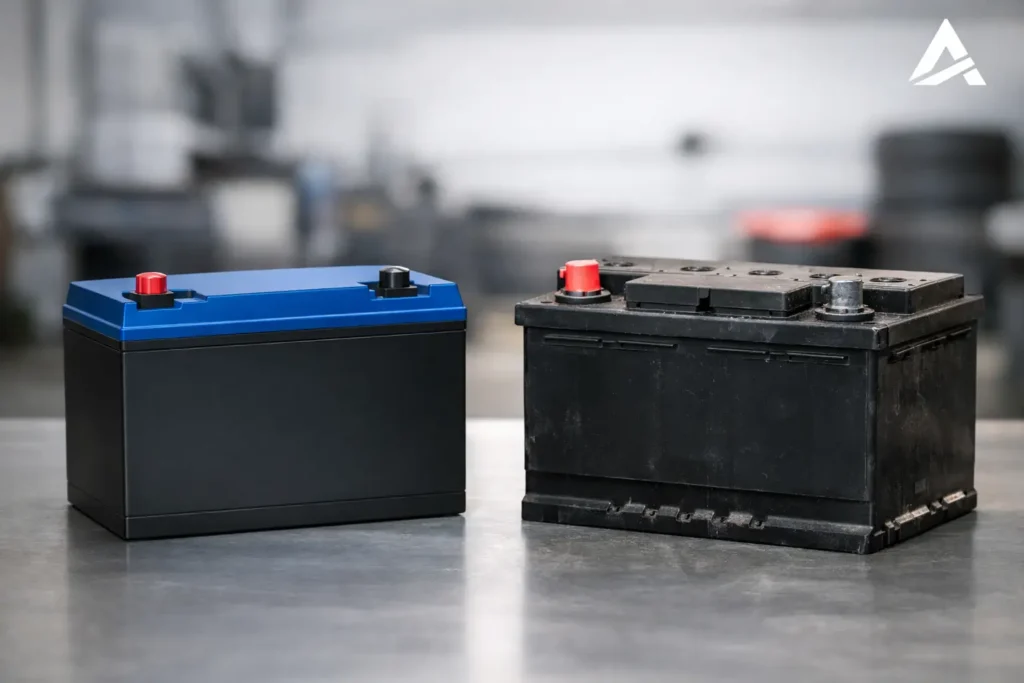
The battery system was designed according to the required autonomy, operating temperature, available space, and replacement strategy over the equipment lifecycle. A few minutes of autonomy may be sufficient when the generator starts reliably and assumes the load within a defined period. However, longer autonomy may be justified where grid conditions are unstable, fuel logistics are complex, or the generator is located far from the IT area.
A key finding was that nominal battery capacity is not the same as available capacity. Ageing, temperature, imbalance between battery strings, and insufficient maintenance all directly affect real discharge performance. The operating plan therefore included periodic inspections, internal resistance measurements, controlled discharge testing, and a clearly defined replacement schedule before the end of reliable service life.
Generator and Automation: The Transfer Must Be Predictable
The diesel generator was sized to support the critical loads while operating within its recommended load range. An oversized generator may operate inefficiently under low load, while an undersized unit may become unstable when large loads start. Generator sizing therefore cannot be reduced to a simple sum of connected kilowatts.
The assessment considered cooling system start-up requirements, battery recharging after an outage, harmonics, power factor, and future expansion. The automatic transfer switch was required to follow a clearly defined sequence: utility failure detection, generator start command, voltage and frequency stabilization, load transfer, return to utility power, and controlled generator cool-down.
A dedicated fuel strategy was also defined. A tank supporting only a few hours of operation may be acceptable in an urban location with reliable fuel delivery, but it is insufficient where multi-day outages are possible. Fuel reserves, contracted refuelling, fuel-quality monitoring, and regular loaded testing must form part of the operating plan rather than being addressed only after an incident occurs.
Cooling Is Part of the Backup System, Not an Auxiliary Load
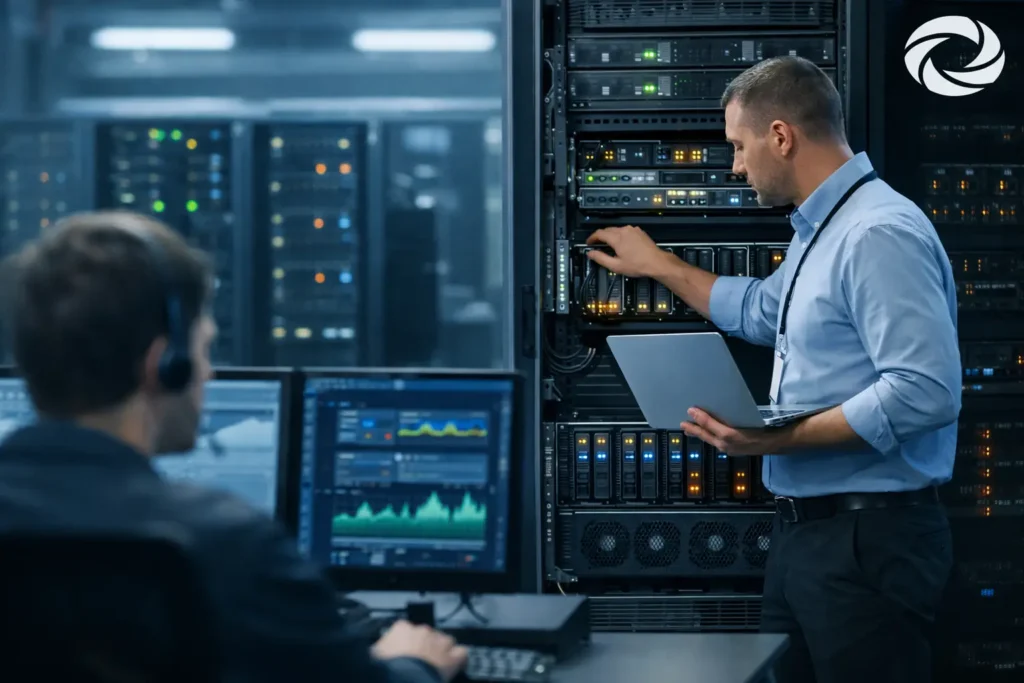
A data center does not lose availability only when servers lose power. Availability is also compromised when room temperature rises faster than the operations team can respond. In this project, precision cooling systems and key circulation components were included in the priority backup power scheme.
This does not mean that every auxiliary load requires the same level of redundancy. Critical and non-critical loads must be separated. Administrative lighting, part of the office demand, and deferrable loads can be disconnected during generator operation, while IT equipment, monitoring, fire protection systems, and the minimum required cooling capacity remain protected.
This prioritization reduces the required generator capacity and extends available operating time based on existing fuel reserves. At the same time, it ensures that capital expenditure is directed towards the systems that genuinely reduce business risk.
Results of the Data Center Backup Case Study
Following the technical assessment, the facility received a design model with clearly defined power paths, load priorities, and operating procedures for emergency conditions. The most important outcome was not simply higher installed capacity, but predictable system behaviour during a grid outage or failure of an individual component.
The operations team received procedures for monthly generator testing, periodic UPS testing, battery condition monitoring, and recording of key operating parameters. Management received a basis for assessing Total Cost of Ownership, including equipment, maintenance, battery replacement, fuel consumption, energy losses, and the potential financial impact of service interruption.
This highlights the difference between purchasing equipment and implementing an engineered solution. A lower-cost initial configuration may result in higher lifecycle costs if it requires frequent intervention, lacks a predictable replacement strategy, or cannot support future IT expansion. Conversely, maximum redundancy is not automatically the best decision when the business risk and contractual obligations do not justify the additional capital expenditure.
What Should Be Verified Before the Next Investment?
Data center owners and operators should ask several specific questions. How long can the system actually operate on batteries under the current load? Does the generator support the cooling system as well as the servers? Was the most recent test performed under a load that reflects real operating conditions? Can the UPS be serviced without interrupting operations, and does the infrastructure have sufficient capacity for planned growth?
The answers should not be based on estimates or outdated design documentation. They should be supported by measurements, failure scenarios, and an engineering design that integrates power supply, energy storage, generator systems, HVAC, and automation into a single coordinated infrastructure.
Energize evaluates projects of this type through system availability, operational risk, and Total Cost of Ownership from the initial feasibility study through implementation and maintenance. For a data center that cannot afford to stop, the next step is not selecting equipment from a catalogue. It is verifying whether the entire power chain will perform as intended when the grid no longer does.