Most mid-sized companies share the same story. The business started with a few servers in a cabinet. Then the IT department took over a room. Then air-conditioning was added, then a second unit when the first one failed. Then a UPS, then a second one. Then someone noticed there was more value in that room than in the entire warehouse, but no one had ever thought through the power, the cooling or access control.
That is where a micro data center comes in. Not as a trend, but as a logical step for a company where IT is no longer a support function but an operational foundation.
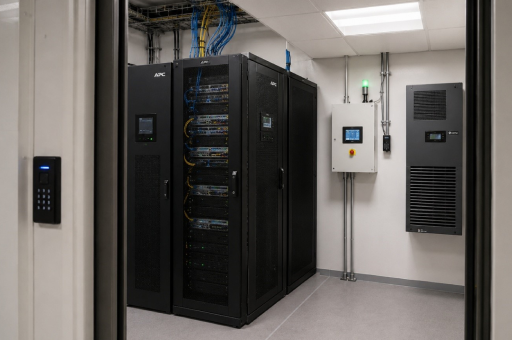
A micro data center is a standardized, modular IT infrastructure unit with integrated power, cooling, monitoring, physical security and access control. Capacity is usually between 5 and 50 kW. That range covers a large number of real scenarios — from a regional bank that does not want to host everything in Belgrade, through a manufacturing company with an MES system that cannot go down, to a municipal administration consolidating IT from fifteen buildings into a single controlled location.
What separates a micro data center from a server room
A classical server room is an adapted space. A micro data center is designed as a whole. The difference looks small until you look closely.
A server room typically has an air-conditioning unit cooling the entire space. A micro data center has precision cooling that works directly with the racks delivering 30 to 50 percent better energy efficiency. A micro data center has an integrated UPS, a monitored battery, a management system and automatic alarms going directly to the facility manager or an external service team.
The biggest difference is that a micro data center is delivered as a defined product. Power, cooling, physical security, monitoring — everything is designed to work together. A server room is usually the result of accumulation, where each system was added once the underlying problem could no longer be ignored. A micro DC starts as a solved problem.
Typical client profile
Micro data centers make sense for companies that meet several conditions at the same time. IT is critical to the business, but not critical enough to justify building a classical data center. There is a real need for physical proximity of data, whether for regulatory, latency or OT integration reasons. Infrastructure space is limited, and the budget does not allow expensive expansions.
In a regional context, these are companies between 50 and 500 employees, with annual revenue in the tens of millions of euros. Manufacturing, distribution, logistics, financial services, healthcare facilities, smaller government agencies, regional public utilities. All of these organizations have an IT dependence that goes beyond a server room, but does not yet reach the level of building a data center.
The second profile is organizations with distributed presence. A pharmacy chain with a centralized ERP. A retail network that has to operate even when the central location is down. University campuses with distributed computing centers. Anywhere IT presence has to be brought close to where the work is actually being done.
A micro data center worth taking seriously has to meet several criteria. Integrated power with a modular UPS that scales with load. Precision cooling sized for the actual heat output of the racks, not the average ambient of the room. A physical security system — access control, video surveillance, smoke detection, intrusion detection. Monitoring that gathers all relevant parameters and routes them into a single console.
UPS modularity is particularly important in this segment. A company using 10 kW today may reach 25 kW in two years. A UPS with 6, 15 or 25 kW modules allows gradual growth without replacing the entire system. With a monolithic UPS, the only option is to oversize from the start — which ties up capital and reduces efficiency in the first years of operation.
Speed of implementation as an argument
A classical data center takes 18 to 36 months from concept to operation. A micro data center, from clearly defined need to operational status, takes 8 to 16 weeks.
For a company whose IT has to be running next quarter rather than next year, that is the difference between a solved problem and a deferred one. It is also why the micro DC market in Europe has doubled in the last three years.
At the end, a micro data center is not a smaller data center. It is a different product, designed for a different kind of company and a different kind of risk. It delivers a level of control, reliability and predictability that companies simply cannot obtain from an adapted room, regardless of how much equipment has been installed there over the years.
For most regional companies, the question is no longer whether to go that route. The question is at what point it becomes more expensive to stay in the old logic than to move into the new one.