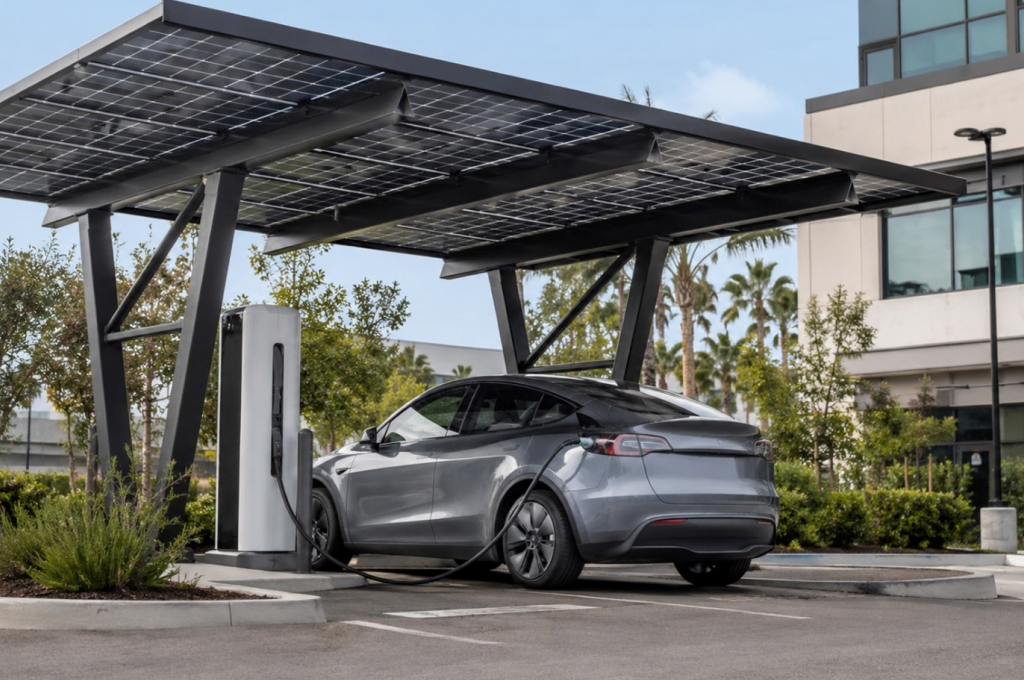
The economic rationale for combining a solar installation with an electric vehicle does not rest on “free energy,” but on maximizing self-consumption. The difference between the price at which energy is imported from the grid and the price at which a solar surplus is exported to it is, as a rule, significant. Every kilowatt-hour of self-generated energy consumed on site is worth that difference – so the objective is to consume as much of the generated energy as possible where it is produced, rather than exporting it at a low feed-in price.
In this context, the electric vehicle is the largest controllable load available to a household or facility. Unlike most appliances, its charging can be shifted in time and its power modulated, which makes it an ideal means of absorbing a solar surplus.
Generation and Consumption Curves
The core problem is one of timing. The output of a photovoltaic installation follows a bell-shaped curve peaking around solar noon. The consumption profile rarely follows that shape: in residential buildings the vehicle is most often absent during the day and is plugged in during the evening, when generation has already fallen to zero.
This anti-correlation between the generation and consumption curves is the principal engineering challenge. Without intervention, the solar surplus is exported to the grid in the middle of the day, while the vehicle charges from the grid in the evening – so the installation and the vehicle, though physically connected, operate energetically independent of one another.
Surplus Charging
The solution is one of control. A metering device at the facility’s grid connection point (a meter or a current transformer) measures the direction and magnitude of energy flow in real time. When export is detected – that is, generation in excess of the facility’s current consumption – the management system modulates the vehicle’s charging current so that the surplus is consumed and the exchange with the grid is reduced to zero.
Here, concrete constraints arise that the system must respect. A charger has a minimum charging current, around 6 A per phase under the standard; below it, the vehicle cannot charge. In single-phase charging this corresponds to roughly 1.4 kW, which is the surplus threshold below which pure solar charging is not possible without topping up from the grid. For this reason, more advanced chargers switch between single-phase and three-phase operation: single-phase for small surpluses, three-phase once generation rises. The control logic must also include hysteresis (a dead band), so that passing clouds and brief fluctuations in generation do not cause the charging to switch on and off continuously.
Bridging the Timing Gap
Where the consumption profile cannot be aligned through modulation, the gap is bridged in two ways.
The first is the charging location. If the vehicle is charged where it spends the day – at the workplace or in a depot – consumption naturally coincides with the hours of greatest generation, with no need for storage.
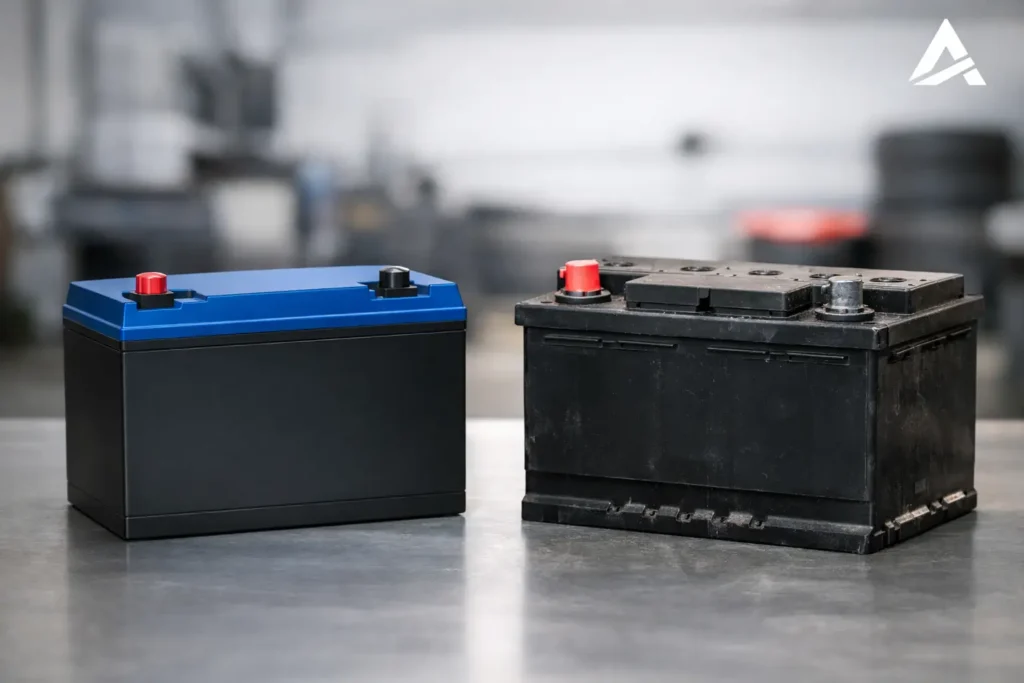
The second is a stationary battery acting as a buffer: it stores the daytime surplus and delivers it to the vehicle in the evening. This must account for losses: every additional stage of storage introduces charging and discharging losses (on the order of 10–15% for lithium batteries). Charging the vehicle directly from the panels is therefore more efficient than the panel–battery–vehicle path, so a battery makes sense primarily for the portion of the surplus that cannot be consumed directly.
Sizing
The system’s functionality depends on the alignment of three quantities: the installed power of the panels, the power of the charger, and the facility’s other consumption profile. An oversized charger will rarely run at full power from surplus alone; an undersized installation will yield a surplus too small for meaningful modulation. Correct sizing starts from the actual generation and consumption curves at the specific site, not from nominal values.
Industrial Application
In a commercial setting the conditions are nearly ideal. An industrial facility has a large roof area and a fleet that sits parked during the day – that is, a consumer present precisely during the hours of greatest generation. The alignment of the curves is natural, the self-consumption share is high, and the effect is twofold: it reduces both the facility’s energy costs and the fleet’s fuel costs.
Limitations
The system is not seasonally neutral. In winter and during overcast weather, generation is considerably lower, so solar charging covers a smaller share of the demand. The realistic objective is not energy self-sufficiency, but the largest possible share of consumed energy drawn from self-generation over the course of the year. Therein lies the measure of the whole system’s success: not in the nominal power of its components, but in the achieved share of self-consumption.